Real Analysis/Section 2 Exercises
| ←Series | Real Analysis Exercises |
Limits→ |
These are a list of problems for the Sequences and Series section of the wikibook. The questions listed here will also contain questions related to Taylor Polynomials and Taylor Series, as they contain sequence and series like qualities. Do those problems only if you have some knowledge on derivatives. Otherwise, these following problems should not rely on too many concepts outside of its section.
Unsorted
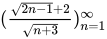
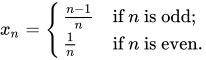
[edit | edit source]- For the following list of sequences determine whether the following sequences converge or diverge directly from the definition of convergence:
- the sequence ;
- the sequence ;
- the sequence ;
- The recursive sequence defined by the following:
- Let
- .
- For the following sequences determine for which real values x does the given sequence converge, and what the sequence converges to:
- ;
- ;
- for an arbitrary real number x;
- Given any real number c, find a recursively defined sequence that converges to .
- Given a sequence (xn), and a natural number k, define a sequence yn by yn = xn+k. Show that (xn) is convergent if and only if (yn) is convergent. Show further that when they converge they converge to the same limit.
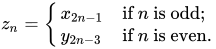
- Suppose that the sequences (xn) and (yn) converge to a real number a. Show that the sequence (zn) defined by
- Let (xn) be a sequence of real numbers and let (yn) be a sub-sequence. Suppose (yn) is convergent, show that (xn) may not necessarily be convergent.
- Suppose that (xn) is a convergent sequence that does not converge to 0. Further assume that for all n in N, xn ≠ 0. Show that there exists δ > 0 so that |xn| > δ and |lim xn | > δ.
- Cesaro Mean convergence: We say a sequence (xn) converges to x by Cesaro means if the sequence of averages yn = (x1 + x2 + … + xn)/n converges to x. Suppose (xn) converges to a real number x, show that (xn) converges by Cesaro means to x. Give an example to show that a divergent sequence (xn) may converge by Cesaro means.
- Find the sequence of Cesaro means for (1, 1, -1, 1, 1, -1...) and determine if the converge. If they converge, find the limit.
- Consider the recursively defined sequence given by x1 = 1 and xn = 1 + 1/xn. Show that xn converges and find its limit.
- In our discussion of telescoping series we showed that a telescoping series converged to a1 − lim aN+1 and for this to hold it was not necessary to have that lim aN+1 = 0. Indeed, it is correct that this is not necessary. On the other hand we later proved that for a convergent series the limit of the terms must be 0. How can both by correct? Explain why, in our set up, we may have a convergent telescoping series such that lim aN+1 ≠ 0, but it is still true that for every convergent series the limit of the terms is 0.
- Suppose that cn ≤ an ≤ bn for all natural numbers n. Show that if both ∑ cn and ∑ bn converge, then ∑ an converges.





On Sequences
[edit | edit source]For the questions below, clicking on the box will reveal a general hint and options to select different types of hints. The solution will also be present, but hidden until clicked. The answer to each question is on a separate page, for both technical and psychological reasons.
1. Given the sequence {an} such that {ai} = ii+1, prove that {an} is strictly increasing.
Prove that ai < ai+1 for all i, a natural number.
It is easy to prove that the sequence strictly increasing using mathematical induction.
During mathematical induction, you may need to multiply out both sides.
2. Prove that the natural numbers have no upper bound
Consequence of N: Given n, there exists n + 1 > n
Prove, using its definition and contradiction, that an upper bound cannot exists for natural numbers
Taylor Polynomials and Series
[edit | edit source]- The following questions do not rely on any theorems related to Taylor Polynomials. However, you should know what the definition of a Taylor Polynomial is.
- Prove that any Taylor Polynomial is continuous.
- Prove that any Taylor Polynomial is infinitely differentiable.