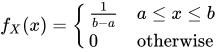
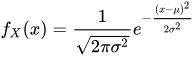
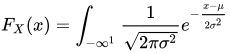
PMF ![{\displaystyle P[X=x]=P[s:X(s)=x]\!\,}](https://wikimedia.org/api/rest_v1/media/math/render/svg/29290696ff4a3cd673d76d5e6c340670343c913b)
a) 
b) 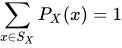
c) event 
![{\displaystyle P[B]=\sum _{x\in B}P_{X}(x)\!\,}](https://wikimedia.org/api/rest_v1/media/math/render/svg/02d806ab58ab23c5a2f7528eca79ab952aa4bd8a)
Some Useful Random Variables[edit | edit source]
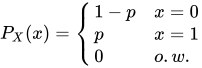
 success probability
1) Flip a coin  # of H
2) Manufacture a Chip # of acceptable chips
3) Bits you transmit successfully by a modem
Number of trials until (and including) a success for an underlying Bernoulli

1) Repeated coin flips # of tosses until H
2) Manufacture chips 3 of chips produced until an acceptable time
"# of successes in n trials"

1) Flip a coin n times. # of heads.
2) Manufacture n chips. # of acceptable chips.
Note: Binomial  where
where  are independent Bernoulli trials
Note: n=1; Binomial=Bernoulli; 
"number of trials until (and including) the kth success with an underlying Bernoulli"

where  is
is  successes in
  trials
Note: Pascal  where
where  are geometric R.V.
Note: K=1 Pascal=Geometric
# of flips until the kth H

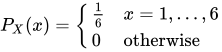
1) Rolling a die. 
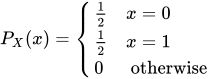
2) Flip a fair coin.  =# of H

(Exercise) limiting case of binomial with 
PMF is a complete model for a random variable
Cumulative Distribution Function[edit | edit source]
![{\displaystyle F_{X}(x)=P[X\leq x]=\sum _{x'\leq x}P_{X}(X=x')\!\,}](https://wikimedia.org/api/rest_v1/media/math/render/svg/fd206a2d08875c59edf32c59ae9955dac1a60557)
Like PMF, CDF is a complete description of random variable.
Flip the coins # of H
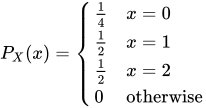
![{\displaystyle {\begin{aligned}P[X\leq 0]&=P[X=0]\\P[X\leq 0.5]&=P[X=0]\\P[X\leq 1]&=\underbrace {P[X=0]} _{\frac {1}{4}}+\underbrace {P[X=1]} _{\frac {1}{2}}\\\end{aligned}}\!\,}](https://wikimedia.org/api/rest_v1/media/math/render/svg/cf9d7e1bd9a138401353581bfb157ebfeff31c60)
- a)
![{\displaystyle F_{X}(-\infty )=0\Leftarrow F_{X}(-\infty )=P[X\leq -\infty ]=0\!\,}](https://wikimedia.org/api/rest_v1/media/math/render/svg/155b159e6f50caab61268e7a420484115cd95577)
![{\displaystyle F_{X}(\infty )=1\Leftarrow F_{X}(\infty )=P[X\leq \infty ]=1\!\,}](https://wikimedia.org/api/rest_v1/media/math/render/svg/6e7c0b6ec5fe7c5d5caad8efeb00ff8892bb7259)
"starts at 0 and ends at 1"
- b) For all
 ,
, 
"non-decreasing in x"
![{\displaystyle {\begin{aligned}F_{X}(x')&\quad F_{X}(x)\\P[X\leq x']&\quad P[X\leq x]\\P[s:X(s)\leq x']&\quad P[s:X(s)\leq x]\\\{s:X(s)\leq x\}&\subset \{s:X(s)\leq x'\}\\P[X\leq x]&\leq P[X\leq x']\\F_{X}(x)&\leq F_{X}(x')\end{aligned}}\!\,}](https://wikimedia.org/api/rest_v1/media/math/render/svg/709515bea2396e1b900ed401762784ae388c0ead)
- c) For all

![{\displaystyle P[x\leq X\leq x']=F_{X}(x')-F_{X}(x)\!\,}](https://wikimedia.org/api/rest_v1/media/math/render/svg/1ccf6c1f873a4c842ec1eec079d6c7e97992116e)
"probabilities can be found by difference of the CDF"

![{\displaystyle P[X\leq x']=P[X\leq x]+P[x\leq X\leq x']\!\,}](https://wikimedia.org/api/rest_v1/media/math/render/svg/1a11c8c3c7ecfe161721183bce48ebf4da79ff48)
- d) For all
 ,
,

"CDF is right continuous"
- e) For


"For a discrete random variable, there is a jump (discontinuity) in the CDF at each value . This jump equals 
![{\displaystyle P[x_{i}\leq x]-P[x_{i}\leq x_{i}-\epsilon ]=P[x_{i}-\epsilon <x<x_{i}]=P[X=x_{i}]\!\,}](https://wikimedia.org/api/rest_v1/media/math/render/svg/b6c08bb1461abdd072e65a38e28e110d741d718c)
- f)
 for all
"Between two jumps the CDF is constant"
![{\displaystyle {\begin{aligned}P[X\leq x]&=P[X\leq x_{i}\cup x_{i}<X\leq x]\\&=P[X\leq x_{i}+\underbrace {P[x_{i}<X\leq x]} _{0}\\&=F_{X}(x_{i})\end{aligned}}}](https://wikimedia.org/api/rest_v1/media/math/render/svg/d9bb89123fbd422813d7ec511bb5c330c5cfa651)
- g)
![{\displaystyle P[X>x]=1-\underbrace {F_{X}(x)} _{P[X\leq x]}\!\,}](https://wikimedia.org/api/rest_v1/media/math/render/svg/49fcbca9f23a05f5084af91ed8177776aa16929e)
Continuous Random Variables[edit | edit source]
outcomes uncountable many
T: arrival of a partical

V: voltage

 : angle

: distance

![{\displaystyle P[x\in A]={\frac {1}{n}}\rightarrow 0\!\,}](https://wikimedia.org/api/rest_v1/media/math/render/svg/bfb7cbca83290db4d58c1314c2eb9968ec51ea21)
No PMF, ![{\displaystyle P[X=x]=0\forall x\!\,}](https://wikimedia.org/api/rest_v1/media/math/render/svg/ffde089d874c7d538fb49bfed51be5465420cec9)
For any random variable (continuous or discrete)
- a)

- b)
 is nondecreasing in
- c)
![{\displaystyle P[x<X\leq x']=F_{X}(x')-F_{X}(x)\!\,}](https://wikimedia.org/api/rest_v1/media/math/render/svg/23bf32969db9e5ddd9bb688b2c6b407124ef9ba5)
- d) is right continuous
![{\displaystyle S_{X}=[0,1]\!\,}](https://wikimedia.org/api/rest_v1/media/math/render/svg/045cc59daea174e910e85694f2ece07f1050e515)
![{\displaystyle P_{[}x\in A]=P[x\ inB]\!\,}](https://wikimedia.org/api/rest_v1/media/math/render/svg/5fa2bc674a79eb0a163ef8a0c535b0d2d4dbfea3) where A, B are intervals of the same length contained in [0,1]
where A, B are intervals of the same length contained in [0,1]
![{\displaystyle P[X\leq 1]=1\Leftrightarrow F_{X}(1)=1\!\,}](https://wikimedia.org/api/rest_v1/media/math/render/svg/8210f6768eb456889555ddb76001bbc16eb254f5)
![{\displaystyle P[X\leq 0]=0\Leftrightarrow F_{X}(0)=0\!\,}](https://wikimedia.org/api/rest_v1/media/math/render/svg/6489d73723955777ef15a189eaa59cb45a330d61)
![{\displaystyle P[x_{1}<x<x_{2}]=P[0<x<x_{2}-x_{1}]\!\,}](https://wikimedia.org/api/rest_v1/media/math/render/svg/67123f56ae9ace41c090fc9ecece2692531ecb03)
(exercise)
Probability Density Function (PDF)[edit | edit source]
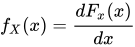
discrete: PMF <--> CDF (sum/difference)
continuous <---> (derivative/integral)
Theorem: Properties of PDF[edit | edit source]
- a)
 ( is nondecreasing)
- b)

- c)

![{\displaystyle {\begin{aligned}P[x_{1}\leq X\leq x_{2}]&=F_{X}(x_{2})-F_{X}(x_{1})\\&=\int _{-\infty }^{x_{2}}f_{X}(x)dx-\int _{-\infty }^{x_{1}}f_{X}(x)dx\\&=\int _{x_{1}}^{x_{2}}f_{X}(x)\end{aligned}}\!\,}](https://wikimedia.org/api/rest_v1/media/math/render/svg/617a0e2c35aee48fb7375e7eb4a3c2c7b37f2f09)
Some useful continuous Random Variables[edit | edit source]