Ordinary Differential Equations/Maximum domain of solution
Even if a differential equation satisfies the Picard–Lindelöf theorem, it may still not have a solution for all of that is uniquely determined by a single initial condition. Here we study the maximum interval to which a solution may be extended.

Uniqueness of solution over intervals[edit | edit source]
Theorem Local uniqueness implies global uniqueness over intervals
Hypothesis
- y is a solution to an IVP
- y is locally unique (by the Picard–Lindelöf theorem for example)
- the domain of y is an interval (which contains , otherwise the initial condition makes no sense)

y(x) is the only solution to that IVP of the which has that domain.
Maximal solution[edit | edit source]
Definition[edit | edit source]
Definition Maximal solution and maximal domain of solution
The maximal solution of an IVP which is locally unique is the solution such that

- has an interval as domain (which contains , otherwise the initial condition makes no sense)
- is not a restriction of any other solution whose domain is a larger interval
is called the maximal domain of solution and is denoted

![{\displaystyle ]x_{-},x_{+}[}](https://wikimedia.org/api/rest_v1/media/math/render/svg/6774153907845a4a17e658688f96fecd4f0f5ad5)
Unicity[edit | edit source]
Theorem Every IVP has an unique maximal solution
Theorem If there is a solution with domain then it is the maximal solution.

We must verify that:
- is an interval. Obviously true.
- is not a restriction of any other solution. Obvious because the domain of is already all of

Behavior at boundary[edit | edit source]
Theorem Behavior at the boundary of a maximal solution
Hypothesis
The domain of a maximal solution is smaller than infinity ()

At one or two of the following happen:

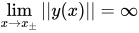
- explosion in finite time:
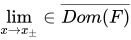
- y falls out of the domain of F:
Sufficient condition for Dom(y) = R[edit | edit source]
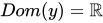
Theorem Growth at most linear implies
Hypothesis
If grows at most linearly with ,



then the domain of the maximal solution is all of
Examples[edit | edit source]
===\begin{cases} y'=y, \\ y(0)=1 \end{cases}===
Example has an infinity of solutions

F(x,y)=y , which is in both x and y, and therefore satisfies the Picard–Lindelöf theorem on all of its domain, so that solutions are locally unique.

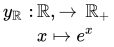
All of the following are solutions to this IVP:
![{\displaystyle {\begin{aligned}y_{1}:\,&]-2,2[\,\to \,]e^{-2},e^{2}[\\&x\mapsto e^{x}\end{aligned}}}](https://wikimedia.org/api/rest_v1/media/math/render/svg/4a1a0a3187ab3912120486bc13bcafbb6241c370)
![{\displaystyle {\begin{aligned}y_{2}:\,&]-1,3[\,\to \,]e^{-1},e^{3}[\\&x\mapsto e^{x}\end{aligned}}}](https://wikimedia.org/api/rest_v1/media/math/render/svg/a47adef29d82b3062a9358791143ecf2206859ee)
Different domains mean completely different solutions
![{\displaystyle {\begin{aligned}y_{3}:&Dom(y_{3})=]-1,1[\,\cup \,]2,4[\\&x\mapsto {\begin{cases}e^{x}&x\in ]-1,1[\\y(3)e^{(x-3)}&]2,4[\end{cases}}\end{aligned}}}](https://wikimedia.org/api/rest_v1/media/math/render/svg/1ed60baddf8f4ae5621ac114d7531beffad34173)
A function is a set of ordered pairs {(x,f(x))}, with . If the domains are different, the sets are completely different, and therefore the solutions are completely different too.

, and are the only solutions on their respective domains


This is a conclusion of the theorem on the uniqueness on intervals, because their domains are all intervals.
If the domain is not an interval there is generally no uniqueness
For the fixed domain of

![{\displaystyle ]-1,1[\,\cup \,]2,4[}](https://wikimedia.org/api/rest_v1/media/math/render/svg/d22fc1e403ea1c92f7c385bce3ae5e0bbe63b236)
which is clearly not an interval, then for any value y(3) we choose we have a different solution.
Therefore, even if the domain is fixed but not an interval and there is local uniqueness, there may not be global uniqueness. This is the major reason why we restrict ourselves to a maximal domain that is an interval, even if there may be larger domains with non-unique solutions.
To determine the solution uniquely the initial value at 0 is not enough. We would have to set a value on such as y(3). This happens because the initial condition at 0 is separated from the interval . We need to set the a value inside of , such as y(3) in order to fully determine the solution.
![{\displaystyle ]2,4[}](https://wikimedia.org/api/rest_v1/media/math/render/svg/5f390a0d4fb811993d97c929198466fc55eb6c63)
is the maximal solution
Since the domain is all of , it must be the maximal solution by the proposition above.
We could immediately see that without solving it because the growth of F is linear, as stated on the theorem of sublinear growth.

We note also that as stated on the definition, any solution that has a domain that is an interval such as and are restrictions of .
Solutions which are not defined on intervals may not be a restriction of the maximal solution
is not a a restriction of unless . However, is not unique, and in unacceptable in a physical situation since there is no causality between the two intervals of its domain. So it is not very serious if it is not a restriction of , which is generally the 'best' one.

y' = y^2[edit | edit source]
Example

, which is and therefore Lipschitz continuous, satisfying the Picard–Lindelöf theorem.

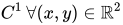
- the maximal domain may depend on the initial condition
- the maximal domain may be different than
- at the borders of the maximal domain the function may go to infinity
The maximal solutions are
![{\displaystyle {\begin{cases}\mathbb {R} &y_{0}=0\\]x_{0}-{\frac {1}{y_{0}}},+\infty [&y_{0}>0\\]-\infty ,x_{0}-{\frac {1}{y_{0}}}[&y_{0}<0\end{cases}}}](https://wikimedia.org/api/rest_v1/media/math/render/svg/2a311f5021e263772bc6961df03f9cb5ef893b6a)
which clearly depend on the initial condition, and are not all of unless for the trivial solution.
At the maximal solution tends to infinity.

Extending the domain other side of the singularity leads to non uniqueness
Fix . One might want to extend the domain of to . But then there is no more uniqueness since for any the following is a solution


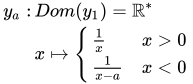
This is no surprise since is not an interval.
above are not maximal solutions

Actually any solution that is an interval is a restriction of those solutions. But this is not a maximal solution since its domain is not an interval.
We wouldn't like those to be maximal solutions since they would not be unique.
[edit | edit source]

Example
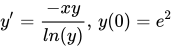
, which is and therefore Lipschitz continuous , satisfying the Picard–Lindelöf theorem. If , f is undefined, so that
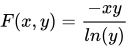


The maximum solution is
At the border the solution may fall out of the domain of F
![{\displaystyle {\begin{aligned}y:&\,Dom(y)=\,]-2,2[\\&x\mapsto \exp({\sqrt {4-x^{2}}})\end{aligned}}}](https://wikimedia.org/api/rest_v1/media/math/render/svg/533529903c4305f5b9b1edbffc7e75ec8074fd4d)
The solution is only defined for , because if then , which is not in the domain of F. The maximal solution ends at those points, which is one of the two possibilities for finite domains. The solution does not explode in this case.
![{\displaystyle x\in ]-2,2[}](https://wikimedia.org/api/rest_v1/media/math/render/svg/3cfba3fa499e5c2885b6bde825702c89d2202f3d)
