Microfluidics/Hydraulic resistance and capacity
We present here simple tools to compute the flow in complex network of channels, just knowing the applied pressure.
Hydrodynamic resistance[edit | edit source]
Flow rate in a channel is proportional to the applied pressure drop . This can be summarized in


with the hydrodynamic resistance. This expression is formally the analog of the electrokinetic law between voltage difference and current, .


The expression for the hydraulic resistance is:
- channel of circular cross-section (total length , radius ):


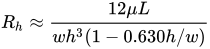
- rectangular cross-section ( is fluidic viscosity, width and height , expression valid when ) [1]


In a network of channels, equivalent resistances can be computed (as in electrokinetics):
- two channels in series have a resistance ,
- two channels in parallel have a resistance


These laws provide useful tools for the design of complex networks. Actually Kirchhoff's laws for electric circuits apply, being modified in:
- the sum of flow rates on a node of the circuit is zero
- the sum of pressure differences on a loop is zero
Hydrodynamic capacitance[edit | edit source]
The volume of fluid in a channel can change just because of a change in pressure: this is either due to fluid compressibility or channel elasticity. This behavior can be summarized with
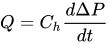
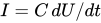
with the hydrodynamic capacitance. It is the microfluidic analog of the electrokinetic law .

Compressible fluid in a container[edit | edit source]
A pressure increase can compress the fluid in a container. The compressibility is measured by
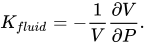
For water its value is which is usually negligible since pressure are usually less than a bar. For air it is which considerable if pressure attain a bar.


The flow rate entering a tube of volume , because of fluid compression is:



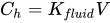
The hydrodynamic capacitance is therefore:
Elastic tubes[edit | edit source]
We define the tube dilatability as
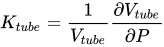
It has a positive sign, since the tube volume increases with pressure.
The tube dilatability is approximately the inverse of the Young modulus The following table gives order of magnitude of this dilatability for different materials

| steel | /bar |
| plastic | /bar |
| rubber | /bar |


This value can be interpreted in the following way: if the pressure is increased by 1 bar the relative volume increase is
Assuming a uniform pressure in the tube (which is not true in long tube where pressure decreases subtantially) , we find a flow rate entering the tube to inflate to be
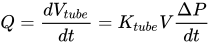
The hydrodynamic capacitance is therefore

Modelling of an elastic long tube with a substantial pressure drop[edit | edit source]
We consider a tube of length on which a pressure difference is applied. In the tube, the pressure decreases along the tube coordinate as . The dilatation is therefore not homogeneous: larger near the entrance. The volume increase of the tube (compared to the rest situation at pressure ) is




We have integrated the inflation of small volumes .
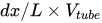

We obtain that the flow due to dilatation is
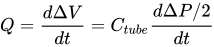
meaning that only half the pressure difference loads the volume capacitor. The capacitor is placed in the middle of the channel, where the overpressure is half, see figure.
Application: syringe injection in a microchannel[edit | edit source]
The syringe may be considered as a tube of diameter and volume , while the cylindrical microchannel has a diameter , a volume , and a length . The resistance of the microchannel is much larger than that of the syringe: . However the capacitance of the syringe is usually much larger: , due to a large surface area of walls (if the walls are elastic) and due to much larger volume of the syringe (if the liquid is compressible).


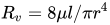


The equivalent circuit is shown in the picture.

The total flow is distributed in the microchannel branch and the capacitor branch:
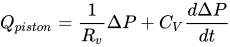
If the piston is suddenly started, initially water or tube elasticity will absorb the flow, and the flow approaches its stationary state asymptotically, with the characteristic time given as follows:
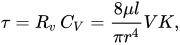
where is the effective compressibility (both from the compressibility of liquid and from the elasticity of the container).

As an example, we take a microchannel of radius 10 micrometers, length 1 cm and a syringe of volume 1cc: the characteristic time is 10 seconds, if the syringe is rigid (glass) and , while it takes up to 1000 seconds if the syringe is made from plastic !


As a conclusion, for practical realization of microfluidic networks:
- avoid elastic tubes and prefer metallic tubes for a faster equilibration
- avoid elastic glues in contact with the liquid: they will compress
- avoid bubbles in the system, the compressibility of any gas is extremely high compared to plastic!
- impose pressure with a valve, instead of piston velocity: the pressure equilibrates at the speed of sound in the liquid and changes in pressure are very rapidly applied to the whole system.
Please find an online calculator here http://biophysical-tools.de/p2cs-syringe-pump-comparison-calculator/