Microfluidics/Fluid dynamics equation
The motion of fluid is described by applying the fundamental law of mechanics, known as Newton's second law, not on a point particle but on a fluid.
Fluid particle[edit | edit source]

A fluid particle is a volume, large enough to contain smooth molecular variations, but small compared to the system size. It has a mesoscopic character, intermediate between a microscopic (molecular) and macroscopic description. A continuum approach is possible.
In liquids the fluid particle size can be larger than molecules and smaller than micrometric channels.
In gases the mean free path can be not smaller than the microsystem size, a specific approach is necessary.

The continuum approach allows to define, as a function of the position in space and the time :


- , the mass density (unit kg/m^3)
- , the velocity (unit m/s)


Mass conservation[edit | edit source]
It writes
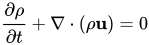
For incompressible fluids (which is almost the case with liquids, and gases at velocities small in front of the speed of sound), , and mass conservation implies a specific flow field that is divergence free, .


Forces within a fluid[edit | edit source]

Two kind of forces are present in a fluid:
- Isotropic normal force: the pressure. They provide a component
- on a small element of surface , being the outward normal to volume element.



- Shear forces: due to internal friction they provide a component
- , with the shear stress tensor.


For a Newtonian fluid the shear stress tensor components are given by
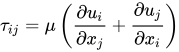
where is the viscosity.

| Viscosity (Pa.s or kg/m·s) at 20°C | |
| air | |
| water | |
| olive oil | |
| glycerin |


[edit | edit source]
For a Newtonian fluid the Navier-stokes equation writes

The second term on the left hand side comes from the inertia of the fluid. It is a non-linear term that produces history dependent effect very present at the human scale or larger scale:
- swirls, tornados
- turbulence
- propulsive forces
However at small scales inertia is damped by viscous effects (second term on the right) that are preponderant. The Reynolds number provides an estimation of the ratio inertial forces/viscous forces: if the typical velocity of the fluid is , and the typical size


- .

At small scales , and the second term can be neglected, the Navier-Stokes equation becomes the Stokes equation. This equation is linear and easier to solve.


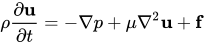
The velocity field solution of these equations is linear in applied stresses meaning:
- the solution is unique (whereas the full Navier-Stokes equation gives rise to turbulence and instabilities)
- the solution is reversed when the forces are reversed: it is impossible to create a fluid "diode" at small scales
It can also be shown that the solution minimizes the total dissipated power.
Boundary conditions[edit | edit source]
The equations of motions can be solved when boundary conditions are given at the surface of the fluid.
For usual liquids[edit | edit source]
there is a no-slip boundary condition, at the surface

For gases, and for some non-wetting liquids[edit | edit source]
For gases, the Knudsen number compares the mean free path to the typical lengthscale of the flow.

For the continuum approach still holds with no slip at the interface. For a molecular approach is necessary. For intermediate numbers , Navier-Stokes still holds but there is a slip at the solid surface, defined by the Navier length , such that the slip velocity of the fluid is


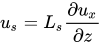
with the distance to the surface. Usually


For liquids, the debate is still open...
Bibliography[edit | edit source]
- Etienne Guyon, Jean-Pierre Hulin, Luc Petit, Catalin Mitescu (2001). Physical Hydrodynamics. Oxford University Press. ISBN 10- 0198517459 Invalid ISBN.
{{cite book}}: CS1 maint: multiple names: authors list (link) - Stéphane Colin (2004). Microfluidique. Hermès science. p. 54. ISBN 10- 2746208156 Invalid ISBN.