Theorem (Riesz' representation theorem)[edit | edit source]
Let  be a locally compact Hausdorff space and let
  be a positive linear functional on
  . Then, there exists a
  -field
  containing all Borel sets of and a unique measure
  such that
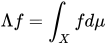 for all
 for all compact
- If
 , and
, and  then
then 
- If , and then

- The measure space
 is complete
Proof
Recall the Urysohn's lemma:
If is a locally compact Hausdorff space and if  is open and
  is compact with
  then
then
there exists ![{\displaystyle f:X\to [0,1]}](https://wikimedia.org/api/rest_v1/media/math/render/svg/fbce99d737c06662e393d2d3dba7505a1e6c6eb6) with satisfying
with satisfying  and
and  . This is written in
short as 
We shall first prove that if such a measure exists, then it is unique. Suppose  are measures that satisfy (1) through (5)
It suffices to show that  for every compact
Let be compact and let  be given.
By (3), there exists open  with
with  such that
Urysohn's lemma implies that there exists such that
(1) implies that  . But , that is
  . We can similarly show that
  . Thus,
Suppose is open in , define 
If  are open , then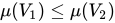
If  is a subset of then define
Define 
Let 
monotonicity of is obvious for all subsets of
Let  with
with 
It is obvious that  which implies that . Hence, we have that
  is complete.
Suppose  is a sequence of subsets of . Then,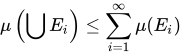
Proof
Let  be open subsets of . We wish to show that
  .
.
Given , let  be such that
 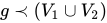 (so that
  ) and
) and  . This is possible because
  .
.
Now by Urysohn's lemma we can find  ,
,  such that
  and
and  on with
  .
.
Thus,  and
and  on .
on .
As is a linear functional  for all
  ,
,

Thus,  for every , i.e.
If  is a sequence of members of , there exist open
  such that given ,
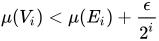 . Define
  , is open. Let
  . Then
 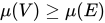 but
but 
Thus, 
If is compact, then  and
and 
Proof
It suffices to show that for every compact
Let  and
and  , define
  Then
Then  is open and
Then, by Urysohn's lemma, there exists such that  , and hence,
  on
on
Since  [1][2], we have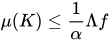
As  , we have and hence,
Let be
By definition, there exists open such that 
By Urysohn's lemma, there exists  such that , which implies that
  , that is
 .
.
Hence,
Every open set satisfies

If is open and ,  , then
Proof
Let be open. Let  such that
  . It suffices to show that there exists compact such that
  .
.
By definition of , there exists such that and 
Let  . Obviously .
Let  be open such that
  , then
  and hence
  , further
Thus,
Suppose  is a sequence of pairwise disjoint sets in
  and let
  . Then,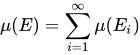
Proof
If  , by step 1, we are done.
If  is finite then, and hence, is countably additive on
Suppose,  are compact and disjoint then
  ;
; 
Claim: 
As is a locally compact Hausdorff space, there exist disjoint open sets  ,
,  with
with  ,
, 
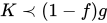
Hence, by Urysohn's lemma, there exists such that  and
and 
Now,  and
and  ,
, 
Thus, 
Assume . Given  , there exists compact
  such that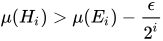
Let  . Obviously,
  is compact.
Thus, 
and hence, 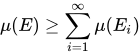 By step 1, we have
 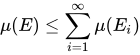 .
.
Thus,
If and then there exists compact and open with  and
and 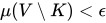
Proof
 is open. As , there exist compact and open such that with

Now,  (by step 4)
Thus,
is a field of subsets of
Proof
Let  and let be given.
There exist compact and open such that  ,
,  with
with

Write 
As  is a closed subsetof , it is compact
Then, 
thus,  is finite and hence,
Now write 
and 
is a -field containing all Borel sets
Proof
Let  be closed
Then,  is compact for every compact
Therefore  and hence
  (by definition) and hence, has all closed sets. In particular,
Let  . Then,
  and
and  and hence,
Now let  where
where 
We know that  for every compact
Let  ,
,  .
.  , but
, but  and hence,

Proof
Let  . Then
  for every compact
Now, let , . Given , there exists open such that  ,
,  , that is, . Further, there exists compact such that
implies that , that is, there exists compact  such that

Therefore,  implies that
As is arbitrary, we are done.
For ,
Proof
Without loss of generality, we may assume that is real valued.
It is obvious from the definition of that 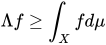
Let . Hence, as is continuous,  is compact. and we can write
 ![{\displaystyle f(K)\subset [a,b]}](https://wikimedia.org/api/rest_v1/media/math/render/svg/237c40b77803e063e9ff336f4172ca1085c9ada8) for some
for some  . Let . Let
  be an
be an  -fine partition of
 ![{\displaystyle [a,b]}](https://wikimedia.org/api/rest_v1/media/math/render/svg/9c4b788fc5c637e26ee98b45f89a5c08c85f7935)
Let  . As is continuous, is compact,
  is measurable for every
  , and hence,

Hence, we can find open sets  such that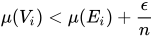
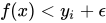 for all
We know that if compact  with open then there exists wiht and
  on
on
Hence, there exist functions such that on .
Thus, 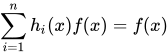 for all
By step 2, we have 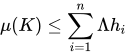
 on each
Thus, 




As is arbitrary, we have 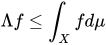 which completes the proof.
- ↑ https://4dspace.mtts.org.in/expository-article-download.php?ai=160
- ↑ https://laurent.claessens-donadello.eu/pdf/giulietta.pdf, search for the label THOooTWZWooHqGDAx.