


Macroeconomics/Keynesian Demand-side Economics and Multipliers
Deep Depression income-expenditure model - Keynesian Multipliers
One way to describe the economy is with the equation where represents total income, represents consumption, and represents investment (other than government investment, of course). If the economy under discussion is that of a country, can be thought of as approximating the countries . We can think of consumption as a function of disposable income where is taxes where is the Marginal Propensity to Consume.






The Marginal Propensity to Consume (MPC) is the rate of growth of consumption in terms of an increase in disposable income and is defined as the derivative of the consumption function, . Assuming all spending is divided evenly between consumption and savings, the Marginal Propensity to Save (MPS) is defined as the rate of growth in savings in terms of an increase in disposable income and is calculated as .


Multipliers
[edit | edit source]GEM - Government expenditure multiplier
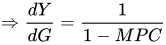
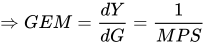
[edit | edit source]The GEM considers the idea that since only a percentage of money that anyone receives is saved, and the rest is put back into the economy. So if the government gives someone a dollar (deficit spending), it will end up meaning that much more than a dollar will be added to the economy. One way to think about it is the GEM is the amount that , total income, changes as , government expenditure changes. So we look at our formula with the consumption function included, we have:





, which, in fact, gives,
TCM - Tax Cut Multiplier
[edit | edit source]In this case, we want to know how much a change in the tax rate will affect total income. Our derivation follows the same lines as before. In this case we have:


, which gives,


In general, since: .


BBM - Balanced Budget Multiplier
[edit | edit source]This is a sort of combination of the previous two multipliers, where any change in spending corresponds to a change in tax rates, i.e. . Now we can take the derivative of our equation with respect to all three variables.




. Now we set

, which gives,

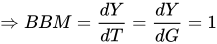
Thus if the we have a balanced budget with respect to government spending and taxation, total income will be unchanged.
More information
[edit | edit source]In general the theoretical multipliers are higher than the actual multipliers. Why? In general agents tend to want to smoothen their consumption over their lifetime, thus they do not respond fully to exogenous shocks. Taxes distort. The model is isolated from the outside world. Other reasons?
References
[edit | edit source]Masego