Linear Algebra/General Systems
Consider the system of m equations





and the matrices
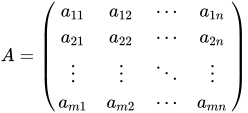
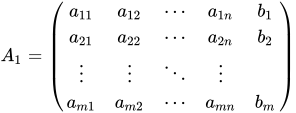
Kronecker-Capelli Theorem[edit | edit source]
The general system of linear equations has a solution if the rank of A is equal to the rank of A1, and has no solution if the rank of A is less than the rank of A1.
Proof[edit | edit source]
The system of linear equations has a solution only when the last column of A1 is a linear combination of the other columns. If that is so, then by a theorem proven earlier, the column span of A is the same as the column span of A1, so their ranks are the same. Now, suppose that their ranks are the same. Then the basis columns of A also form a basis column of A1 since they have column spans of the same dimension. Thus, their column spans are the same, and so the last column also belongs to the column span of A, and so is linearly dependent on the other columns, this linear dependence is the solution to this system of equations. Suppose that the rank of A1 is greater than A. This implies that Another proof is if we sopose that the rank of A is r, so if b is linear with {a1,a2....ar} it proof that the rank of {a1,a2...ar,b} is r,so the theorem is solved, But if the b is not combination with system (a1,a2.....ar),it means that the system (a1,a2...ar,b) is a base of system (a1....an,b), if we atach any ai/r<i<n,the system (a1,a2...ar,b,ai}is linear it mean that system (a1,a2.....ar,b)is a base of {a1,a2.....an.b),so the rank of (a1,a2.....an,b)is equal with Rank(A)+1. So we can not solve the system,