This subsection is optional. Later material will not require the work here.
Comparing Set Descriptions[edit | edit source]
A set can be described in many different ways.
Here are two different descriptions of a single set:
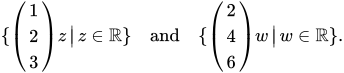
For instance, this set contains

(take  and
and  ) but does not contain

(the first component gives  but that clashes with the third component,
similarly the first component gives
but that clashes with the third component,
similarly the first component gives  but the third component
gives something different).
Here is a third description of the same set:
but the third component
gives something different).
Here is a third description of the same set:
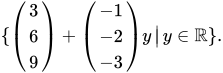
We need to decide when two descriptions are describing the same set.
More pragmatically stated,
how can a person tell when an answer to a homework question describes
the same set as the one described in the back of the book?
Sets are equal if and only if they have the same members.
A common way to show that two sets,
 and
and  , are equal is to show mutual inclusion:
any member of is also in , and
any member of is also in .[1]
, are equal is to show mutual inclusion:
any member of is also in , and
any member of is also in .[1]
- Example 4.1
To show that
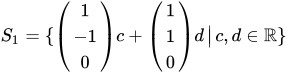
equals
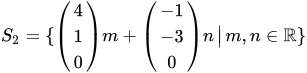
we show first that  and then that
  .
.
For the first half we must check that any vector
from is also in .
We first consider two examples to use them as models for the general argument.
If we make up a member of by trying  and
and  ,
then to show that it is in we need
,
then to show that it is in we need  and
and  such that
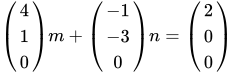
that is, this relation holds between and .
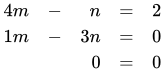
Similarly,
if we try  and
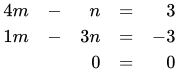
and  , then to show that the resulting
member of is in we need and such that
, then to show that the resulting
member of is in we need and such that

that is, this holds.
In the general case,
to show that any vector from is a member of we must show
that for any  and
and  there are appropriate and .
We follow the pattern of the examples; fix
there are appropriate and .
We follow the pattern of the examples; fix
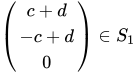
and look for and such that
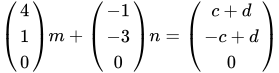
that is, this is true.
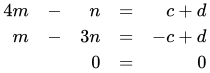
Applying Gauss' method
![{\displaystyle {\begin{array}{rcl}{\begin{array}{*{2}{rc}r}4m&-&n&=&c+d\\m&-&3n&=&-c+d\end{array}}&{\xrightarrow[{}]{-(1/4)\rho _{1}+\rho _{2}}}&{\begin{array}{*{2}{rc}r}4m&-&n&=&c+d\\&&-(11/4)n&=&-(5/4)c+(3/4)d\end{array}}\end{array}}}](https://wikimedia.org/api/rest_v1/media/math/render/svg/a77e02189911ac183e08399164ce4904545b0618)
gives  and
and  .
This shows that for any choice of and there are appropriate
and .
We conclude any member of is a member of because
it can be rewritten in this way:
.
This shows that for any choice of and there are appropriate
and .
We conclude any member of is a member of because
it can be rewritten in this way:

For the other inclusion, , we want to do the opposite.
We want to show that for any choice of and there are appropriate
and .
So fix and and solve for and :
![{\displaystyle {\begin{array}{rcl}{\begin{array}{*{2}{rc}r}c&+&d&=&4m-n\\-c&+&d&=&m-3n\end{array}}&{\xrightarrow[{}]{\rho _{1}+\rho _{2}}}&{\begin{array}{*{2}{rc}r}c&+&d&=&4m-n\\&&2d&=&5m-4n\end{array}}\end{array}}}](https://wikimedia.org/api/rest_v1/media/math/render/svg/426f6fd6b84615075a38081be952831d9c1858ba)
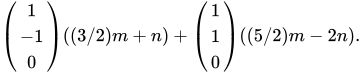
shows that  and
and  .
Thus any vector from
.
Thus any vector from
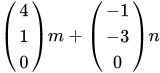
is also of the right form for
- Example 4.2
Of course, sometimes sets are not equal.
The method of the prior example will help us see the relationship
between the two sets.
These

are not equal sets.
While  is a subset of
  , it is a proper subset of because
is not a subset of .
, it is a proper subset of because
is not a subset of .
To see that, observe first that given a vector from
we can express it in the form for — if
we fix  and
and  , we can solve for appropriate , , and
  :
:
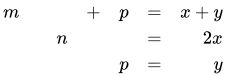
shows that that any
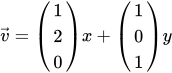
can be expressed as a member of with
 ,
,  , and
, and  :
:
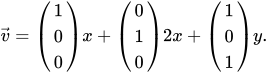
Thus  .
.
But, for the other direction, the reduction
resulting from fixing , , and and looking for and
![{\displaystyle {\begin{array}{rcl}{\begin{array}{*{2}{rc}r}x&+&y&=&m+p\\2x&&&=&n\\&&y&=&p\end{array}}&{\xrightarrow[{}]{-2\rho _{1}+\rho _{2}}}&{\begin{array}{*{2}{rc}r}x&+&y&=&m+p\\&&-2y&=&-2m+n-2p\\&&y&=&p\end{array}}\\&{\xrightarrow[{}]{(1/2)\rho _{2}+\rho _{3}}}&{\begin{array}{*{2}{rc}r}x&+&y&=&m+p\\&&-2y&=&-2m+n-2p\\&&0&=&m+(1/2)n\end{array}}\end{array}}}](https://wikimedia.org/api/rest_v1/media/math/render/svg/f31f6502a17d50bba5d6db09993eef416f025f30)
shows that the only vectors

representable in the form

are those where  .
For instance,
.
For instance,

is in but not in .
- Problem 1
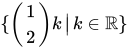
Decide if the vector is a member of the set.
-
 ,
,
-
 ,
,
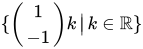
-
 ,
,
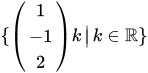
- ,
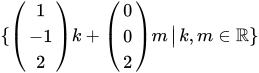
-
 ,
,
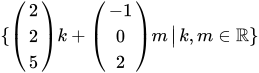
-
 ,
,
- Problem 2
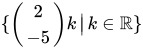
Produce two descriptions of this set that are different than this one.
- This exercise is recommended for all readers.
- Problem 3
Show that the three descriptions given at the start of this
subsection all describe the same set.
- This exercise is recommended for all readers.
- Problem 4
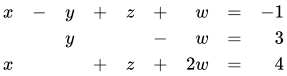
Show that these sets are equal

and that both describe the solution set of this system.
- This exercise is recommended for all readers.
- Problem 5
Decide if the sets are equal.
-
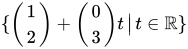 and
and
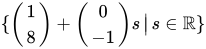
-
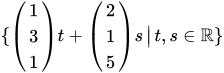 and
and

-
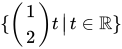 and
and
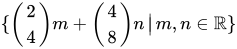
-
 and
and
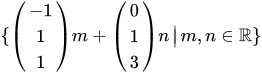
-
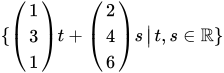 and
and
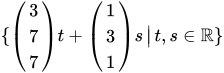
Solutions
- ↑ More information on set equality is in the appendix.