Introduction to Mathematical Physics/Some mathematical problems and their solution/Nonlinear evolution problems, perturbative methods
Problem statement[edit | edit source]
Perturbative methods allow to solve nonlinear evolution problems. They are used in hydrodynamics, plasma physics for solving nonlinear fluid models (see for instance ([ph:plasm:Chen84]). Problems of nonlinear ordinary differential equations can also be solved by perturbative methods (see for instance ([ma:equad:Arnold83]) where averaging method is presented). Famous KAM theorem (Kolmogorov--Arnold--Moser) gives important results about the perturbation of hamiltonian systems. Perturbative methods are only one of the possible methods: geometrical methods, normal form methods ([ma:equad:Arnold83]) can give good results. Numerical technics will be introduced at next section.
Consider the following problem:
proeqp
Problem: Find such that:


- verifies boundary conditions on the border of .
- verifies initial conditions.


Various perturbative methods are presented now.
Regular perturbation[edit | edit source]
Solving method can be described as follows:
Algorithm:
- Differential equation is written as:
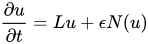
- The solution of the problem when is zero is known.
- General solution is sought as:


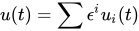
- Function is developed around using Taylor type formula:


- A hierarchy of linear equations to solve is obtained:

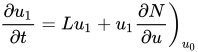
This method is simple but singular problem my arise for which solution is not valid uniformly in .

Example:
Non uniformity of regular perturbative expansions (see ([ma:equad:Bender87]). Consider Duffing equation:
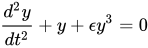
Let us look for solution which can be written as:


The linear hierarchy obtained with the previous assumption is:
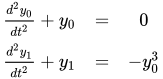
With initial conditions:
,

one gets:
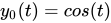
and a particular solution for will be unbounded[1] , now solution is expected to be bounded. Indeed (see [ma:equad:Bender87]), multiplying Duffing equation by , one gets the following differential equation:


![{\displaystyle {\frac {d}{dt}}[{\frac {1}{2}}({\frac {dy}{dt}})^{2}+{\frac {1}{2}}y^{2}+{\frac {1}{4}}\epsilon y^{4}]=0.}](https://wikimedia.org/api/rest_v1/media/math/render/svg/04ed226e5c1a45ded865bb711ded542a6835974c)
We have thus:

where is a constant. Thus is bounded if .


Remark:
In fact Duffing system is conservative.
Remark:
Origin of secular terms : A regular perturbative expansion of a periodical function whose period depends on a parameter gives rise automatically to secular terms (see ([ma:equad:Bender87]):


Born's iterative method[edit | edit source]
Algorithm:
- Differential equation is transformed into an integral equation:

- A sequence of functions converging to the solution is sought:

Starting from chosen solution , successive are evaluated using recurrence formula:
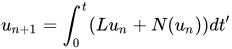
This method is more "global" than previous one \index{Born iterative method} and can thus suppress some divergencies. It is used in diffusion problems ([ph:mecaq:Cohen73],[ph:mecaq:Cohen88]). It has the drawback to allow less control on approximations.
Multiple scales method[edit | edit source]
Algorithm:



For examples see ([ma:equad:Nayfeh95]).
Poincaré-Lindstedt method[edit | edit source]
This method is closely related to previous one, but is specially dedicated to studying periodical solutions. Problem to solve should be:\index{Poincaré-Lindstedt}
Problem:
Find such that:
eqarespo

where is a periodic function of pulsation . Setting ,


one gets:

Resolution method is the following:
Algorithm:







WKB method[edit | edit source]
mathsecWKB
WKB (Wentzel-Krammers-Brillouin) method is also a perturbation method. It will be presented at section secWKB in the proof of ikonal equation.
- ↑
Indeed solution of equation:
is

