


Introduction to Chemical Engineering Processes/Chapter 1 Practice Problems
Chapter 1 Practice Problems
[edit | edit source]
1. Perform the following conversions, using the appropriate number of significant figures in your answer:
a)

b)
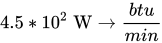
c)
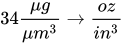
d) (note: kWh means kilowatt-hour)
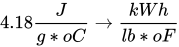
e)

2. Perform a dimensional analysis on the following equations to determine if they are reasonable:
a) , where v is velocity, d is distance, and t is time.

b) where F is force, m is mass, v is velocity, and r is radius (a distance).

c) where is density, V is volume, and g is gravitational acceleration.


d) where is mass flow rate, is volumetric flow rate, and is density.


3. Recall that the ideal gas law is where P is pressure, V is volume, n is number of moles, R is a constant, and T is the temperature.

a) What are the units of R in terms of the base unit types (length, time, mass, and temperature)?
b) Show how these two values of R are equivalent:

c) If an ideal gas exists in a closed container with a molar density of at a pressure of , what temperature is the container held at?

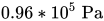
d) What is the molar concentration of an ideal gas with a partial pressure of if the total pressure in the container is ?


e) At what temperatures and pressures is a gas most and least likely to be ideal? (hint: you can't use it when you have a liquid)
f) Suppose you want to mix ideal gasses in two separate tanks together. The first tank is held at a pressure of 500 Torr and contains 50 moles of water vapor and 30 moles of water at 70oC. The second is held at 400 Torr and 70oC. The volume of the second tank is the same as that of the first, and the ratio of moles water vapor to moles of water is the same in both tanks.
You recombine the gasses into a single tank the same size as the first two. Assuming that the temperature remains constant, what is the pressure in the final tank? If the tank can withstand 1 atm pressure, will it blow up?
4. Consider the reaction , which is carried out by many organisms as a way to eliminate hydrogen peroxide.

a). What is the standard enthalpy of this reaction? Under what conditions does it hold?
b). What is the standard Gibbs energy change of this reaction? Under what conditions does it hold? In what direction is the reaction spontaneous at standard conditions?
c). What is the Gibbs energy change at biological conditions (1 atm and 37oC) if the initial hydrogen peroxide concentration is 0.01M? Assume oxygen is the only gas present in the cell.
d). What is the equilibrium constant under the conditions in part c? Under the conditions in part b)? What is the constant independent of?
e). Repeat parts a through d for the alternative reaction . Why isn't this reaction used instead?

5. Two ideal gasses A and B combine to form a third ideal gas, C, in the reaction . Suppose that the reaction is irreversible and occurs at a constant temperature of 25oC in a 5L container. If you start with 0.2 moles of A and 0.5 moles of B at a total pressure of 1.04 atm, what will the pressure be when the reaction is completed?

6. How much heat is released when 45 grams of methane are burned in excess air under standard conditions? How about when the same mass of glucose is burned? What is one possible reason why most heterotrophic organisms use glucose instead of methane as a fuel? Assume that the combustion is complete, i.e. no carbon monoxide is formed.
7. Suppose that you have carbon monoxide and water in a tank in a 1.5:1 ratio.
a) In the literature, find the reaction that these two compounds undergo (hint: look for the water gas shift reaction). Why is it an important reaction?
b) Using a table of Gibbs energies of formation, calculate the equilibrium constant for the reaction.
c) How much hydrogen can be produced from this initial mixture?
d) What are some ways in which the yield of hydrogen can be increased? (hint: recall Le Chatlier's principle for equilibrium).
e) What factors do you think may influence how long it takes for the reaction to reach equilibrium?
Problem 8. A bio-fuel plant converts the sugars (glucose) in corn into ethanol and carbon dioxide in a process called fermentation. The plant produces 100 gpm (gallons per minute) of ethanol and can produce of 2.5 gallons of ethanol per bushel of corn. Jimmy farms a total of 2000 acres, 75% of which are corn. He sells 80% of his corn supply to the bio-fuel plant for $4.00/bushel. (Hint: 120 bushels = 1 acre)
a) How long can the plant run with the supply of corn from Jimmy? (hours)
b) How much money did Jimmy make for his corn?