Guide to Non-linear Dynamics in Accelerator Physics/Definitions
phase space
[edit | edit source]Phase space refers to the space in which dynamics occurs. In order to describe dynamics with a Hamiltonian, one must specify the positions and momenta, and . Although phase space in general may be a 2N dimensional manifold with non-trivial topology(a pendulum for example, has a position coordinate that connects back on itself). Usually, however, the phase space is .


observable or function
[edit | edit source]An observable or simply function is a function from the phase space to . They can be represented as a multivariate polynomial or approximated by a truncated taylor series. An example of distribution is:


An observable or function can be composed with a map. See later.
map
[edit | edit source]A map is a function of the phase space into itself. It can be represented as a vector of observables or functions. Maps can be summed and multiplied by a scalar. A map can be a constant map:

A map can be linear. If A is a matrix:

A map can be non linear as well.

Function can be composed with maps.
If a point in the face space has coordinates , is an observable, is a map where are observables, composition is defined by:




.

Composition can be extended to vector of functions and therefore with maps. Maps form an algebra with the composition operation.
We denote composition with or or nothing.


If is a map and is a function, we denote the composition operation with



If A,B are maps, we denote the composition operation with
,

For instance if



Please note that if A and B are matrices:

One may consider a tracking code as an algorithm for computing a map which is an approximation of the one turn map.
operator
[edit | edit source]An operator is a function that transform a function in a function. A map is also an operator. Operators can be generated by function like derivative operators, vector fields, lie operator. Operator can be composed to form, for instance, exponential operators.
derivative operators
[edit | edit source]A derivative operator is made of various powers of derivatives and multiplications by distributions. Examples are vector fields and lie operators.
vector field
[edit | edit source]A differential operator with the form

dynamical system
[edit | edit source]A dynamical system can be defined by the problem of solving
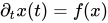
where is a trajectory in and is a map.


If we are interested in finding , where is in general a map, the solution can be written as



where is a vector field and
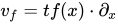

The method can be used for instance for solving the diff. eq. starting from an initial condition . First define


then compute

then substitute with in s, and the solution will be .


lie operator
[edit | edit source]A special case of a vector field when the map is defined by where is the symplectic matrix.


If is a function of and .


.

It is often denoted in the literature as

such that
![{\displaystyle :H:g=[H,g]}](https://wikimedia.org/api/rest_v1/media/math/render/svg/008c751d15fa649f2ce43a56fd1b77835b439b6c)
Other concepts
[edit | edit source]- differential algebra
An algebra with the properties of the derivative. Related to field of non-standard analysis. TPSA vectors are approximate examples of. See also [1]
- TPSA
Truncated power series algebra. Algebra of power series all truncated at a particular order. Power series may be added, multiplied. Analytic functions can be defined for them. A power series can be composed with a map. Example: epsilon(z).
- k-Jets
Power series vector truncated at a particular order . A compositional map may be represented as a K-jets if the generating map maps the origin into the origin. See also [2]

- compositional map
An operator generated by a map or a function equivalent to the composition of the map with another map. A compositional map may be represented as a k-jets if the generating map maps the origin into the origin.
- Lie transformation
The transformation induced by a Lie operator by exponentiating. In particular, if :f: is a Lie operator, then is a Lie transformation. The Lie Transformations form a group, a Lie group, which is also a topological group, when defined in a more general setting.

- lie algebra
In general, any vector field that also has a multiplication property that satisfies
- bilinear
- anti-commutative
- Jacobi identity
In classical dynamics, refers to either phase space functions with Poisson bracket as multiplication, or Lie operators with commutation as multiplication
- Floquet space
Normalized space in which particles move in circles. Connected to Floquet's theorem which is more commonly known in solid state physics as Bloch's theorem. See also [3]
- BCH formula
A formula relating the combining of two exponential operators into a single operator. For finite matrices, we state

where C is composed of sums of nested commutators of A and B. Due to the formula [:f:,:g:]=:{f,g}:, this generalizes in the case of Lie operators to the statement that

where h is a distribution on phase space. We note, however, that this is a purely formal relationship, and may in fact break down due to lack of convergence. h may be expressed in a series in different forms depending on what is considered the expansion parameter. If both f and g are considered small, then

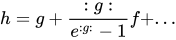
If only g is considered small, then