Geometry/Appendix A
< Geometry
This is an incomplete list of formulas used in geometry.
Length[edit | edit source]
Perimeter and Circumference[edit | edit source]
Polygon[edit | edit source]
- Sum the lengths of the sides.
Circle[edit | edit source]
-
- is the diameter
- is the radius


Triangles[edit | edit source]
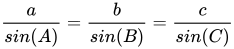
- Law of Sines:
- are sides, are the angles corresponding to respectively.
- Law of Cosines:
- are sides, are the angles corresponding to respectively.



Right Triangles[edit | edit source]
- Pythagorean Theorem:
- are sides where c is greater than other two.

Area[edit | edit source]
Triangles[edit | edit source]
-
- = base, = height (perpendicular to base), = area
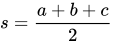
- Heron's Formula:
- are sides, and , = area



Equilateral Triangles[edit | edit source]
-
- is a side


Quadrilaterals[edit | edit source]
Squares[edit | edit source]
-
- is the length of the square's side


Rectangles[edit | edit source]
-
- and are the sides of the rectangle

Parallelograms[edit | edit source]
-
- is the base, is the height

Trapezoids[edit | edit source]
-
- are the two bases, is the height


Circles[edit | edit source]
-
- is the radius

Surface Areas[edit | edit source]
- Cube: 6×()
- is the length of a side.
- Rectangular Prism: 2×(( × ) + ( × ) + ( × ))
- , , and are the length, width, and height of the prism
- Sphere: 4×π×(2)
- is the radius of the sphere
- Cylinder: 2×π××( + )
- is the radius of the circular base, and is the height
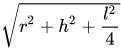
- Pyramid:
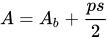
- = Surface area, = Area of the Base, = Perimeter of the base, = slant height.




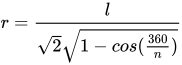
- The surface area of a regular pyramid can also be determined based only on the number of sides(), the radius() or side length(), and the height()
- If is known, is defined as
- or if is known, is defined as
- The slant height is given by
- The total surface area of the pyramid is given by




![{\displaystyle n{\frac {l}{2}}[h_{1}+h_{0}]}](https://wikimedia.org/api/rest_v1/media/math/render/svg/c5ac629a1306de91033ba867a237e1418f53c571)
- Cone: π×r×(r + √(r2 + h2))
- is the radius of the circular base, and is the height.
Volume[edit | edit source]
- Cube
- s = length of a side
- Rectangular Prism
- l = length, w = width, h = height
- Cylinder(Circular Prism)
- r = radius of circular face, h = distance between faces
- Any prism that has a constant cross sectional area along the height:
- A = area of the base, h = height
- Sphere:
- r = radius of sphere
- Ellipsoid:
- a, b, c = semi-axes of ellipsoid
- Pyramid:
- A = area of base, h = height from base to apex
- Cone (circular-based pyramid):
- r = radius of circle at base, h = distance from base to tip


- Geometry Main Page
- Motivation
- Introduction
- Geometry/Chapter 1 - HS Definitions and Reasoning (Introduction)
- Geometry/Chapter 1/Lesson 1 Introduction
- Geometry/Chapter 1/Lesson 2 Reasoning
- Geometry/Chapter 1/Lesson 3 Undefined Terms
- Geometry/Chapter 1/Lesson 4 Axioms/Postulates
- Geometry/Chapter 1/Lesson 5 Theorems
- Geometry/Chapter 1/Vocabulary Vocabulary
- Geometry/Chapter 2 Proofs
- Geometry/Chapter 3 Logical Arguments
- Geometry/Chapter 4 Congruence and Similarity
- Geometry/Chapter 5 Triangle: Congruence and Similiarity
- Geometry/Chapter 6 Triangle: Inequality Theorem
- Geometry/Chapter 7 Parallel Lines, Quadrilaterals, and Circles
- Geometry/Chapter 8 Perimeters, Areas, Volumes
- Geometry/Chapter 9 Prisms, Pyramids, Spheres
- Geometry/Chapter 10 Polygons
- Geometry/Chapter 11
- Geometry/Chapter 12 Angles: Interior and Exterior
- Geometry/Chapter 13 Angles: Complementary, Supplementary, Vertical
- Geometry/Chapter 14 Pythagorean Theorem: Proof
- Geometry/Chapter 15 Pythagorean Theorem: Distance and Triangles
- Geometry/Chapter 16 Constructions
- Geometry/Chapter 17 Coordinate Geometry
- Geometry/Chapter 18 Trigonometry
- Geometry/Chapter 19 Trigonometry: Solving Triangles
- Geometry/Chapter 20 Special Right Triangles
- Geometry/Chapter 21 Chords, Secants, Tangents, Inscribed Angles, Circumscribed Angles
- Geometry/Chapter 22 Rigid Motion
- Geometry/Appendix A Formulae
- Geometry/Appendix B Answers to problems
- Appendix C. Geometry/Postulates & Definitions
- Appendix D. Geometry/The SMSG Postulates for Euclidean Geometry


