General Mechanics/Index Notation

From Wikibooks, open books for an open world
Jump to: navigation, search

[edit] Summation convention

If we label the axes as 1,2, and 3 we can write the dot product as a sum
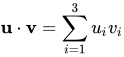
\mathbf{u} \cdot \mathbf{v} = \sum_{i=1}^3 u_i v_i

If we number the elements of a matrix similarly,

\mathbf{A}=
\begin{pmatrix}A_{11} & A_{12} & A_{13}\\ A_{21} & A_{22} & A_{23} 
\\A_{31} & A_{32} & A_{33} \end{pmatrix} \quad 
\mathbf{B}= \begin{pmatrix} B_{11} & B_{12} & B_{13}\\ B_{21} & B_{22} & B_{23} \\B_{31} & B_{32} & B_{33} \end{pmatrix}

we can write similar expressions for matrix multiplications

(\mathbf{A} \mathbf{u})_i=\sum_{j=1}^3 A_{ij} u_j \quad
 (\mathbf{A} \mathbf{B})_{ik}=\sum_{j=1}^3 A_{ij} B_{jk}

Notice that in each case we are summing over the repeated index. Since this is so common, it is now conventional to omit the summation sign.

Instead we simply write

\mathbf{u} \cdot \mathbf{v} =  u_i v_i \quad
(\mathbf{A} \mathbf{u})_i= A_{ij} u_j \quad 
(\mathbf{A} \mathbf{B})_{ik}= A_{ij} B_{jk}

We can then also number the unit vectors, êi, and write

\mathbf{u}=u_i \hat{\mathbf{e}}_i

which can be convenient in a rotating coordinate system.

[edit] Kronecker delta

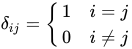
The Kronecker delta is

\delta_{ij}=
\left\{ \begin{matrix} 1 & i=j\\ 0 & i\ne j \end{matrix} \right.

This is the standard way of writing the identity matrix.

[edit] Levi-Civita (Alternating) symbol

Another useful quantity can be defined by

\epsilon_{ijk}=
\left\{ \begin{matrix} 
1 & (i,j,k)= (1,2,3) \mbox{ or } (2,3,1) \mbox{ or } (3,1,2) \\
-1 & (i,j,k)= (2,1,3) \mbox{ or } (3,2,1) \mbox{ or } (1,3,2) \\
 0 & \mbox{ otherwise } \end{matrix} \right.

With this definition it turns out that

\mathbf{u} \times \mathbf{v} = \epsilon_{ijk}  \hat{\mathbf{e}}_i u_j v_k

and

\epsilon_{ijk}\epsilon_{ipq}=
\delta_{jp}\delta_{kq}-\delta_{jq}\delta_{kp} \,

This will let us write many formulae more compactly.

Personal tools
Namespaces
Variants
Actions
Navigation
Community
Toolbox
Sister projects
Print/export