A Banach space  over
over  is called a Banach algebra if it is an algebra and satisfies
 .
.
We shall assume that every Banach algebra has the unit  unless stated otherwise.
Since  as
as  , the map

is continuous.
For  , let
, let  be the set of all complex numbers
  such that
  is not invertible.
5 Theorem For every , is nonempty and closed and
 .
.
Moreover,

( is called the spectral radius of
  )
)
Proof: Let  be the group of units. Define
  by
by 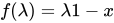 . (Throughout the proof is fixed.) If
  , then, by definition,
  or
or  . Similarly, we have:
 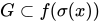 . Thus,
  . Since
  is clearly continuous,
  is open and so is closed. Suppose that
  for
for  . By the geometric series (which is valid by Theorem 2.something),
we have:
. By the geometric series (which is valid by Theorem 2.something),
we have:
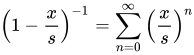
Thus,  is invertible, which is to say,
  is invertible. Hence,
  . This complete the proof of the first assertion and gives:

Since is compact, there is a  such that
  . Since
  (use induction to see this),

Next, we claim that the sequence  is bounded for
  . In view of the uniform boundedness principle, it suffices to show that
  is bounded for every
  . But since
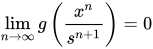 ,
,
this is in fact the case. Hence, there is a constant  such that
 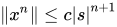 for every
  . It follows:
 .
.
Taking inf over completes the proof of the spectral radius formula. Finally, suppose, on the contrary, that is empty. Then for every , the map

is analytic in . Since  , by Liouville's theorem, we must have:
  . Hence,
 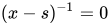 for every , a contradiction.
5 Corollary (Gelfand-Mazur theorem) If every nonzero element of is invertible, then is isomorphic to .
Proof: Let be a nonzero element. Since is non-empty, we can then find  such that
  is not invertible. But, by hypothesis, is invertible, unless
  .
.
Let  be a maximal ideal of a Banach algebra. (Such exists by the usual argument involving Zorn's Lemma in abstract algebra). Since the complement of consists of invertible elements, is closed. In particular,
  is a Banach algebra with the usual quotient norm. By the above corollary, we thus have the isomorphism:

Much more is true, actually. Let  be the set of all nonzero homeomorphism
  . (The members of are called characters.)
5 Theorem is bijective to the set of all maximal ideals of .
5 Lemma Let . Then is invertible if and only if  for every
5 Theorem 
An involution is an anti-linear map  such that
  . Prototypical examples are the complex conjugation of functions and the operation of taking the adjoint of a linear operator. These examples explain why we require an involution to be anti-linear.
Now, the interest of study in this chapter. A Banach algebra with an involution is called a C*-algebra if it satisfies
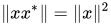 (C*-identity)
From the C*-identity follows
 ,
,
for
 and the same for
  in place of . In particular,
  (if exists). Furthermore, the
  -identity is equivalent to the condition:
 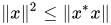 , for this and
 implies
  and so
  .
.
For each , let  be the linear span of
  . In other words, is the smallest C*-algebra that contains . The crucial fact is that is commutative. Moreover,
Theorem Let be normal. Then 
A state on -algebra is a positive linear functional f such that  (or equivalently
  ). Since
  is convex and closed, is weak-* closed. (This is Theorem 4.something.) Since is contained in the unit ball of the dual of , is weak-* compact.
5 Theorem Every C^*-algebra is *-isomorphic to  where
where  is the spectrum of .
5 Theorem If is isomorphic to  , then it follows that and
  are homeomorphic.
3 Lemma Let  be a continuous linear operator on a Hilbert space
  . Then
  if and only if
  for all
  .
.
Continuous linear operators with the above equivalent conditions are said to be normal. For example, an orthogonal projection is normal. See w:normal operator for additional examples and the proof of the above lemma.
3 Lemma Let  be a normal operator. If
  and
and  are distinct eigenvalues of , then the respective eigenspaces of and are orthogonal to each other.
Proof: Let  be the identity operator, and
  be arbitrary eigenvectors for
  , respectively. Since the adjoint of
  is
is  , we have:
 .
.
That is,  , and we thus have:

If  is nonzero, we must have
  .
.
5 Exercise Let be a Hilbert space with orthogonal basis  , and
, and  be a sequence with
  . Prove that there is a subsequence of that converges weakly to some and that
  . (Hint: Since
  is bounded, by Cantor's diagonal argument, we can find a sequence
  such that
  is convergent for every
  .)
.)
5 Theorem (Von Neumann double commutant theorem) M is equal to its double commutant if and only if it is closed in either weak-operator topology or strong-operator topology.
Proof: (see w:Von Neumann bicommutant theorem)
