Formal Logic/Predicate Logic/Free and Bound Variables
| ← Formal Syntax | ↑ Predicate Logic | Informal Conventions → |
Free and Bound Variables[edit | edit source]
Informal notions[edit | edit source]
The two English sentences,
- If Socrates is a person, then Socrates is mortal,
- if Aristotle is a person, then Aristotle is mortal,
are both true. However, outside any context supplying a reference for 'it',
- (1) If it is a person, then it is mortal,
is neither true nor false. 'It' is not a name, but rather an empty placeholder. 'It' can refer to an object by picking up its reference from the surrounding context. But without such context, there is no reference and no truth or falsity. The same applies to the variable 'x' in
- (2) If x is a person, then x is mortal.
This situation changes with the two sentences:
- (3) For any object, if it is a person, then it is mortal,
- (4) For any object x, if x is a person, then x is mortal.
Neither the occurrences of 'it' nor the occurrences of 'x' in these sentences refer to specific objects as with 'Socrates' or 'Aristotle'. But (3) and (4) are nonetheless true. (3) is true if and only if:
- (5) Replacing both occurrences of 'it' in (3) with a reference to any object whatsoever (the same object both times) yields a true result.
But (5) is true and so is (3). Similarly, (4) is true if and only if:
- (6) Replacing both occurrences of 'x' in (4) with a reference to any object whatsoever (the same object both times) yields a true result.
But (3) is true and so is (4). We can call the occurrences of 'it' in (1) free and the occurrences of 'it' in (3) bound. Indeed, the occurrences of 'it' in (3) are bound by the phrase 'for any'. Similarly, the occurrences 'x' in (2) are free while those in (4) are bound. Indeed, the occurrences of 'x' in (4) are bound by the phrase 'for any'.
Formal definitions[edit | edit source]
An occurrence of a variable is bound in if that occurrence of stands within a subformula of having one of the two forms:


Consider the formula

Both instances of are bound in (7) because they stand within the subformula

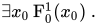
Similarly, both instances of are bound in (7) because they stand within the subformula


An occurrence of a variable is free in if and only if is not bound in . The occurrences of both and in

are free in (8) because neither is bound in (8).
We say that an occurrence of a variable is bound in by a particular occurrence of if that occurrence is also the first (and perhaps only) symbol in the shortest subformula of having the form


Consider the formula

The third and fourth occurrences of in (9) are bound by the second occurrence of in (9). However, they are not bound by the first occurrence of in (9). The occurrence of

in (9)—as well as the occurrence of (9) itself in (9)—are subformulae of (9) beginning with a quantifier. That is, both are subformula of (9) having the form
Both contain the second third and fourth occurrences of in (9). However, the occurrence of (10) in (9) is the shortest subformula of (9) that meets these conditions. That is, the occurrence of (10) in (9) is the shortest subformula of (9) that both (i) has this form and (ii) contains the third and fourth occurrences of in (9). Thus it is the second, not the first, occurrence of in (9) that binds the third and forth occurrences of in (9). The first occurrence of in (9) does, however, bind the first two occurrences of in (9).
We also say that an occurrence of a variable is bound in by a particular occurrence of if that occurrence is also the first (and perhaps only) symbol in the shortest subformula of having the form

Finally, we say that a variable (not a particular occurrence of it) is bound (or free) in a formula if the formula contains a bound (or free) occurrence of . Thus is both bound and free in

since this formula contains both bound and free occurrences of . In particular, the first two occurrences of are bound and the last is free.
Sentences and formulae[edit | edit source]
A sentence is a formula with no free variables. Sentential logic had no variables at all, so all formulae of are also sentences of . In predicate logic and its language , however, we have formulae that are not sentences. All of (7), (8), (9), and (10) above are formulae. Of these, only (7), (9), and (10) are sentences. (8) is not a sentence because it contains free variables.


Examples[edit | edit source]
All occurrences of in

are bound in the formula. The lone occurrence of is free in the formula. Hence, (11) is a formula but not a sentence.
Only the first two occurrences of in

are bound in the formula. The last occurrence of and the lone occurrence of in the formula are free in the formula. Hence, (12) is a formula but not a sentence.
All four occurrences of in

are bound. The first two are bound by the universal quantifier, the last two are bound by the existential quantifier. The lone occurrence of in the formula is free. Hence, (13) is a formula but not a sentence.
All three occurrences of in

are bound by the universal quantifier. Both occurrences of in the formula are bound by the existential quantifier. Hence, (14) has no free variables and so is a sentence and as well as a formula.