FHSST Physics/Rectilinear Motion/Speed and Velocity
Speed and Velocity[edit | edit source]
Let's take a moment to review our definitions of velocity and speed by looking at the worked example below:
Worked Example 23 Speed and Velocity[edit | edit source]

Question: A cyclist moves from A through B to C in 10 seconds. Calculate both his speed and his velocity.
Answer:
Step 1 :
Analyse the question to determine what is given. The question explicitly gives
- the distance between A and B
- the distance between B and C
- the total time for the cyclist to go from A through B to C
all in the correct units!
Step 2 :
What is being asked? We are asked to calculate the average speed and the average velocity of the cyclist.
His speed - a scalar - will be
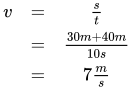
Since velocity is a vector we will first need to find the resultant displacement of the cyclist. His velocity will be

The total displacement is the vector from A to C, and this is just the resultant of the two displacement vectors, i.e.

Using the rule of Pythagoras:

∴

For this cyclist, his velocity is not the same as his speed because there has been a change in the direction of his motion. If the cyclist traveled directly from A to C without passing through B his speed would be

and his velocity would be

In this case where the cyclist is not undergoing any change of direction (i.e. he is traveling in a straight line) the magnitudes of the speed and the velocity are the same. This is the defining principle of rectilinear motion.
| Important: |
| For motion along a straight line the magnitudes of speed and velocity are the same, and the magnitudes of the distance and displacement are the same. |