
Engineering Guesstimations
Approximations are deliberate misrepresentations of physical or mathematical things, e.g., Π is approximately 3, an atom is spherical, the drag force on a moving tank is zero. The question is not why do we need them. The most accurate mathematical description of reality is Quantum electrodynamics (QED). Everything else, every physics formula, all engineering empirical formulas work with around three decimal place accuracy. Gödel proved that it will always be possible that unknown truths exist outside of human knowledge. Nothing is absolute.
General approximations[edit | edit source]
- guesstimation
- ballpark estimate
- scientific wild ass guess (SWAG) .. an air force term
Mental Calculation[edit | edit source]
Before calculators there were slide rules which required estimating the power of 10. This prevented a lot of mistakes. The term calculator actually referred to a person not a machine. Hundreds of human calculators were employed during WWII. Calculations were split up into small tasks that could be checked. It was not a solitary job. A majority were women.
Today there are competitions and training software. There are books and wiki pages written about how to do this. There are tricks such as .. when multiplying by 9, subtract one from the other number and then subtract it from 9. So 9*7 ... 7-1=6 .. 9-6 = 3 ... answer 63 or instead of 9*7 round up to 10*7 then subtract a 7: (70-7= 63).
Engineering and Science approximations[edit | edit source]
Introduction (4 minute audio) from the podcast Engines of our ingenuity.
The scientific method is carried out with a constant interaction between scientific laws (theory) and empirical measurements. Theory and measurements are constantly compared to one another.
Approximation also refers to using a simpler process. This model is used to make predictions easier. The most common versions of philosophy of science accept that empirical measurements are always approximations — they do not perfectly represent what is being measured.
The history of science indicates that the scientific laws commonly felt to be true at any time in history are only approximations to some deeper set of laws.
Each time a newer set of laws is proposed, the old law and proposed must correspond with the same predicts at the margins or limits. This is the correspondence principle.
Between the old and the new laws, there is approximation confusion, empirical doubt, and a theory competition. The theory competition does not hold previous theories sacred. Here is a small sampling of these related topics:
Formal Math approximations[edit | edit source]
- Small-angle approximation
- Fourier Series approximate any function as sin waves added together
- Taylor Series simplify functions
- Stein's Paradox
Assumptions, perditions, and simplifications[edit | edit source]
Approximation is a big part of engineering. All short cuts are approximations. General solutions are often not possible. Approximations are sometimes the only practical solution. New short cuts are being discovered every day.
- Continuum Approximation The world is made of atoms, yet we approximate it with continuous materials and fluids.
- Data Compression creates smaller files that approximate the original.
- Finite element Analysis reformat calculus problems so computers can solve them
Examples[edit | edit source]
Engineering starts with estimating things. Estimating the number of steps, stairs, lamp posts, or people that could be fired without anyone noticing. Every moment of life can be turned into an estimation hypothesis and can be rewarded with a fact. Engineers can entertain themselves very easily.
Here is a 4 minute audio with a debate describing how to estimate the gas consumed by sport team flags attached to car windows. It comes from the podcast "Naked Scientist."
How many babies are born in the world every second?[edit | edit source]
Let's get to solving our first problem. Let's think, from common knowledge what we have as input data:
- World population: 6,000,000,000
- Average person's lifespan: ~ 60 years
60 years have 60 × 365 days, 60 × 365 × 24 hours, 60 × 365 × 24 × 60 minutes or 60 × 365 × 24 × 60 × 60=1892160000 seconds. So assuming that the whole world's population is renewed over the course of 60 years, that means that the number of babies born per second are:
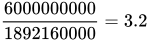
According to Wikipedia in 2007 about 134 million babies were born, which amounts to 4.2 babies per second. So our guesstimate was not so bad at all!
All the zeros in the numbers above can certainly cause some confusion, so using scientific format turns out to be much more convenient.

What is the bandwidth of a Boeing 747?[edit | edit source]
- Never underestimate the bandwidth of a station wagon full of tapes hurtling down the highway. —Tanenbaum, Andrew S.
Imagine we didn't have Internet and satellite communication, and the only way to transfer data between Europe and USA was to burn the data on DVDs, pack them on board of an airplane and ship them overseas. What would be the bandwidth of a 747 full of DVDs?
According to technical specs, the length of a 747 is 70m, and the internal diameter of the cabin is about 6 m. This gives a total usable volume of:

Assuming we have the DVDs in thin cases, with dimensions 12 cm × 12 cm × 0.5 cm, with a volume of:

the total number of DVDs that we could fit in the plane would be given by:

In terms of data this is 28 × 106 GB, or estimating the average flight duration about 7 hours, the data transfer rate is:

Now we have to stop for a moment, and think if the assumptions we did in this problem are realistic. One thing we did not take into account, is the weight of all the disks. Will the airplane be actually able to take off with all that weight. Let's check! Assuming that about 50% of the DVD case is empty space, and the density of the plastic comprising the DVD is comparable to the density of water, we estimate the total weight of the cargo to be about 240 tons. The empty airplane weighs 162 tons, while the maximum take-off weight is 333 tons. This gives maximum of 171 tons of useful cargo, or 70% of what we calculated we could pack inside. This new factor reduces the bandwidth of the plane down to 0.8 TB/s. This is about 4% of the bandwidth of a single strand optical fibre (20 TB/s). Added to this the 15 hour round trip of the plane (a 54000 second latency, about a million times what you expect on an ADSL connection), and the infrastructure required to read that information off the 747 and distribute it, this is probably not an effective way to communicate.
Unanswered Questions[edit | edit source]
- The mass of how many Ford Mustangs is equal to the mass of the water in the Atlantic Ocean?
- How many jelly beans fill a one-liter jar?
- What is the mass in kilograms of the student body in your school?
- How many golf balls will fit in a suitcase?
- How many gallons of gasoline are used by cars each year in the United States?
- How high would the stack reach if you piled on trillion dollar bills in a single stack?
- Approximately what fraction of the area of the continental United States is covered by automobiles?
- How many hairs are on your head?
- What is the weight of solid garbage thrown away by American families every year?
- If your life earnings were doled out to you at a certain rate per hour for every hour of your life, how much is your time worth?
- How many cells are there in the human body?
- How many individual frames of film are needed for a feature-length film? How long is such a film?
- How many water balloons will it take to fill the school gymnasium?
- How many flat toothpicks would fit on the surface of a sheet of poster board?
- How many hot dogs will be eaten at major league baseball games during a one year season?
- How many revolutions will a wheel on the bus make during a trip from Baton Rouge, LA to Washington, D.C.?
- How many minutes will be spent on the phone by students in the United States this year?
- How many pizzas will be ordered in your state this year?
More[edit | edit source]
A 2008 book on this subject is Guesstimation: Solving the World's Problems on the Back of a Cocktail Napkin from the Old Dominion University PHYS 309 course called: Physics on the Back of an Envelope.