Engineering Analysis/Probability Functions
Probability Density Function[edit | edit source]
The probability density function, or pdf of a random variable is the function defined by:
![{\displaystyle f_{X}(x)=P[X=x]}](https://wikimedia.org/api/rest_v1/media/math/render/svg/8b6b11c5622e67b9e3758ebd7560ec269042a038)
Remember here that X is the random variable, and x is a related variable (but is not random). The subscript X on denotes that this is the pdf for the X variable.

pdf's follow a few simple rules:
- The pdf is always non-negative.
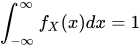
- The area under the pdf curve is 1.
Cumulative Distribution Function[edit | edit source]
The cumulative distribution function, (CDF), is also known as the Probability Distribution Function, (PDF). to reduce confusion with the pdf of a random variable, we will use the acronym CDF to denote this function. The CDF of a random variable is the function defined by:
![{\displaystyle F_{X}(x)=P[X\leq x]}](https://wikimedia.org/api/rest_v1/media/math/render/svg/2f00e5a8760e058d1ee0823961a1b99ead81dee1)
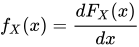
The CDF and the pdf of a random variable are related:
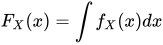
The CDF is the function corresponding to the probability that a given value x is less than the value of the random variable X. The CDF is a non-decreasing function, and is always non-negative.
Example: X between two bounds[edit | edit source]
To determine whether our random variable X lies between two bounds, [a, b], we can take the CDF functions:
![{\displaystyle P[a\leq X\leq b]=F_{X}(b)-F_{X}(a)}](https://wikimedia.org/api/rest_v1/media/math/render/svg/fe6d37620459089fbe199c9898e9b696bb226526)