Electronics/Inductors
Electronics | Foreword | Basic Electronics | Complex Electronics | Electricity | Machines | History of Electronics | Appendix | edit
Inductor[edit | edit source]
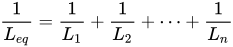
An inductor is a passive electronic component dependent on frequency used to store electric energy in the form of a magnetic field. An inductor has the symbol

Inductance[edit | edit source]
Inductance is the characteristic of the Inductor to generate a magnetic field for a given current. Inductance has a letter symbol L and measured in units of Henry (H).

This section list formulas for inductances in specific situations. Beware that some of the equations are in Imperial units.
The permeability of free space, μ0, is constant and is defined to be exactly equal to 4π×10-7 H m-1.
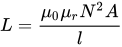
Basic inductance formula for a cylindrical coil[edit | edit source]
- L = inductance / H
- μr = relative permeability of core material
- N = number of turns
- A = area of cross-section of the coil / m2
- l = length of coil / m
The self-inductance of a straight, round wire in free space[edit | edit source]
![{\displaystyle L_{self}={\frac {\mu _{0}b}{2\pi }}\left[\ln \left({\frac {b}{a}}+{\sqrt {1+{\frac {b^{2}}{a^{2}}}}}\right)-{\sqrt {1+{\frac {a^{2}}{b^{2}}}}}+{\frac {a}{b}}+{\frac {\mu _{r}}{4}}\right]}](https://wikimedia.org/api/rest_v1/media/math/render/svg/1319287561f2f2913cd9042321f3f29db9db9106)
- Lself = self inductance / H(?)
- b = wire length /m
- a = wire radius /m
- = relative permeability of wire

If you make the assumption that b >> a and that the wire is nonmagnetic (), then this equation can be approximated to

- (for low frequencies)
![{\displaystyle L_{self}={\frac {\mu _{0}b}{2\pi }}\left[\ln \left({\frac {2b}{a}}\right)-3/4\right]}](https://wikimedia.org/api/rest_v1/media/math/render/svg/2c2e4c5b1ece0e0860737ee6415f2983fa3fd9a2)
- (for high frequencies due to the skin effect)
- L = inductance / H
- b = wire length / m
- a = wire radius / m
![{\displaystyle L_{self}={\frac {\mu _{0}b}{2\pi }}\left[\ln \left({\frac {2b}{a}}\right)-1\right]}](https://wikimedia.org/api/rest_v1/media/math/render/svg/051e38457b22f414774e223497e30bd9732f53f7)
The inductance of a straight wire is usually so small that it is neglected in most practical problems. If the problem deals with very high frequencies (f > 20 GHz), the calculation may become necessary. For the rest of this book, we will assume that this self-inductance is negligible.
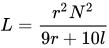
Inductance of a short air core cylindrical coil in terms of geometric parameters:[edit | edit source]
- L = inductance in μH
- r = outer radius of coil in inches
- l = length of coil in inches
- N = number of turns
- L = inductance in μH
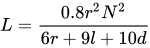
Multilayer air core coil[edit | edit source]
- L = inductance in μH
- r = mean radius of coil in inches
- l = physical length of coil winding in inches
- N = number of turns
- d = depth of coil in inches (i.e., outer radius minus inner radius)
- L = inductance in μH
Flat spiral air core coil[edit | edit source]
-
- L = inductance / H
- r = mean radius of coil / m
- N = number of turns
- d = depth of coil / m (i.e. outer radius minus inner radius)
- L = inductance / H
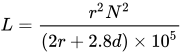
Hence a spiral coil with 8 turns at a mean radius of 25 mm and a depth of 10 mm would have an inductance of 5.13µH.
Winding around a toroidal core (circular cross-section)[edit | edit source]
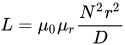
- L = inductance / H
- μr = relative permeability of core material
- N = number of turns
- r = radius of coil winding / m
- D = overall diameter of toroid / m
- L = inductance / H
Quality of good inductor[edit | edit source]
There are several important properties for an inductor that may need to be considered when choosing one for use in an electronic circuit. The following are the basic properties of a coil inductor. Other factors may be important for other kinds of inductor, but these are outside the scope of this article.
- Current carrying capacity is determined by wire thickness and resistivity.
- The quality factor, or Q-factor, describes the energy loss in an inductor due to imperfection in the manufacturing.
- The inductance of the coil is probably most important, as it is what makes the inductor useful. The inductance is the response of the inductor to a changing current.
The inductance is determined by several factors.
- Coil shape: short and squat is best
- Core material
- The number of turns in the coil. These must be in the same direction, or they will cancel out, and you will have a resistor.
- Coil diameter. The larger the diameter (core area) the larger the induction.
Coil's Characteristics[edit | edit source]
For a Coil that has the following dimension

- Area enclosed by each turn of the coil is A
- Length of the coil is 'l'
- Number of turns in the coil is N
- Permeability of the core is μ. μ is given by the permeability of free space, μ0 multiplied by a factor, the relative permeability, μr
- The current in the coil is 'i'

The magnetic flux density, B, inside the coil is given by:

We know that the flux linkage in the coil, λ, is given by;

Thus,

The flux linkage in an inductor is therefore proportional to the current, assuming that A, N, l and μ all stay constant. The constant of proportionality is given the name inductance (measured in Henries) and the symbol L:

Taking the derivative with respect to time, we get:
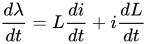
Since L is time-invariant in nearly all cases, we can write:

Now, Faraday's Law of Induction states that:
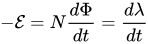
We call the electromotive force (emf) of the coil, and this is opposite to the voltage v across the inductor, giving:


This means that the voltage across an inductor is equal to the rate of change of the current in the inductor multiplied by a factor, the inductance. note that for a constant current, the voltage is zero, and for an instantaneous change in current, the voltage is infinite (or rather, undefined). This applies only to ideal inductors which do not exist in the real world.
This equation implies that
- The voltage across an inductor is proportional to the derivative of the current through the inductor.
- In inductors, voltage leads current.
- Inductors have a high resistance to high frequencies, and a low resistance to low frequencies. This property allows their use in filtering signals.
An inductor works by opposing current change. Whenever an electron is accelerated, some of the energy that goes into "pushing" that electron goes into the electron's kinetic energy, but much of that energy is stored in the magnetic field. Later when that or some other electron is decelerated (or accelerated the opposite direction), energy is pulled back out of the magnetic field.
Inductor and Direct Current Voltage (DC)[edit | edit source]
When a coil of several turns is connected to an electricity source in a closed loop, the current in the circuit induces a magnetic field that has the same properties as a Magnetic Field of a Magnet.

When the current is turned off, the Magnetic Field does not exist.

Conducting Coil is called ElectroMagnet
Inductor and Alternating Current Voltage (AC)[edit | edit source]
Inductor's Voltage[edit | edit source]
Inductor's Current[edit | edit source]
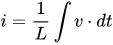
Reactance[edit | edit source]
- , where .


Impedance[edit | edit source]

Angle Difference Between Voltage and Current[edit | edit source]
For Lossless Inductor
- The angle difference between Voltage and Current is 90
For Lossy Inductor

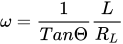
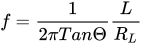
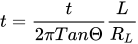
Changing the value of L and RL will change the value of Angle of Difference, Angular Frequency, Frequency and Time.
Time Constant[edit | edit source]

Quality factor[edit | edit source]
Quality factor denoted as Q is defined as the ability to store energy to the sum total of all energy losses within the component