


Electronics/Basic Concepts
What is Electronics?
[edit | edit source]Electronics is the study of flow of electrons in various materials or space subjected to various conditions. In the past, electronics dealt with the study of Vacuum Tubes or Thermionic valves, today it mainly deals with flow of electrons in semiconductors. However, despite these technological differences, the main focus of electronics remains the controlled flow of electrons through a medium. By controlling the flow of electrons, we can make them perform special tasks, such as power an induction motor or heat a resistive coil.
Plumbing Analogy: A simple way to understand electrical circuits is to think of them as pipes. Let's say you have a simple circuit with a voltage source and a resistor between the positive and negative terminals on the source. When the circuit is powered, electrons will move from the negative terminal, through the resistor, and into the positive terminal. The resistor is basically a path of conduction that resists the movement of electrons. This circuit could also be represented as a plumbing network. In the plumbing network, the resistor would be equivalent to a section of pipe, where the water is forced to move around several barriers to pass through, effectively slowing its flow. If the pipe is level, no water will flow in an organized fashion, since the pressure is equal throughout the pipe. However, if we tilt the pipe to a vertical position (similar to turning on a voltage source), a pressure difference is created (similar to a voltage difference) and the water begins flowing through the pipe. This flow of water is similar to the flow of electrons in a circuit.
Electricity
[edit | edit source]To understand electronics, you need to understand electricity and what it is. Basically, electricity is the flow of electrons due to a difference in electrical charge between two points. This difference in charge is created due to a difference in electron density. If you have a point where the electron density is higher than the electron density at another point, the electrons in the area of higher density will want to balance the charge by migrating towards the area with lower density. This migration is referred to as electrical current. Thus, flow in an electrical circuit is induced by putting more electrons on one side of the circuit than the other, forcing them to move through the circuit to balance the charge density.
Electric Charge
[edit | edit source]Observations tell us that matter can either be electrically neutral (that is, have no net charge), or carry a positive or negative charge. On a microscopic level, a negative charge corresponds to an excess of electrons in the material (which each carry a 'unit' of negative charge), and a positive charge a shortage of electrons. We denote the charge of an object by , which is measured in Coulombs.

Coulomb's Law
[edit | edit source]Two objects that have the same type of charge are known to repel, whereas objects with opposite charges attract. The force between charged objects is given by Coulomb's Law:
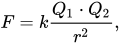
where and are the charges of the two objects (positive or negative), is the distance between them, and a universal constant.


Electric field
[edit | edit source]Suppose we have a fixed particle (or a collection of fixed particles), then we can calculate the force on any given (test) particle with charge by applying Coulomb's Law. There is a force at any point in space; we say that there is an electric field due to the (fixed) charges. The field at any point is equal to the net force on a charged particle divided by its charge, or:


Lorentz's Law
[edit | edit source]When a charge in motion passes through a magnetic field, the magnetic field will push a positive charge upward and negative charge downward in the direction perpendicular to the initial direction traveled. The magnitude of the magnetic force on the charge is given by Lorentz's Law:

Electromagnetic Force
[edit | edit source]The sum of the Coulomb and Lorentz's Forces is called the ElectroMagnetic Force:

Electricity and Matter
[edit | edit source]All matter interacts with Electricity, and are divided into three categories: Conductors, Semi Conductors, and Non Conductors.
- Matter that conducts Electricity easily. Metals like Zinc (Zn) and Copper (Cu) conduct electricity very easily. Therefore, they are used to make Conductors.
- Matter that does not conduct Electricity at all. Non-Metals like Wood and Rubber do not conduct electricity so easily. Therefore, they are used to make Non-Conductors.
- Matter that conducts electricity in a manner between that of Conductors and Non-Conductors. For example, Silicon (Si) and Germanium (Ge) conduct electricity better than non-conductors but worse than conductors. Therefore, they are used to make Semi Conductors.
Electricity and Conductors
[edit | edit source]Normally, all conductors have a zero net charge . If there is an electric force that exerts a pressure on the charges in the conductor to force charges to move in a straight line result in a stream of electric charge moving in a straight line
Voltage
[edit | edit source]- The pressure the electric force exert on the charges is called voltage denoted as V measured in Volt (V) and defined as the ratio of Work Done on Charge


Current
[edit | edit source]- The moving of straight lines of electric charges in the conductor is called current denoted as I measured in Ampere (A) and defined as Charge flow through an area in a unit of time

Conductance
[edit | edit source]- Conductance is defined as the ratio of current over voltage denoted as Y measured in mho
- or siemens (S)

Resistance
[edit | edit source]- Resistance is defined as the ratio of voltage over current denoted as R measured in Ohm

Generally, resistance of any conductor is found to increase with increasing temperature
For Conductor
- R = Ro(1 + nT)
For Semi Conductor
- R = Ro enT
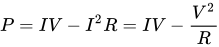
When a conductor conducts electricity, it dissipates heat energy into the surrounding . This results in a loss of electric energy transmitted. If the electric supply energy is PV and the electric loss energy is PR Then the electric energy delivered:
- P = PV - PR


Black Body Radiation
[edit | edit source]Further experience with conductors that conduct electricity . It is observed that all conductors that conduct electricity exhibit
- Change in Temperature
- Release Radiant Heat Energy into the surrounding
Experiment
[edit | edit source]Connect a conductor with an electric source in a closed loop . Plot the value I at different f to have a I - f diagram
Observation
[edit | edit source]for f<fo
- Current increasing with increasing f .
- Radiant heat is a wave travels at velocity v = λf carries energy E = m v2 .
for f=fo,
- Current stops increasing .
- Radiant heat is a wave travels at velocity v = c (speed of Light) carries energy E = hfo .
for f>fo,
- Current remains at the value of current at fo .
- Radiant heat is a wave travels at velocity v = c (speed of Light) carries energy E = h nfo
Conclusion
[edit | edit source]- All conductor that conducts Electricity has a threshold frequency fo
- The Radiant Heat Energy is a Light Wave of dual Wave Particle characteristic. Sometimes it behaves like Particle, sometimes it behaves like Wave
- At Frequency f > fo . The energy of the Light is quantized . it can only have the value of multiple integer of fo . E = hf = h nfo