Complex Analysis/Elementary Functions/Exponential Functions
Jump to navigation
Jump to search

Consider the real-valued exponential function defined by . It has the following properties:
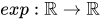

1)

2)

3)

We want to extend the exponential function to the complex numbers in such a way that

1)

2)

3)

But has been already defined for and we have .


