


Complex Analysis/Complex Numbers/Topology
As we have already seen the complex numbers are identified with the Euclidean Plane. So it is not surprising that much of what we know about the plane carries over to the complex numbers. In this section we will be specifically interested in topological properties of the complex plane. What are "topological properties"? In mathematics the term topology is used to describe certain geometric properties of spaces. Here we will mostly be concerned with ideas of open, closed, and connected. The notion of limits also falls under this section, because it is really a statement about the geometry of the complex plane to say two quantities are "close" or that one quantity "approaches" another.
We begin with the notion of a limit of a sequence of complex numbers.
We say that the limit of a sequence of complex numbers is if given there is a natural number so that if then


One difficulty with this notion of limit is that it requires us to know the limit ahead of time before we can decide if a sequence is convergent. To handle cases when we do not know the limit, an equivalent reformulation called the Cauchy criteria for convergence is stated below.
A sequence of complex numbers converges to some limit iff given there is a natural number so that if then

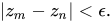
One direction of this equivalence is easy, but the other direction relies on the completeness of the Complex numbers. A topic we will defer until later.
Of course this is precisely the same as the definition for a limit of a sequence of points in . Of course, a first important application of the limit of a sequence is defining convergence for a series of numbers.

Given a series we define partial sum of order to be the sum . We shall say the infinite series converges to if .


Notice that when the Cauchy criteria is applied to infinite sums it takes the form: given there is an so that, if then .


To give a concrete example consider the series . For a fixed it can easily be seen that this series converges, and we shall denote the value it converges to by .


To show this we simply we "bootstrap" from what we know about the real numbers. Recall that, for the real number we know that the sum for converges. Applying the Cauchy criteria to we know there is an so that, if then . Now consider the series . For the determined above, lets examine for .


- .

And hence by the Cauchy criteria the sum converges.

Even more, we showed the series converges absolutely. Recall that for a series of real numbers, any possible reordering of the series converged to the same value. This theorem remains true for complex numbers. For us it will be very useful to examine the series for theta a real number.

In this case we have

Now using that and we can rewrite the series above as

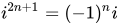

Finally if we rearrange the series to determine the real and imaginary parts we have that:

But now we notice by inspection that the series in the first set of parenthesis is exactly the Taylor series for and the series in the second parenthesis is exactly the Taylor series for . And so we we conclude:


- Euler's Formula

Thus we no longer need the name cis θ, we will instead simply use .
Advanced Topics
[edit | edit source]This section contains some more advanced topics that should perhaps be skipped on a first reading of this text.
Metric property
[edit | edit source]Define the metric as


It can easily be seen that satisfies positive definiteness, symmetry and the triangle inequality, implying that is a metric space.


Completeness
[edit | edit source]Recall that a metric space is said to be complete if every Cauchy sequence converges to a limit.
For any point , we call the open ball , consisting of all the points such that , a neighborhood of . Similarly, a set consisting of points z such that for a positive δ will be called a neighborhood of infinity. Given a set , we call the set open if every point in has a neighborhood completely contained in . Similarly, we call a set closed if its complement is open. A point is called an accumulation point of if every neighborhood of z contains a point in other than z itself. It can be shown that a set is closed if and only if it contains all of its accumulation points: see proof.


The Riemann Sphere
[edit | edit source]
An interesting idea related to the extension of the complex numbers is the construction of the Riemann Sphere. The Riemann Sphere, essentially a stereographic projection, is constructed by projecting the Complex plane onto the unit sphere about the point .

Formally, the rectangular coordinates of the projection can be given by the transformations


Or equivalently, the reverse transformation,

The Riemann sphere is this transformation, together with the point labeled as

It can also be shown that the stereographic projection preserves angles, and that circles and lines in the plane correspond to circles on the sphere: see proof.
In the metric |a-b| used earlier, the point z=∞ causes problems. However, using the stereographic projection, we can define another metric where the distance between two points a and b is the chordal distance
- ,
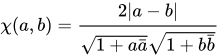
which has a well-defined meaning even when one of the points is ∞. We will only employ this metric when dealing with infinite values. For example, using this metric, neighborhoods of infinity do not require special treatment; we say that a neighborhood of a point is the set of all points z satisfying
- ,

where is allowed to be infinity.