Circuit Theory/Maximum Power Transfer
Maximum Power Transfer[edit | edit source]
Often we would like to transfer the most power from a source to a load placed across the terminals as possible. How can we determine the optimum resistance of the load for this to occur?
Let us consider a source modelled by a Thévenin equivalent (a Norton equivalent will lead to the same result, as the two are directly equivalent), with a load resistance, RL. The source resistance is Rs and the open circuit voltage of the source is vs:

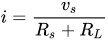
The current in this circuit is found using Ohm's Law:
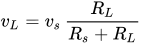
The voltage across the load resistor, vL, is found using the voltage divider rule:
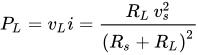
We can now find the power dissipated in the load, PL as follows:
We can now rewrite this to get rid of the RL on the top:
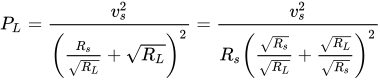
Assuming the source resistance is not changeable, then we obtain maximum power by minimising the bracketed part of the denominator in the above equation. It is an elementary mathematical result that is at a minimum when x=1. In this case, it is equal to 2. Therefore, the above expression is minimum under the following condition:


This leads to the condition that:

We will get maximum power out of the source if the load resistance is identical to the internal source resistance. This is the Maximum Power Transfer Theorem.
Efficiency[edit | edit source]
The efficiency, η of the circuit is the proportion of all the energy dissipated in the circuit that is dissipated in the load. We can immediately see that at maximum power transfer to the load, the efficiency is 0.5, as the source resistor has half the voltage across it. We can also see that efficiency will increase as the load resistance increases, even though the power transferred will fall.
The efficiency can be calculated using the following equation:
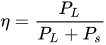
where Ps is the power in the source resistor. This can be found using a simple modification to the equation for PL:
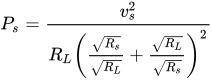
The graph below shows the power in the load (as a proportion of the maximum power, Pmax) and the efficiency for values of RL between 0 and 5 times Rs.

It is important to note that under conditions of maximum power transfer as much power is dissipated in the source as in the load. This is not a desirable condition if, for example, the source is the electricity supply system and the load is your electric heater. This would mean that the electricity supply company would be wasting half the power it generates. In this case, the generators, power lines, etc. are designed to give the lowest source resistance possible, giving high efficiency. The maximum power transfer condition is used in (usually high-frequency) communications systems where the source resistance can not be made low, the power levels are relatively low and it is paramount to get as much signal power as possible to the receiving end of the system (the load).