


Circuit Theory/Bode Plots
Bode Plots
[edit | edit source]Bode plots plot the transfer function. Since the transfer function is a complex number, both the magnitude and phase are plotted (in polar coordinates). The independent variable ω is swept through a range of values that center on the major defining feature such as time constant or resonant frequency. A magnitude plot has dB of the transfer function magnitude on the vertical axis. The phase plot typically has degrees on the vertical axis.


MatLab tr and bode
[edit | edit source]Example 1
[edit | edit source]Previously the transfer function was found to be:

MatLab has a short hand notation method for entering this information where the coefficients are listed (high power to low power)(numerator first, then denominator). For this example
f = tf([1],[1 2 1])
Leaving the colon off the end should display the transfer function. The next step is to plot it:
grid on
bode(f)
The result is a low pass filter. Rather than understand how to create these plots (not trivial), the goal is to interpret the plot .. (which is almost the same thing). But at this point, the goal is to exercise MatLab.
Example 2
[edit | edit source]Previously the transfer function was found to be:

f = tf([1000 0 5*10^9 0],[1 5*10^6 2.000015*10^12 3.5*10^13 5*10^13])
grid on
bode(f)
Magnitude Graph
[edit | edit source]Bode magnitude plots are dB which is both a measure of power and voltage and current simultaneously. The vertical dB axis is not an approximation or relative to anything. The vertical axis is an accurate number. The horizontal, dependent axis could be radians/sec or Hz.
Phase Graph
[edit | edit source]The Bode Phase Plot is a graph where the radial frequency is plotted along the X axis, and phase shift of the circuit at that frequency is plotted on the Y-axis. Axis could be in radians or degrees, frequency could be in radians per second or Hz.
Poles and Zeros
[edit | edit source]A transfer function has 7 features that can be realized in circuits. Before looking at these features, the terms pole, zero and origin need to be defined. Start with this definition of a transfer function:
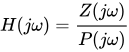
- Zeros are roots in the numerator.
- Poles are roots in the denominator.
- The origin is where s = jω = 0 (no real part in a Bode analysis). When the frequency is zero, the input is DC. This is where after a long time caps open and inductors short.
The 7 possible features in a transfer function are:
- A constant
- Zeros at the origin (s in the numerator)
- Poles at the origin (s in the denominator)
- Real Zero (an s+a factor in the numerator)
- Real Pole (an S+a factor in the denominator)
- Complex conjugate poles
- Complex conjugate zeros
The bode and bodeplot functions are available in the MatLab Control system toolbox. BodePlotGui does the same thing and is discussed here. BodePlotGui was developed at Swarthmore through an NSF grant. There is a summary of the Swathmore Bode Diagram tutorial.
Circuit simulation software can plot bode diagrams also.
Bode Equation Format
[edit | edit source]let us say that we have a generic transfer function with poles and zeros:
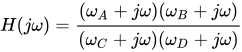
Each term, on top and bottom of the equation, is of the form . However, we can rearrange our numbers to look like the following:


Now, if we do this for every term in the equation, we get the following:
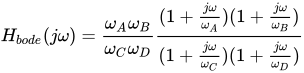
This is the format that we are calling "Bode Equations", although they are simply another way of writing an ordinary frequency response equation.
DC Gain
[edit | edit source]The constant term out front:

is called the "DC Gain" of the function. If we set , we can see that everything in the equation cancels out, and the value of H is simply our DC gain. DC then is simply the output when the input's frequency is zero.

Break Frequencies
[edit | edit source]in each term:

the quantity is called the "Break Frequency". When the radial frequency of the circuit equals a break frequency, that term becomes (1 + 1) = 2. When the radial frequency is much higher than the break frequency, the term becomes much greater than 1. When the radial Frequency is much smaller than the break frequency, the value of that term becomes approximately 1.

Approximations
[edit | edit source]Bode diagrams are constructed by drawing straight lines (on log paper) that approximations of what are really curves. Here is a more precise definition.
The term "much" is a synonym for "At least 10 times". "Much Greater" becomes "At least 10 times greater" and "Much less" becomes "At least 10 times less". We also use the symbol "<<" to mean "is much less than" and ">>" to mean "Is much greater than". Here are some examples:
- 1 << 10
- 10 << 1000
- 2 << 20 Right!
- 2 << 10 WRONG!
For a number of reasons, Electrical Engineers find it appropriate to approximate and round some values very heavily. For instance, manufacturing technology will never create electrical circuits that perfectly conform to mathematical calculations. When we combine this with the << and >> operators, we can come to some important conclusions that help us to simplify our work:
If A << B:
- A + B = B
- A - B = -B
- A / B = 0
All other mathematical operations need to be performed, but these 3 forms can be approximated away. This point will come important for later work on bode plots.
Using our knowledge of the Bode Equation form, the DC gain value, Decibels, and the "much greater, much less" inequalities, we can come up with a fast way to approximate a bode magnitude plot. Also, it is important to remember that these gain values are not constants, but rely instead on changing frequency values. Therefore, the gains that we find are all slopes of the bode plot. Our slope values all have units of "decibel per decade", or "db/decade", for short.
At Zero Radial Frequency
[edit | edit source]At zero radial frequency, the value of the bode plot is simply the DC gain value in decibels. Remember, bode plots have a log-10 magnitude Y-axis, so we need to convert our gain to decibels:

At a Break Point
[edit | edit source]We can notice that each given term changes its effect as the radial frequency goes from below the break point, to above the break point. Let's show an example:

Our breakpoint occurs at 5 radians per second. When our radial frequency is much less than the break point, we have the following:


When our radial frequency is equal to our break point we have the following:


And when our radial frequency is much higher (10 times) our break point we get:




However, we need to remember that some of our terms are "Poles" and some of them are "Zeros".
Zeros
[edit | edit source]Zeros have a positive effect on the magnitude plot. The contributions of a zero are all positive:
- Radial Frequency << Break Point
- 0db/decade gain.
- Radial Frequency = Break Point
- 3db/decade gain.
- Radial Frequency >> Break Point
- 20db/decade gain.
Poles
[edit | edit source]Poles have a negative effect on the magnitude plot. The contributions of the poles are as follows:
- Radial Frequency << Break Point
- 0db/decade gain.
- Radial Frequency = Break Point
- -3db/decade gain.
- Radial Frequency >> Break Point
- -20db/decade gain.
Conclusions
[edit | edit source]To draw a bode plot effectively, follow these simple steps:
- Put the frequency response equation into bode equation form.
- identify the DC gain value, and mark this as a horizontal line coming in from the far left (where the radial frequency conceptually is zero).
- At every "zero" break point, increase the slope of the line upwards by 20db/decade.
- At every "pole" break point, decrease the slope of the line downwards by 20db/decade.
- at every breakpoint, note that the "actual value" is 3db off from the value graphed.
And then you are done!
Courtesy of UCB