


Circuit Idea/Revealing the Mystery of Negative Impedance

Circuit idea: Injecting energy into circuits in the same manner as the respective "positive" impedance elements absorb it
True negative impedance... what is it?[nb 1] Is it possible? Does it violate natural laws? Does it exist at all? If so, how do we make it? What is the use of the true negative impedance? What is the difference and what is the common between the true and differential negative resistance? You will find answers to all these questions in this exciting circuit story about the mystic phenomenon...
The true negative resistance is closely related to the differential negative resistance. To see the close connection between them, a lot of reciprocal links are placed inside the two stories.


How to inject energy into circuits
[edit | edit source]Essence. There is absolutely no mystery about the true (absolute) negative impedance! It is just a property of some (really, quite odd and exotic but still understandable) one-port electronic circuits to inject a portion of energy into circuits to which they are connected in the same manner as the corresponding "positive" elements (resistors, capacitors or inductors) absorb energy. Thus, from energetic viewpoint, these negative resistors, capacitors and inductors act as a kind of inverted "positive" resistors, capacitors or inductors. They do this "magic" either by producing voltage that depends on the current passing through them or by producing current depending on the voltage applied across them; the first are qualified as current controlled (S-shaped) and the second – as voltage controlled (N-shaped) negative impedance elements. So they actually are dynamic electrical sources...

Special case. The true negative resistor configuration is the most popular negative impedance circuit. It produces voltage/current that is proportional to the current/voltage through/across itself according to Ohm's law (there are also negative non-linear resistors, e.g. "negative diodes", that do not obey Ohm's law). On the graphical representation (e.g., Fig. 10 below), the IV curve of the absolute negative resistor has a negative slope in the negative resistance region and passes through the origin of the coordinate system as the voltage and the current have opposite signs for every operating point along the curve. As a result, the ratio R = V/I < 0 (the resistance R is negative).
Basic applications. The amazing feature of negative impedance is to neutralize the equivalent "positive" impedance: connecting a current-driven negative impedance element in series witn the equivalent "positive" impedance element gives zero total impedance (Fig. 1); connecting a voltage-driven negative impedance element in parallel to the equivalent positive impedance element (Fig. 20) gives infinite total impedance. Because of these remarkable properties current-driven negative impedance elements are used in circuitry (e.g., in telephony line repeaters) to zero the line resistance, internal voltage source resistance and load resistance. Voltage-driven negative impedance elements are used in such excentric circuits as Howland current source, Deboo integrator, load and stray capacitance cancellers to increase up to infinity the internal current source and load impedance. Actually, true negative resistors are one-port amplifiers that can be connected in series or in parallel to the load. They add additional energy to the energy of the input source; so, true negative resistors help the input source while conventional two-port amlifiers replace the input source.
Relations. Although the term negative resistance is frequently used to encompass negative differential resistance as well, the two phenomena are quite different. A true negative resistor is not a resistor; it is actually a dynamic electrical source while a negative differential resistor is a dynamic positive resistor. It cannot be used independently; it may be used in combination with an electrical source to build a true negative resistor.
Negative versus "positive" impedance
[edit | edit source]Negative resistance is the most elementary and comprehensible negative impedance manifestation. We can reveal its nature below by comparing an ordinary "positive" resistor having resistance R with a true negative resistor having the same resistance -R. For this purpose, two pairs of equivalent electrical circuits are used,[1] in which the resistors are connected in series with the loads so that the same current passes through them or in parallel to the loads so that the same voltage is applied across them.
What the "positive" impedance is
[edit | edit source]In electrical circuits, passive elements (resistors, capacitors and inductors) impede current by their inherent resistance, capacitance and inductance (more generally, impedance). As a result, voltage drops appear across passive elements that represent the energy losses in them. Passive elements absorb this energy from the exciting electrical source: resistors dissipate energy from themselves to outside environment while capacitors and inductors accumulate energy into themselves. From the negative impedance viewpoint it is not important if passive elements dissipate or accumulate energy; it is only important that they absorb energy.
Series-connected "positive" impedance elements
[edit | edit source]

Electrical elements may be connected in series, parallel or mixed. For example, if a resistor R is connected in series with a load (Fig. 2a), voltage drop VR = R.I that is proportional to the current appears across the resistor. When capacitors or inductors are placed at this place, voltage drops changing through time in the corresponding manner appear across these elements.
The graphic-analytical interpretation on Fig. 2b visualizes the "positive" resistor operation by using superimposed IV curves. It is supposed the resistor is supplied by a real current source (its IV curve is green colored). When the input current varies, the crossing operating point slides over an IV curve (orange) representing the positive resistance. It is a real, static, immovable IV curve having a positive slope and passing through the origin of the coordinate system.
Parallel-connected "positive" impedance elements
[edit | edit source]

Conversely, if the resistor R is connected in parallel with the load (Fig. 3a), current IR = VL/R, that is proportional to the voltage, flows through the resistor. When capacitors or inductors are placed there, currents changing through time in the corresponding manner flow through them.
The graphic-analytical interpretation of this kind of "positive" resistance phenomenon is shown on Fig. 3b. Now it is supposed the resistor is supplied by a real voltage source (its IV curve is red colored). When the input voltage varies, the crossing operating point slides over an IV curve (orange) representing the positive resistance. It is again a real, static, immovable IV curve having a positive slope and passing through the origin of the coordinate system.
What the true negative impedance is
[edit | edit source]Elements with true negative impedance do the opposite – they inject energy into electrical circuits. Whereas passive elements with positive impedance absorb energy from the input source (they are loads), elements with negative impedance add energy to the input source (they are sources). While voltage drops appear across positive elements, negative elements produce voltage; while positive elements sink current, negative elements produce current. However, they are not ordinary varying (dependent) electrical sources. They are special sources – a kind of "self-varying", dynamic, "self-dependent" sources (voltage sources whose voltage across them depends on the current through them or current sources whose current depends on the voltage across them). Besides, the relation between the voltage and the current is as in the corresponding passive resistors, capacitors or inductors – linear, nonlinear or time-dependent.
Current-driven negative impedance elements
[edit | edit source]In Fig. 4a a negative resistor NR with a resistance of -R is connected in series with the load so that voltage VNR = R.I that is proportional to the current appears across the negative resistor. However, while above the "positive" resistor detracts the voltage VR from the input voltage (there VR is a voltage drop), here the negative resistor adds voltage VNR to the input voltage (here VNR is a voltage). The element named "resistor" is really a resistor while the "negative resistor" here is actually a voltage source, whose voltage is proportional to the current passing through it; the resistor is a current-to-voltage drop converter while the negative resistor is a one-port current-to-voltage converter. If negative capacitors or inductors are placed at this place, they produce voltages changing through time.

A negative resistor can be implemented as a self-varying (dynamic) voltage source, whose voltage is proportional to the current passing through it; this two-terminal current-controlled voltage source acts as a current-driven negative resistor. Negative impedance elements can be implemented as dynamic voltage sources, whose voltage depends on the current in the same manner as the voltage drop across the corresponding passive elements (resistors, capacitors or inductors) depends on the current passing through them.
A graphic-analytical interpretation of this kind of negative resistance phenomenon is shown on Fig. 4b. It illustrates the operation of an S-shaped true negative resistor in the middle part of its IV curve (in blue). In this region, the IV curve has a negative slope and passes through the origin of the coordinate system. The green line represents the IV curve of the input real current source and the red line represents the IV curve of the internal dynamic voltage source. The multitude of lines gives an impression of line movement (animation). It is supposed the negative resistor is driven by a real current source. When the input current varies, its green IV curve moves vertically remaining parallel to itself. The internal voltage source representing the negative "resistor" changes proportionally its voltage. Its IV curve (red colored) moves horizontally and the intersection (operating) point slides over a new dynamic IV curve (blue colored) representing the negative resistance. Note it is not a real IV curve; it is an artificial, imaginary IV curve having a negative slope and passing through the origin of the coordinate system. It lies completely in 2nd and 4th quadrants.
Voltage-driven negative impedance elements
[edit | edit source]Dually, when the negative resistor is connected in parallel to the load (Fig. 5a), current INR = VL/R that is proportional to the voltage drop across the load flows through the negative resistor. However, while above the positive resistor sinks a current from the input current (diverts it from the load current), here the negative resistor adds the same current to the input current (injects additional current into the load). If negative capacitors or inductors are placed there, they inject currents changing through time.

A negative resistor can be implemented also as a varying (dynamic) current source, whose current is proportional to the voltage across it; this two-terminal voltage-controlled current source acts as a voltage-driven negative resistor. Negative impedance elements can be implemented as dynamic current sources, whose current depends on the voltage in the same manner as the current passing through the corresponding passive elements (resistors, capacitors or inductors) depends on the voltage drop across them.
The graphic-analytical interpretation of this kind of negative resistance phenomenon is shown on Fig. 5b. Now it is supposed the negative resistor is driven by a real voltage source. When the input voltage varies, the current source representing the negative "resistor" changes proportionally its current. As a result, its IV curve (green colored) moves and the crossing operating point slides over a new dynamic IV curve (blue colored) representing another kind of negative resistance. Note it is not a real IV curve; it is an artificial, imaginary IV curve having a negative slope and passing through the origin of the coordinate system.
How negative impedance elements interact with input sources
[edit | edit source]True negative resistors act as supplemental sources that "overhelp" the basic input sources: current-driven negative resistors are voltage sources "overhelping" the input voltage source to pass bigger current through the load; voltage-driven negative resistors are current sources "overhelping" the input current source to create higher voltage across the load. Figuratively speaking, the input source has the illusion:) that only it determines the current/voltage through/across the load; but actually, both the sources determine these atrtributes (the output quantity depends on two input quantities).
It is interesting fact that as long as the input quantity is zero, the "helping" quantity is zero as well. So, a negative resistor begins operating after the input quantity appears.
How to create negative impedance (compare with NDR)
[edit | edit source]We have already convinced that true negative impedance elements are amazing and extremely useful. Unfortunately, they do not exist in nature; there are only ordinary passive elements with "positive" impedance (resistors, capacitors, inductors and memristors). Then how do we create them?
The idea is simple but powerful – we can make negative impedance by inverting some initial positive impedance. Thus the original positive elements will serve as shaping elements for creating "mirror" negative elements. But how do we invert the positive impedance? In the simplest case, how do we invert the positive resistance?
The answer is simple if only we know the Ohm's law:) It presents the resistance as a ratio between the voltage and the current (R = V/I); so when the two variables are positive, the resistance is positive as well. To make negative resistance, we have to invert one of them – the voltage or the current:
Inverting the voltage polarity. In the case of the S-shaped negative resistance RS, we invert the voltage (RS = -V/I = -R). This means that if we pass current through the S-shaped negative resistor, the input terminal becomes negative (instead positive as in the case of the ordinary "positive" resistor). That is why, circuits implementing this technique are named voltage-inversion negative impedance converters (VNIC). Note the power is also inverted (PS = -V.I = -P).
Reversing the current direction. In the case of the N-shaped negative resistance RN, we invert the current (RN = V/-I = -R). This means that if we apply positive voltage across the N-shaped negative resistor, the current goes out of the negative resistor and enters the positive terminal of the voltage source (instead to leave the positive terminal of the voltage source and to enter the negative resistor as in the case of the ordinary "positive" resistor). That is why, circuits implementing this technique are named current-inversion negative impedance converters (INIC). Note the power is also inverted (PN = V.-I = -P).
Now, we have only to answer the questions, "How do we invert the voltage?" and "How do we invert the current?" To do that, we need more than Ohm's law...
How to show the secret of the true negative resistance
[edit | edit source]We already know that the truth about circuit phenomena is hidden rather in the movement from simple to complex circuits (in the circuit evolution) than in the final perfect circuit solutions. So, the best way to reveal the NR phenomenon is to show the metamorphosis of the true negative resistor from the ordinary ohmic resistor to the sophisticated negative one, to show the evolution of the bare ohmic resistance... According to this idea, we can first reveal the secret of S-shaped true negative resistors by following the succession of typical resistances in the order high ohmic > decreased > zeroed > S-negative. Then we can reveal the secret of the dual N-shaped true negative resistors by a similar succession of other typical resistances – low ohmic > increased > infinite > N-negative. To visualize the resistor evolution, we will gradually draw the particular segments of the seesaw NR IV curves and will explain how they are obtained. Note they are straight lines although the whole IV curves represent nonlinear resistances. Let's do it!
An S-shaped negative resistor (compare with S-shaped NDR)
[edit | edit source](aka current-controlled negative resistor)
Looking for the basic S-shaped NR idea
[edit | edit source]We can find the solution in many situations (some of them quite funny and even confusing) extracted from our routine.
Money analogy. For example, think of people as of "resistors" – some of them are consumers spending money (acting as "positive resistors":) while other are producers earning money (acting as "negative resistors":) And to make the situation more concrete and jocular, assume that women spend while men earn money (if you prefer, you may swap the roles:) A funny example is a woman spending some money (e.g., $1000 monthly) and the problem is how to make her begin gaining the same money ($1000) instead. The straight solution – to decrease the drain, is hard and unpleasant... but the woman quickly finds out a "lateral" solution – she just puts in touch with a man earning money:) Thus the new community (but we think the woman) begins spending less, zero or even gaining money. The trick is that we do not see the man (he keeps in the background and only works hard:); we see, as before, only the woman and we think that she has changed from a consumer to a producer:) But this is just an illusion since she continues spending the same money as before...[nb 2][nb 3]
Water analogy. Another example can be the classical water circuit analogy where a constriction and an input flow pump are connected in series in a closed loop of pipe. In this arrangement, I put (unnoticeably for you) on the same direction another "helping" pressure pump and change pressure when you vary the flow of the input pump. Thus I can give an impression of decreased, zeroed and even inverted water impediment.
More analogies. There are many other similar situations in our routine where we mix two opposite things (quantities) in various proportions: acid and alkali, hot and cold water, pressure and vacuum, bitter and sweet, goodness and wickedness, etc., and the result varies depending from the proportion. So, the general idea is:
A setup for emulating an S-shaped negative resistor
[edit | edit source]We know that the best way to see how such weird electronic devices do this magic (inverting the resistance what particularly means inverting either the voltage or current) is to place ourselves in their place and begin performing their functions, to emulate their behavior by an empathy (we have already used this technique in negative differential resistance). Then how do we emulate a true negative resistor? Following the general idea above, we have just to connect a variable voltage source (the man:) in series to a constant resistor R (the woman:) to obtain the emulating setup in Fig. 6. And to match the resistor with the woman:), choose R = 1000 Ω. Well, let's do it as a funny game: you will control the input current source; I will control the voltage source (you are the source, I am the negative load:) Thus I, the voltage source and the resistor combine to form a "man-controlled" S-shaped true negative resistor and you drive it with current.[nb 4]

We can present graphically the circuit operation of this simple electrical circuit (the circuit KVL equation VA = VH – IA.R) if we consider that the voltage across the two elements (the input current source and the "negative resistor") is the same and the current flowing through them is the same as well. For this purpose, we have to superimpose their IV curves on the same coordinate system: the IV curve of the "negative resistor" consisting of the "helping" voltage source and the resistor (the community:) is an inclined line with a slope depending on the resistance; the IV curve of the input current source is a horisontal line vertically shifted from the X-axis. The intersection point A (alias operating point) represents the instant magnitudes of the current IA and the voltage VA. When the input current increases (changes from the most negative to the most positive value), the IV curve of the input current source moves up; the operating point moves up from point 0 to point 7 along the S-shaped IV curve below and gradually draws the curve. To help the understanding of the operation, we will draw step-by-step the particular segments of the IV curve and will explain how they are obtained. A light-grey colored guide line will direct us during our "excursion" showing the trajectory of the operating point...
Now connect a voltmeter across the input current source and an ammeter in series with it to monitor the voltage and the current. Are you ready? Let's start the "game"!
A setup for emulating an N-shaped true negative resistor (below)
A setup for emulating an S-shaped negative differential resistor
How do we make decreased, zero and negative resistance: Starting point)
How to investigate the linear mode of VNIC
High positive resistance
[edit | edit source]In the beginning, the woman from our funny example is alone and continuously spends money (in the simple case, $1000 monthly)... In routine, when applying some kind of "flow" and experiencing a constant high impediment, the obtained "pressure" is proportional to our efforts. For example, in the water analogy I have initially set zero pressure of the "helping" pump (or I have not still connected it). So, when you increase the input flow, the water pressure begins increasing proportionally (a hydraulic manifestation of the Ohm's law).

According to these life situations, I set the maximum positive voltage VH and keep it constant while you begin increasing (in the sense that you make it more positive[nb 5]) continuously the input current IIN. As a result, voltage drop VR appears across the resistor R. According to Ohm's law, it is proportional to the current passing through the resistor – VR = R.IIN. The difference VH – VR (negative) appears across the whole element (the future "negative resistor"). Note this voltage depends only on the input current and the Ohm's law equation is a function of one variable.
On the graphical representation (fig. 7), when you vary the current IIN of the input current source, its (your) IV curve moves vertically remaining parallel to itself (i.e., it translates). As a result, the operating point A slides over the IV curve of the ohmic resistor R from point 0 to point 1 that is a straight line. The slope of the R IV curve represents graphically the value of the ohmic resistance R. This is a real, static, ohmic, "positive" resistance... But why the IV curve does not pass through the coordinate origin?
The reason is that the IV curve is symmetrically located toward the coordinate origin and we begin moving along the curve from point 0. Actually, in the section 0-1, we investigate not only the bare resistor R but a network consisting of two connected in series components – the resistor R and the voltage source VH.[nb 6] But the voltage source is static (constant) in this region and it does not affect the whole network resistance. This introduces some (inessential for understanding) difference between the operation of the electrical circuit and the funny analogy.
N-shaped true negative resistor: Section 0-1 (low positive resistance) (below)
S-shaped negative differential resistor: Section 0-1 (high ohmic resistance)
How do we make decreased, zero and negative resistance: Investigating the ordinary resistance
Voltage inversion NIC: Section 0-2 (bottom positive resistance region)
Virtually decreased resistance
[edit | edit source]Then our problem in the funny situation becomes how to make the woman begin spending less money (for concreteness, $500). And she successfully solves the problem putting in touch with a man that earns less money ($500) than she spends ($1000). Thus the woman is moderately helped by the man and we think she begins spending less money ($1000 - $500 = $500). But this is an illusion since she continues spending the same $1000 as before and we are misled because we do not see the moderately working man...

There are many other situations in our life where while we implement our purposes someone begins (inconspicuously) helping us. As a result, we have the illusion that the opposition has decreased so the "flow" increases. In our water analogy, when you increase the input flow, the pressure drop across the constriction proportionally increases but, at the same time, I begin increasing the pressure of the helping pump. As a result, the water flow begins more quickly increasing and you have the feeling that the water resistance is decreased. But this is an illusion since you do not see my helping pump...
Let's now apply this clever trick to decrease virtually the resistance R in such an exotic way. Imagine when you reach the point 1 (fig. 8), I decide to help you along the whole section 1-2. When you increase the current IIN of the input source from point 1 to point 2, its IV curve translates upward. But, at the same time, I begin moderately decreasing the voltage VH (and its magnitude) thus helping you to increase the current (to decrease its magnitude). The composed VH-R IV curve moves to the left remaining parallel to itself (translates). As a result, the operating point A slides along a new more vertical IV curve, which represents the new virtual resistance dR1 < R.
Actually, the voltage across the "negative resistor" depends both on the current IIN and the voltage VH and the Ohm's law equation becomes a function of two variables – VOUT = f(IIN, VH). You have the illusion that the resistance R has decreased and you see new, lower dynamic resistance dR1 < R; thus the initial ohmic resistance R is converted into a smaller virtual resistance dR1. Note the segment 1-2 is a straight line and it resembles ordinary ohmic resistance. Looking only at this part of the curve, you may think that you investigate an ohmic resistor... but this is just an illusion...
The virtually decreased resistance can be observed in circuits with imperfect parallel negative feedback implemented by an imperfect inverting amplifier with finite gain (usually realized by discrete transistors): transimpedance amplifier, inverting amplifier, etc.
N-shaped true negative resistor: Section 1-2 (virtually increased resistance) (below)
S-shaped negative differential resistor: Section 1-2 (virtually decreased resistance)
How do we make decreased, zero and negative resistance: Varying the voltage slightly
Miller theorem: Obtaining decreased impedance
Virtually zeroed resistance
[edit | edit source]Inspired by the power of the clever "female technique":), we decide to go more far and to make the woman spend... no money ($0). As a reaction, she puts in touch with a man earning so much money ($1000) as she spends ($1000). Thus the woman is exactly helped by the man and we think she spends nothing ($1000 - $1000 = $0). But this is an illusion again since she continues spending the same $1000 as before... and we are misled once more because we do not see the hard working man...
There are many worldly situations where the dynamizing idea above is enforced so that our helper increases (again, inconspicuously for us) his/her help to such extent that we do not experience any impediment when implementing our purposes. The result is amazing: we have the illusion that the opposition has dissapeared and we realize our purposes without any efforts! For example, in the water analogy, you continue increasing the input flow so that the pressure drop across the impediment proportionally increases but I begin increasing the pressure of the "helping" pump with the same rate of change (i.e., the pressure drop and the "helping" pressure change with the same rate). As a result, the water pressure seen by you stays constant and you have the feeling that there is no any impediment...

As this idea is so wonderful, let's apply it to zero virtually the resistance R in such a marvellous manner. Now imagine when you reach the point 2 (fig. 9), I decide to help exactly you along the whole section 2-3. You continue increasing (make more positive) the current IIN of the input source from point 2 to point 3 so that its IV curve continues translating up. But now I begin vigorously decreasing the voltage VH so the composed VH-R IV curve quckly moves (translates) to the left. As a result, the operating point A slides along a new vertical IV curve, which represents the new zero virtual resistance dR2 = 0 and you have the illusion the resistance R has become zero...
This great virtual ground idea may be observed in all kinds inverting op-amp circuits with perfect parallel negative feedback: transimpedance amplifier, active ammeter, inverting amplifier, etc. In all these circuits, the op-amp acts as the compensating voltage source VH – it adds so much voltage to the input voltage as it loses across the resistor connected between the op-amp output and the inverting input. The compensating voltage serves as output voltage supplying the load.
N-shaped true negative resistor: Section 2-3 (virtual infinite resistance) (below)
S-shaped negative differential resistor: Section 2-3 (virtually zeroed resistance)
How do we make decreased, zero and negative resistance: Varying the voltage exactly
Miller theorem: Obtaining zeroed impedance
How do we create a virtual ground? reveals the secret of the great circuit phenomenon
How I revealed the secret of parallel negative feedback circuits
Op-amp circuit builder is an animated Flash tutorial about building virtual ground circuits
Reinventing the transimpedance amplifier
How do we build an op-amp ammeter? converts the imperfect ammeter into an almost ideal one
Op-amp inverting summer is an animated Flash tutorial about the famous op-amp summing circuit
What is the idea behind the op-amp inverting current source?
How do we build an op-amp RC integrator? shows the evolution of the humble RC integrating circuit
"Inverted positive" (S-shaped negative) resistance
[edit | edit source]Finally, fascinated by the unlimited potentialities of the woman's ingenuity:), we go extremely far and dicide to make the woman earn money ($1000) instead spend them?!? Incredible but true – she takes up the challenge and, in responce to our provocation, she puts in touch with a man earning two times more money ($2000) as she spends ($1000). Thus the woman is overhelped by the man and we think she earns money ($2000 - $1000 = $1000) instead to spend them. As though the woman is "inverted"; she is transmuted into a man:)[nb 3] But this is our biggest illusion since she, as usual, continues spending the same $1000... and we are cruelly deceived for the last time because we do not see the extremely hard working man...

In the water analogy, you continue increasing the input flow. But I extremely increase the pressure of my "helping" pump so that the water pressure seen by you not only decreases and becomes zero but imagine it even reverses its sign (you see vacuum instead pressure)! In the same way, we can convert a bad man/woman into a good one by making two times bigger goodness than his/her wickedness, 1 liter acid into 1 liter alkali by adding 2 liters alkali, 1 atm. vacuum into 1 atm. pressure by adding 2 atm. pressure, etc. In all these life situations, the dynamizing idea is enormously reinforced so that our helper goes too far increasing many times more his/her help than needed and the result is very, very surprising. So, the general idea is:
Eureka! This is what we needed to transform the positive into negative resistance – to convert the "bad" voltage drop across the positive resistor R into a "good" voltage by adding two times higher voltage![nb 7] Then let's put this fairy idea in practice to "invert" the resistance R! The recipe is clear – when you reach the point 3 (fig. 10), I begin overhelping you along the whole section 3-4. As usual, you are continuously increasing (make more positive) the current IIN of the input source from point 3 to point 4 so that its IV curve is translating up remaining parallel to itself. Following the recipe, I am extremely vigorously decreasing[nb 8] the voltage VH so the composed VH-R IV curve extremely quckly is translating to the left. As a result, the operating point A slides up along the new IV curve of the inverted positive resistance that is inclined (folded up) to the left and has a negative slope. You have the illusion the resistance R has become true negative resistance dR3 < 0.
This idea is directly implemented in voltage-inversion negative impedance converters (VNIC).
N-shaped true negative resistor: Section 3-4 ("inverted positive", i.e. negative, resistance) (below)
S-shaped negative differential resistor: Section 3-4 ("decreasing" negative differential resistance)
How do we make decreased, zero and negative resistance: Varying the voltage considerably
Miller theorem: Obtaining negative impedance by inversion the voltage
Voltage inversion NIC: Section 2-4 (middle negative resistance region)
How to compensate resistive losses by series connected negative resistors: Making a negative resistor
Understanding negative impedance converters with voltage inversion
After the S-shaped NR region
[edit | edit source]
Unfortunately, there are no unlimited things in this world:( The woman from our funny situation ruthlessly continues increasing her expenses and, at a given moment, the man is so exhausted that he cannot overcompensate the woman's drain anymore. He slows down the rate of working and begins first exactly, then – moderately and finally – stop compensating the woman's expenses (but the woman does not stop increasing the drain:)...
Let's implement this situation in our emulating setup. As usual, you continue increasing (make more positive) the current IIN of the input source from point 4 to point 7 (fig. 11) so that its IV curve is translating up. At point 4, I have already exhausted a great part of the initial voltage and, mimicking the man's behavior, I begin slowing the rate of change along the segment 4-5. The composed VH-R IV curve is quckly translating to the left. As a result, the operating point A slides along the vertical segment 4-5 of the IV curve, which represents virtually zeroed resistance. Then, at point 5, I slow more down the rate of the voltage change. The VH-R IV curve translates slower and the operating point A slides along the inclined segment 5-6 (virtually decreased resistance). Finally, along the segment 6-7, I stop voltage changing. The VH-R IV curve stops moving and the operating point A slides along the final segment 6-7 (ohmic resistance).
Let's finally see how we have formed the S shape of the whole IV curve. In the beginning, we took the humble linear IV curve of the ohmic resistance R. Then, in a sertain region, we bent counterclockwise the curve by adding "helping" voltage to the input voltage. When the voltage stops changing, the curve folds up clockwise thus resembling the letter "S". The conclusion is:
The S-shaped true negative resistance IV curve is a modified linear IV curve of high ohmic resistance.
N-shaped true negative resistor: Section 4-7 (after the N-shaped NR region) (below)
S-shaped negative differential resistor: Sections 4-7 (after the S-shaped NDR region)
Voltage inversion NIC: Section 4-6 (top positive resistance region)
Compensating resistive losses by S-shaped negative resistors
[edit | edit source]The problem
[edit | edit source]
Internal resistance. Real voltage sources have some internal resistance (Ri in Fig. 12). So, when we connect a load RL, the current flows through the internal resistance and creates the voltage drop VRi = I.Ri across it. This voltage drop is undesired as it subtracts from the input voltage and, as a result, the voltage applied to the load is less than the input voltage. So, the problem is to remove (to zero) the undesired internal resistance.
The classical solution is to buffer the imperfect voltage source by a powerful voltage follower (i.e., to replace the "original" input source by a "copy" source supplied by its own power supply). More original and clever would be to compensate somehow the source's internal resistance. But how do we do this magic? What do we place between the input source and the load?
Probably, we would want to do it by applying the ubiquitous virtual ground configuration (a transimpedance amplifier). But it is impossible to connect the op-amp "sense" (the inverting input) to the left side of the internal resistance since it is distributed inside the source; it is not represented by a separate component. Then we arrive at this so strange, exotic and paradoxical idea to compensate the internal resistance by equivalent negative resistance.
Line resistance. Another similar problem appears if we move the load away from the source. Since the line has some resistance, it adds to the internal source resistance and, as a result, the voltage across the load droops even more. In this case the virtual ground configuration is possible but it is inconvinient to stretch an additional third wire.
How to compensate resistive losses by series connected negative resistors: Step 2
The basic idea of the series NR compensation
[edit | edit source]It's time to put in practice all the wisdom about the true negative resistance extracted from the routine. For this purpose, we have just to incorporate the emulating arrangement above into the circuit. Let's do it!

As the internal "positive" resistance Ri is not accessible (or the line is too long to stretch a third "sensing" line), we apply another clever trick. We place in series to the "original" resistor Ri another "positive" resistor R (the woman:) with equivalent resistance serving as a duplicate of the unaccessible "resistor" Ri or Rl. Since the current passing through the two series connected resistors is the same and they have equal resistances, the voltage drops across them are also equal. Thus we have successfully copied the voltage drop VRi across the our resistor R and now we have only to overcompensate it (to invert the resistor R). Following the voman's strategy:), we connect in series an "overhelping" voltage source (the man:) adding twice as much voltage VH = 2VRi.[nb 9] A half of this voltage compensates the voltage drop across the duplicate resistor R; the rest half (VRi – 2VRi) appears across the whole "negative resistor" as inverse voltage -VRi. It compensates the voltage drop across the source internal resistance Ri (in other words, the negative resistance R = -Ri of the whole element neutralizes the positive internal resistance Ri). As a result, only the load resistance RL remains in the circuit and the whole input voltage is applied to the load (VL = VIN).
How to compensate resistive losses by series connected negative resistors: Step 4
Building a true S-shaped NR (voltage-inversion NIC)
[edit | edit source]
To transmute the emulated S-shaped true negative resistor into a real electronic circuit, we have only to realize somehow the "helping" voltage source VH. An amplifier with a fixed gain of two will do this donkey work if only we connect its input in parallel and its output in series to the resistor R. It will amplify two times the voltage drop VH across the resistor R and will add the amplified voltage to it. But this solution would match more with Armstrong's times; now we prefer to make an op-amp with giant gain amplify two times (Fig. 14). How do we do it?
We may borrow the idea from the well-known circuit of a transimpedance amplifier where the op-amp keeps its output voltage equal to the voltage drop across the resistor. For our purposes here, we may trick the op-amp by connecting a voltage divider (composed by two equal resistors R) between the op-amp output and the non-iverting[check spelling] input. As a result, the op-amp will produce two times higher voltage... what was our purpose. A half of this voltage compensates the voltage drop across the duplicate resistor R (below the op-amp); the rest half appears across the circuit terminals as inverse voltage -VRi. So, we may think of this circuit as of an overacting transimpedance amplifier.
The "invented" circuit as though inverts the initial voltage drop across the resistor Ri (the mental reservation is that we do not see the op-amp; we see only the resistor R); thus the name negative impedance converter with voltage inversion or voltage-inversion negative impedance converter (VNIC).
How to compensate resistive losses by series connected negative resistors: Step 8
Stability (operating mode)
[edit | edit source]A current-driven true negative resistor with resistance -R connected in series with a positive resistor with total resistance RTOT destroys, eats, neutralizes R-part of the total positive resistance thus converting it to zero resistance. Only, in order to have a stability (see below|), some part of the positive resistance has to remain.
Current-driven true negative resistors are circuits with positive feedback where a part of the output quantity adds to the input quantity. The gain of the feedback loop is proportional to the ratio between the negative resistance RN and positive resistance RP. In order to have a stability (to operate in active mode), we need the positive resistance to dominate over the negative one (RN/RP < 1). For the op-amp INIC from Fig. 14 this means: Ri/(Ri + R) > R/(R + R) = 1/2. Otherwise, the circuit will operate in a bi-stable (memory) mode.
Mimicking the true S-shaped negative resistance
[edit | edit source]
In the circuit of a transimpedance amplifier, the op-amp "copies" the voltage drop across the resistor R (Ri in Fig. 15) and adds this voltage in series to the resistor. In contrast to a true negative resistor, here the op-amp uses an additional third wire to "feel" by its inverting input the difference between the voltage drop across the resistor and its output voltage. The op-amp compares its output voltage with the voltage drop across the resistor R and changes it so that to keep (almost) zero difference between them. As a result, the op-amp produces output voltage compensating the voltage drop. So, the op-amp acts as (mimics ) a true negative resistor that neutralizies the resistance R; in the circuit of a transimpedance amplifier two equal but opposite (positive and negative) resistances are neutralized.
This arrangement can be used to neutralize the line resistance since we can stretch a third wire from the op-amp inverting input (the "sense") to the left side of the "positive" line "resistor". Note in this arrangement the op-amp has "floating" power supply, in order the load to be grounded.
How to compensate resistive losses by series connected negative resistors: Step 9
Transimpedance amplifier (op-amp current-to-voltage converter)
Reinventing transimpedance amplifier
Generalizing the S-shaped negative resistance idea
[edit | edit source]In the examples above, the S-shaped negative resistor converts the voltage drop across a "positive" resistor into voltage that is proportional to the current. With the same success it can convert the voltage drop across any "positive" element – time dependant (capacitor, inductor, memristor), non-linear (diode, varistor), etc., into voltage. Actually, the negative resistor does not "understand" what it converts; it just doubles the voltage drop across a kind of element and "inserts" the same voltage in series to the element.
Negative impedance. For example, if we replace the resistor R with a capacitor C, we will obtain a negative capacitor that will add (instead to subtract) its voltage to the input voltage. If we connect this negative capacitor in series to a "positive" one, it will compensate the voltage drop across the "positive" capacitor and the effective voltage across the network will be zero. A similar arrangement is implemented in the circuit of the op-amp inverting integrator where the op-amp acts as a negative capacitor:
A negative capacitor
How do we build an op-amp RC integrator?
Building an op-amp integrator (an animated Flash minitutorial)
Keeping a constant current by adding additional voltage
An N-shaped negative resistor (compare with N-shaped NDR)
[edit | edit source](aka voltage-controlled negative resistor)
Looking for the basic N-shaped NR idea
[edit | edit source]Let's now looking for situations in our routine, where we experience some opposition when implementing our purposes. A good example can be another water circuit analogy similar to this above (a constriction and an input pressure pump connected in series in a closed loop of pipe). But now, I put (unnoticeably for you) on the contrary the additional pressure pump (it is opposing here) and change its pressure when you vary the pressure of the input pump. Thus I can give an impression of increased, infinite and even inverted water impediment.
A setup for emulating an N-shaped negative resistor
[edit | edit source]We can emulate this type of true negative resistor in a similar way as above (Fig. 16) – we connect a variable voltage source in series to a constant resistor R and contrary to the input voltage source. Well, let's do it again as a funny game: you will control the input voltage source; I will control the additional contrary voltage source (you are the source, I am the negative load again:) Thus I, the contrary voltage source and the resistor combine to form a "man-controlled" N-shaped true negative resistor and you drive it with voltage (to see the negative resistance region in the IV curve, i.e. to operate in a linear mode, now we have to supply the negative resistor by a voltage source; otherwise, it will operate in the exotic bi-stable mode).

We can present graphically the circuit operation (the circuit KVL equation VA = VO – IA.R) if we consider as above that the voltage across the two elements is the same and the current flowing through them is the same as well. This allows to superimpose their IV curves on the same coordinate system: the IV curve of the combination "voltage source + resistor" is an inclined line (in green color) with a slope depending on the resistance; the IV curve of the input voltage source is a vertical line (in red) horizontally shifted from the Y-axis. The intersection (operating) point A represents the instant magnitudes of the current IA and the voltage VA. When the input voltage increases (changes from the most negative to the most positive value), the IV curve of the input voltage source moves to right (in contrast to the S-type negative resistor, here the two IV curves move in the same direction); the operating point moves to right from point 0 to point 7 along the N-shaped IV curve and gradually draws the curve. To help the understanding of the operation as above, we will draw step-by-step the particular segments of the IV curve and will explain how they are obtained; the light-grey line will guide us during our "excursion" showing the trajectory of the operating point...
Now connect a voltmeter across the input current source and an ammeter in series with it to monitor the voltage and the current and start the "game"!
A setup for emulating an S-shaped true negative resistor (above)
A setup for emulating an N-shaped negative differential resistor
Low positive resistance
[edit | edit source]In the beginning, imagine that in the water analogy I have initially set zero pressure of the opposing pump (or I have not still connected it). So, when you increase the input pressure, the water flow begins increasing proportionally (another hydraulic manifestation of the Ohm's law).

According to this life situation, I set the maximum negative voltage VO and keep it constant while you begin increasing (in the sense that you make it more positive[nb 10]) continuously the input voltage VIN. As VIN is more negative than VO, the current flows through the resistor R from the left to the right. According to Ohm's law, it is proportional to the difference between the two voltages. Note the current depends only on the input voltage and the Ohm's law equation is a function of one variable.
In the graphical representation (fig. 17), when you vary the voltage VIN of the input voltage source, its (your) IV curve moves horizontally remaining parallel to itself (i.e., it translates). As a result, the operating point A slides over the IV curve of the ohmic resistor R from point 0 to point 1 that is a straight line. The slope of the R IV curve represents graphically the value of the ohmic resistance R. This is a real, static, ohmic, "positive" resistance... But again, why the IV curve does not pass through the coordinate origin?
The reason is as above – the IV curve is symmetrically located toward the coordinate origin and we begin moving along the curve from point 0. Actually, in the section 0-1, we investigate not only the bare resistor R but a network consisting of two connected in series components – the resistor R and the voltage source VO. The voltage source is static (constant) in this region and it does not affect the whole network resistance. As above, this introduces some (inessential for understanding) difference between the operation of the electrical circuit and the funny analogy.
S-shaped true negative resistor: Section 0-1 (high positive resistance) (above)
N-shaped negative differential resistor: Section 0-1 (low ohmic resistance)
Current inversion NIC: Section 0-2 (left positive resistance region)
Virtually increased resistance
[edit | edit source]Remember situations in our life when we implement our purposes but an opposer appears and begins increasing (inconspicuously for us) his/her opposition. As a result, we have the illusion that the opposition has increased so the "flow" decreases. In our water analogy, when you increase the input pressure, I begin increasing the pressure of the opposing pump. As a result, the water flow begins increasing lazier (but continues flowing in the same direction) and you have the feeling that the water resistance is increased. But this is an illusion since you do not see my opposing pump...

Let's now apply this clever "plumbing" trick to increase virtually the resistance R in such an exotic way. Imagine when you reach the point 1 (fig. 18), I decide to oppose you along the whole section 1-2. When you increase the voltage VIN of the input source from point 1 to point 2, its IV curve translates to the right. But, at the same time, I begin moderately increasing the voltage VO (and its magnitude) thus opposing you to increase the current (to decrease its magnitude). The composed VO-R IV curve translates to the right. As a result, the operating point A slides along a new more inclined IV curve, which represents the new virtual resistance dR1 > R.
Actually, the current through the "negative resistor" depends both on the input voltage VIN and the opposing voltage VO, and the Ohm's law equation becomes a function of two variables – IOUT = f(VIN, VO). You have the illusion that the resistance R has increased and you see new, higher dynamic resistance dR1 > R; as though, the initial ohmic resistance R is converted into a higher virtual resistance dR1. Note the segment 1-2 is a straight line and it resembles ordinary ohmic resistance. Looking only at this part of the curve, you may think that you investigate an ohmic resistor... but this is just an illusion...
The virtually increased resistance can be observed in imperfect voltage followers made by low gain amplifiers (usually realized by discrete transistors) – emitter, source and cathode followers.
S-shaped true negative resistor: Section 1-2 (virtually decreased resistance) (above)
N-shaped negative differential resistor: Section 1-2 (virtually increased resistance)
Miller theorem: Obtaining increased impedance
Virtual infinite resistance
[edit | edit source]Now imagine that the dynamizing idea above is enforced so that our opposer increases (again, inconspicuously for us) his/her opposition to such extent that we experience infinite impediment when implementing our purposes. The result is amazing: we have the illusion that the opposition has become infinite, we cannot realize our purposes at all and the "flow" stays constant! In the water analogy, you continue increasing the input pressure but I begin increasing the pressure of the opposing pump with the same rate of change (i.e., the input pressure and the opposing pressure change with the same rate and in the same directions). As a result, the water flow stays constant (there is a flow but there is no change of the flow) and you have the feeling you do nothing:)

What a wonderful idea! Let's then apply it to make virtual infinite resistance in such a marvellous manner. So imagine when you reach the point 2 (fig. 19), I decide to oppose exactly you along the whole section 2-3. You continue increasing (make more positive) the voltage VIN of the input voltage source from point 2 to point 3 so that its IV curve continues translating to the right. But now I begin vigorously increasing the voltage VO so the composed VO-R IV curve quckly moves (translates) to the right as well. As a result, the operating point A slides along a new horizontal IV curve, which represents the new virtual infinite resistance dR2 = ∞ and you have the illusion the resistance R has become infinite...
We can see this clever trick in the Ohm's equation – I = (VO – VIN)/R. In the numerator, the two voltages change with the same rate and direction; so, their difference and respectively the current, stays constant.
This great idea is known as bootstrapping; we will use it below. The bootstrapping may be observed in perfect op-amp voltage followers. It is frequently used in amplifiers and constant current sources to increase extremely their input impedance.
S-shaped true negative resistor: Section 2-3 (virtually zeroed resistance) (above)
N-shaped negative differential resistor: Section 2-3 (virtual infinite resistance)
Miller theorem: Obtaining infinite impedance
"Inverted positive" (N-shaped negative) resistance
[edit | edit source]In the middle of our "excursion", imagine that the dynamizing idea is enormously reinforced so that our opposer goes too far increasing many times more his/her opposition than needed. The result is very, very surprising – we increase our efforts but the "flow" not only does not increase or stay constant but even reverses its direction and goes against us! In the water analogy, you continue increasing the input pressure but I increase the pressure of the opposing pump more considerably (for concreteness, two times higher than the input pressure) so that the water flow reverses its direction (the water begins flowing from me to you).

Eureka! This is the same inverting idea but here we have inverted the flow instead the pressure as above. So we have another idea how to transform the positive into negative resistance – by inverting the current. The recipe is clear – when you reach the point 3 (fig. 20), I begin "overopposing" you along the whole section 3-4. As usual, you are continuously increasing (make more positive) the voltage VIN of the input voltage source from point 3 to point 4 so that its IV curve continues translating to the right. But now I am extremely vigorously increasing[nb 11] the voltage VO so the composed VO-R IV curve quckly moves (translates) to the right as well. As a result, the operating point A slides down along the new IV curve of the inverted positive resistance that is inclined (folded up) to the right and has a negative slope. You have the illusion the resistance R has become true negative resistance dR3 < 0.
This idea is directly implemented in current-inversion negative impedance converters (INIC).
S-shaped true negative resistor: Section 3-4 ("inverted positive" resistance) (above)
N-shaped negative differential resistor: Section 3-4 ("increasing" NDR)
Miller theorem: Obtaining negative impedance by inversion the current
Current inversion NIC: Section 2-4 (middle negative resistance region)
After the N-shaped NR region
[edit | edit source]But there are no unlimited things in this world; so, finally the opposer is so exhausted that he/she cannot overoppose to our efforts and the "flow" begins increasing again from us to him/her. In the water analogy, you continue increasing the input pressure but I slow down the pressure of the opposing pump – exactly, moderately and finally – stop changing it.

Let's see this situation in our emulating setup. As usual, you continue increasing (make more positive) the voltage VIN of the input source from point 4 to point 7 (Fig. 21) so that its IV curve is translating to the right. At point 4, I have already exhausted a great part of the initial opposing voltage and begin slowing the rate of change along the segment 4-5. The composed VO-R IV curve is quckly translating to the right. As a result, the operating point A slides along the horizontal segment 4-5 of the IV curve, which represents virtual infinite resistance. Then, at point 5, I slow more down the rate of the voltage change and the operating point A slides along the inclined segment 5-6 (virtually increased resistance). Finally, along the segment 6-7, I stop voltage changing and the operating point A slides along the final segment 6-7 (ohmic resistance).
Let's finally see how we have formed the N shape of the whole IV curve. In the beginning, we took the humble linear IV curve of the ohmic resistance R. Then, in a sertain region, we bent the curve clockwise by adding "opposing" voltage to the input voltage. When the voltage stops changing, the curve folds up counterclockwise thus resembling the letter "N". The conclusion is:
The N-shaped true negative resistance IV curve is a modified linear IV curve of low ohmic resistance.
S-shaped true negative resistor: Section 4-7 (after the S-shaped NR region) (above)
N-shaped negative differential resistor: Sections 4-7 (after the N-shaped NDR region)
Current inversion NIC: Section 4-6 (right positive resistance region)
Compensating resistive losses by N-shaped negative resistors
[edit | edit source](neutralizing the load resistance)
The problem
[edit | edit source]
In nature, real sources (motors, beings, etc.) have a limited power but if they are not loaded, they behave perfectly.
An example of this situation in electricity and electronics is the simplest varying voltage source on Fig. 16. It is composed of a steady voltage source V and a potentiometer P (a voltage divider r1-r2). If there is no load connected, this real voltage source works well – it produces exactly VOUT = r2/(r1 + r2).
How to compensate resistive losses by parallel connected negative resistors: Step 1
If the natural sources are loaded (for example, if we try to raise a big weight – Fig. 17), they droop. A similar problem exists in electronics (electricity) when imperfect voltage sources are loaded. For example, when a load RL is connected to the voltage divider in Fig. 18, it "sucks" a current IL and the output voltage VL drops. We may generalize the problem if we complicate a bit the dual current-supplied electrical circuit shown on Fig. 5a by adding another element with positive resistance PE2 (see Fig. 20 below). Now it contains two elements with positive resistance connected in parallel: the first element PE1 (the load) is useful; the second element PE2 (e.g., leakage resistance, voltmeter internal resistance, etc.) is undesired. Well, what do we do to remove the disturbance?
How to compensate resistive losses by parallel connected negative resistors: Step 2


The basic idea of the parallel NR compensation
[edit | edit source]The classic remedy is to connect a voltage follower (a unity-gain amplifier acting as a buffer amplifier) before the load, in order to decrease the current IL (to increase the load resistance RL). Unfortunately, this solution introduces some errors inherent for this circuit.[2] Then let's look for a remedy in our routine.


What can we do in real life when some object (being, machine etc.) supplied by a real power source droops? We can just help it. For this purpose, we usually use an additional power source, which "helps" the main source by compensating the losses caused by the load. For example, if someone has to raise a heavy loaded cage, we can help it by an equivalent "anti-weght" (a powerful idea of mechanics that is widely used in the lift systems, cranes etc. - Fig. 19).
According to this powerful "neutralization" idea, the positive resistance of the undesired element can be eliminated (can be made infinite) by connecting in parallel an additional voltage-driven element (N-shaped) NE with the same negative resistance. The current flowing through the undesired "positive" resistance element PE2 (Fig. 20) is proportional to the voltage across it. In order to eliminate this disturbing current, the same current (proportional in the same way to the voltage) has to be produced by the compensating negative resistance element NE. As a result, the disturbing element PE2 will not consume any current from the input source; the compensating negative resistance element will provide all the needed current for PE2.
As this idea is so wonderful then let's realize it. How do we create the needed N-shaped negative resistor? We can use various building "scenarios" to do it, let's begin...
Scenario 1. To make a current-driven (S-shaped) negative resistor, we produced voltage that is proportional to the current flowing through it. Now, to make a voltage-driven (N-shaped) negative resistor, we have to do the opposite – to produce "helping" current that is proportional to the voltage across it. For this purpose, we connect in series a voltage source (the output of an amplifier) and a "positive" resistor R acting as a voltage-to-current converter (Fig. 21). The voltage source has to keep the same voltage VR across the resistor as the voltage VL across the load; that means it to produce two times higher voltage VH= 2VL producing the "helping" current.

Scenario 2. If a voltage VL is applied across the "positive" load resistor RL, it will consume a load current IL = VL/RL. Conversely, if we apply the same voltage VL across an identical negative resistor -R with resistance RL, it has to produce the same current IH = VL/RL = IL. So, we have to "lift" the right end of the resistor (originally connected to ground) with voltage VL toward its left end that is connected to the load. For this purpose, we connect a compensating voltage source BH (a non-inverting amplifier with K = 2) in series with the "copy" positive resistor R having the same resistance as the "original" positive resistor RL (Fig. 21).
The voltage source makes a current IH = (VH – VL)/R = (2VL – VL)/RL = VL/RL = IL that is equal to the load current IL flow through the load. In this way, the whole load current IL is provided only by the "helping" current source IH (the negative resistor -RL) instead by the real input voltage source. The load does not consume any energy from the input source since it is supplied completely by the "helping" source. Figuratively speaking, the load "pulls" the point A down toward the ground while the resistor R "pulls" the point A up toward the voltage VH. As a result of this "stretching", the point A experiences "weightlessness" (as it pulls itself up) and it follows easily the point B. There is no current flowing through the "bridge" connecting the point B and point A since the whole right part of the circuit (RL, R and VH) behaves as a load with infinite internal resistance. This is the well-known phenomenon of bootstrapping and it is put in practice for the first time by Baron Munchhausen (the legend says that he was using his own boot straps to pull himself out of the sea:)
Note the current flowing through the composed voltage-driven negative resistor -R has an opposite direction to the current flowing through the initial "positive" resistor R as though the circuit has inverted the initial current.
Building a true N-shaped NR (current-inversion NIC)
[edit | edit source]
Fixed gain amplifier. We need a doubling voltage source; a non-inverting amplifier A having a gain of (only) +2 can act as such a "helping" voltage source (Fig. 22). We have just to connect the amp's input to the point A and the amp's output in place of the "helping" voltage source BH. The amplifier is single-supplied since here the input voltage is only positive.
The amplifier doses the voltage +V of the power supply, in order to produce the voltage needed (VA = 2VRL). Actually, the steady voltage source +V and the amplifier A constitute the varying voltage source needed. The combination of this composed voltage source and the resistor R acts as a "helping" current source. It injects a current IH through the resistor R into the point A and raises its voltage; as a result, the point A "pulls itself up". The output voltage affects the input voltage as a part of the output voltage adds to the input voltage. This great phenomenon is referred to as positive feedback.

Op-amp amplifier with negative feedback. In electronics, we realize such amplifiers with fixed gain (in this case we need G = 2) by operational amplifiers. There are perfect op-amps having extremely large but unstable voltage gain (typically 200000). By applying a negative feedback we can make an op-amp amplify exactly two times needed. How do we do this magic?
Negative feedback systems have a nice feature to reverse the causality in electronic circuits. For example, if we put a passive circuit (an integrator, differentiator, attenuator, etc.) into the feedback loop, we will obtain the opposite active circuit (a differentiator, integrator, amplifier, etc.) According to this idea, let's build a voltage divider having a ratio 0.5 by connecting in series two equal resistors R1 and R2; then, let's connect it between the op-amp's output and the inverting input (Fig. 23). As a result, we obtain an op-amp non-inverting amplifier having the stable gain of 2 needed.
Actually, this op-amp circuit converts the positive resistance R of the duplicate resistor into a negative resistance -R, i.e. it acts as a negative impedance converter (NIC). As the current flowing through this kind of negative resistance circuit has an opposite direction to the current flowing through the initial "positive" resistor, this circuit is named negative impedance converter with current inversion (INIC).
When the op-amp output voltage approaches supply rails, it stops changing as the op-amp saturates and begins acting as an ordinary constant voltage source. The "magic" of negative resistance ceases.
Stability (operating mode)
[edit | edit source]A voltage-driven true negative resistor with resistance -R connected in parallel to a positive resistor with a total resistance RTOT destroys, eats, neutralizes R-part of the total positive resistance thus converting it to infinite resistance. Only, in order to have a stability (see below), some portion of negative resistance has to remain.
Voltage-driven true negative resistors are also circuits with positive feedback where a part of the output quantity adds to the input quantity. Here, the gain of the feedback loop is proportional to the ratio between the positive resistance RP and negative resistance RN. So, in order to have a stability (to operate in active mode), now we need the negative resistance to dominate over the positive one ( RP/RN < 1). For the op-amp INIC from Fig. 21 this means: RL/(R + RL) < R2/(R1 + R2). Otherwise, the circuit will operate in bi-stable (memory) mode.
Generalizing the N-shaped negative resistance idea
[edit | edit source](neutralizing the stray capacitance or creating a negative capacitor)
So far we have been using linear ohmic resistors as initial, passive elements with "positive" resistance to make dual active elements with voltage-controlled negative resistance. But with the same success we can transmute every non-linear "positive" resistor into a negative one (e.g., a diode into a negative diode). Finally, by using the same technique, we can create various time-dependent elements with negative impedance, e.g. a voltage-controlled negative capacitor.
The concept of negative capacitance is abstract enough; so, let's consider a typical application – neutralizing a stray capacitance by a negative capacitance. Although this brilliant idea is proposed as far back as in early 60s maybe we might find its origin in Armstrong's radio times. It seems paradoxical but there are not still clear, simple and intuitive explanations of the capacitive neutralization idea. So, it is worth unveiling the mystery of this clever trick.
Negative capacitors are AC circuits driven by sine wave input voltage. In order to really understand how they exactly operate, we will show what the voltages are and where the currents flow in the circuits at one given (arbitrary chosen) moment of the sine wave. So, think of the pictures of voltage bars and current loops superimposed on the figures below as kinds of snapshots.
The problem caused by the stray capacitance
[edit | edit source]Imagine a sine wave generator with output resistance RIN drives a load with infinite input resistance (Fig. 24a). As no current flows through the resistance there is no voltage drop across it and, as a result, the output voltage is equal to the input one (VOUT = VIN).


If the load has a significant stray capacitance CSTR, it constitutes (in conjunction with the resistance RIN) an integrating circuit (Fig. 24b). As a result, the output voltage begins lagging and thus differing from the input one.
The problem is that the capacitor draws a current from the input source; it is a passive element that absorbs energy from the exciting electrical source and accumulates the "stolen" energy into itself.
The basic electrical circuit
[edit | edit source]
Exactly in the same way as above, we may neutralize the positive impedance of the stray capacitance CSTR by connecting in parallel an additional voltage-driven negative capacitor with the same but negative impedance. While the ordinary "positive" capacitor consumes energy from the input source (it is a load); the negative capacitor does the opposite – it injects energy into the circuit (it is a source). Speaking more concrete, while a series connected "positive" capacitor detracts a voltage drop from the input voltage, a current-driven negative capacitor adds voltage to the input voltage (it is a voltage source); while a parallel connected "positive" capacitor "sucks" current, a voltage-driven negative capacitor produces current (it is a current source). As above, a current flows through the undesired stray capacitance (Fig. 25) that is a differential of the voltage across it. In order to eliminate this disturbing current, the negative capacitor has to produce the same current (depending in the same way on the voltage through time). As a result, the stray capacitance will not consume any current from the input source; the negative capacitor will provide all the current needed to charge the stray capacitance. It is wonderful but yet... how do we make a negative capacitor?
We may use the same trick as above – to convert a "positive" capacitor into a negative one. For this purpose, we connect a "helping" voltage source VH = 2.VSTR (a non-inverting amplifier with K = 2) in series with a "positive" capacitor C having the same as the stray capacitance CSTR. The voltage source makes a current IH flow that is equal to the current IC flowing through the stray capacitance. In this way, the whole current IC is provided only by the "helping" voltage source VH instead by the real input voltage source. The load does not consume any energy from the input source since it is supplied completely by the "helping" source. The input voltage source works at ideal load conditions; it has the "feeling" that there is not a capacitive load connected and the output voltage VSTR is equal to the input one VIN. The situation is exactly as it is shown in Fig. 24a.
But... where do we take the output voltage from?
We may use, as usual, VSTR as an output voltage (OUT1 serves as an output). Only, if the load has some resistance RL, it will constitute a voltage divider with the internal resistance RIN and the output voltage will droop – VOUT = VIN.RL/(RL + RIN (note that the negative capacitor compensates only the stray capacitance; it does not compensate the load resistance). But we have the unique possibility to use the compensating voltage VH = 2VSTR as an output voltage (OUT2 serves as an output)! As a result, the stray capacitance will consume energy from the helping voltage source instead from the input voltage source and the output voltage will not droop. In addition, it will be amplified two times (whether we wish it or not). this clever trick is widely used in op-amp inverting circuits with parallel negative feedback (with a virtual ground configuraion).
Op-amp implementation
[edit | edit source]The op-amp implementation of a negative capacitor (Fig. 27) is similar to the op-amp circuit of a negative resistor (Fig. 21) with only one difference – a capacitor C is connected instead the resistor R. As above, the op-amp and the voltage divider (the resistors R1 and R2) constitute a non-inverting amplifier with gain of 2 that serves as a compensating voltage source.


Finally, let's look at the scanned image on Fig. 26 giving thanks to pioneers. It is an extract from page 8 of the remarkable genuine paper written by Dan Sheingold in the enthusiastic issue The Lightning Empiricist of Philbrick Researches in the distant 60's. As you can see, the basic idea behind this exotic circuit solution is thoroughly hidden there...and it was staying hidden as many as 45 years...and we have finally managed to reveal it relying only on our human intuition and common sense!
General considerations about creating the NR
[edit | edit source]How to bend the positive resistor IV curve
[edit | edit source]Let's finally generalize how we have obtained such exotic IV curves having regions with negative slope in their middle parts. In both the cases, we use as an initial material the linear IV curve of an ordinary ohmic ("positive") resistor. Then, in a certain region, we bent the curve by adding/subtracting additional proportional voltage to/from the input voltage: if we add "helping" voltage, the IV curve folds up counterclockwise thus resembling the letter "S"; if we subtract "opposing" voltage, the IV curve folds up clockwise thus resembling the letter "N". Figuratively speaking, at given moment we change the movement (trajectory) of the operating point (by adding "helping" voltage we make it turn to the left and by subtracting "opposing" voltage we make it turn to the right). The general conclusion is:
The nonlinear true negative resistance IV curve is a modified linear ohmic resistance IV curve.
"Helping" or "opposing" negative resistors?
[edit | edit source]Probably, you already ask yourself why in some cases we consider negative resistors (e.g., N-shaped) as opposing while in other cases we consider them as helping. The answer is simple – negative resistors can be both "opposing" and "helping"; this depends on the way of connection.
If we connect an S-shaped negative resistor in series to the load, it adds its voltage to the input voltage; thus it "helps" the input voltage source in its desire to pass the current through the load. Conversely, if we connect the negative resistor in parallel to the load, it "opposes" the input source.
If we connect an N-shaped negative resistor in parallel to the load, it adds its current to the input current; thus it "helps" the exciting input voltage source (that creates the current) in its desire to create the voltage across the load. Conversely, if we connect the negative resistor in series to the load, it "opposes" the input source.
S-shaped |
N-shaped
| |
Series |
helping |
opposing
|
| Parallel{{center | opposing |
helping
|
Quantitative considerations
[edit | edit source]In the arrangements above, by using a "positive" resistor with resistance R and an amplifier with a gain of 2, we have created a negative resistor with equivalent negative resistance -R. So, we can change the value of the negative resistance in two possible ways:
- by changing the value of the initial "positive" resistance R
- by changing the value of the amplifier gain К
The value of the negative resistance RNEG can be defined by applying the Miller theorem:
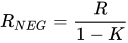
For example, in the case of the N-shaped NR above where K = 2, RNEG = -R.
General properties of negative impedance elements
[edit | edit source]True negative versus "positive" impedance elements
[edit | edit source]- True negative impedance elements are sources injecting energy into circuits while the according "positive" impedance elements (resistors, capacitors and inductors) absorb energy from circuits.
- True negative impedance elements add as much energy to the input sources as it loses into "positive" impedance elements having the same impedance.
- True negative impedance elements are electronic circuits while "positive" impedance elements are real elements (components).
True negative elements versus sources
[edit | edit source]- True negative impedance elements are dynamic sources while ordinary (constant-voltage and constant-current) sources are static.
- Elements with true negative impedance compensate the equivalnt impedance for each value of the input voltage/current; constant (static) sources compensate the equivalnt impedance for only one value of the input quantity (i.e., they have static negative impedance).
Current controlled versus voltage controlled negative impedance elements
[edit | edit source]- Both the true negative impedance elements are composed circuits consisting of two connected in series components: an internal "positive" impedance element and (the output of) an amplifier with gain of 2. The amplifier of a current-driven negative impedance element amplifies the voltage drop across the internal "positive" impedance element; the amplifier of a voltage-driven negative impedance element amplifies the voltage drop across the terminals of the very negative impedance element.
- A current-driven negative impedance element is a current-driven voltage source consisting of a current-to-voltage converter that drives a voltage amplifier; a voltage-driven negative impedance element is a voltage-driven current source consisting of a voltage amplifier and a voltage-to-current converter.
- Current-driven negative impedance elements are connected in series while voltage-driven negative impedance elements are connected in parallel to "positive" impedance elements.
- Current-driven negative impedance elements add so much voltage to the input voltage source as it would appear across an equivalent "positive" impedance element; voltage-driven negative impedance elements add so much current to the input current source as it would flow through an equivalent "positive" impedance element.
- A current-driven true negative resistor with resistance -R connected in series with a positive resistor with a total resistance RTOT destroys, "eats", neutralizes R-part of the total positive resistance; the result of this neutralization is zero resistance. A voltage-driven true negative resistor with resistance -R connected in parallel to a positive resistor with a total resistance RTOT neutralizes R-part of the total positive resistance; the result of this neutralization is infinite resistance.
- The voltage across a current-driven negative impedance element has an opposite polarity to the voltage drop across the initial "positive" resistor; so, it behaves as a negative impedance converter with voltage inversion (VNIC). The current flowing through a voltage-driven negative impedance element has an opposite direction to the current flowing through the initial "positive" resistor; so, it behaves as a negative impedance converter with current inversion (INIC).
- To operate in active mode, the positive resistance has to dominate over the negative resistance in circuits with current-controlled negative resistors while the negative resistance has to dominate over the "positive" resistance in circuits with voltage-controlled negative resistors. Otherwise, these circuits will operate in bi-stable mode (acting as Schmitt trigger).
True negative versus differential negative resistors
[edit | edit source]- True negative resistors are electronic circuits while negative differential resistors can be elements (components) as well as circuits.
- Both the negative resistors are dynamic electronic elements (circuits).
- True negative resistors are dynamic electrical sources while negative differential resistors are just dynamic resistors that cannot be used independently; they may be used in combination with electrical sources to build true negative resistors.
General rules for using negative impedance elements
[edit | edit source]- Current-driven negative impedance elements:
- Transform a "positive" impedance element into a current-driven negative one by connecting in series an amplifier with gain of 2 that amplifies the voltage drop across the "positive" impedance element.
- Connect current-driven negative impedance elements in series with "positive" impedance elements to decrease their impedance.
- Make the negative impedance equal to some part of the positive one to destroy it and to give zero impedance.
- Reserve some positive resistance to operate in an active mode.
- Voltage-driven negative impedance elements:
- Transform a "positive" impedance element into a voltage-driven negative one by connecting in series an amplifier with gain of 2 that amplifies the voltage drop across the terminals of the very negative impedance element.
- Connect voltage-driven negative impedance elements in parallel to positive impedance elements to decrease their impedance.
- Make the negative impedance equal to some part of the positive one to annihilate it and to give infinite impedance.
- Reserve some negative resistance to operate in an active mode.
Notes
[edit | edit source]- ↑ In this area of electronics, negative impedance has the meaning of anti-impedance as it symbolizes the ability of special active electronic circuits (NICs) to produce energy in the same manner as the according passive electrical elements with "positive" impedance consume energy. In contrast to this "with regard to energy" viewpoint, the classical AC electricity uses a "with regard to time" viewpoint at the same terms. There, negative impedance and positive impedance terms symbolize the two opposite kinds of behavior (reactance) that reactive elements show through time – increasing voltage opposition (capacitors) or decreasing voltage opposition (inductors). As a result, in negative impedance circuitry both capacitors and inductors have positive impedance while in AC electricity capacitors have negative impedance but inductors have positive impedance.
- ↑ Our situation (according to the emulating setup below) is even more complicated since the woman will continuously increase expenses and the man will accordingly increase his gains.
- ↑ a b With the same success we can make the opposite transformation – to make the man spend money ($1000) instead earn them, to "invert" the man and to transmute him to a woman:). For this purpose, he has only to put in touch with a woman spending two times more money ($2000) as he earns ($1000). Thus the man is oversqueezed by the woman and we think he spends money ($1000 - $2000 = -$1000) instead to earn them. While the direct example above helped us to convert positive into negative resistance, this reverse example can help us to convert negative into positive resistance (of course, the former is more useful and frequently use). Actually, they represent the same resistance neutralization idea.
- ↑ To see the negative resistance regions in the IV curves of negative resistors, they have to operate in a linear mode (to be stable). For this purpose, we have to supply S-shaped negative resistors by a current source; otherwise, they will operate in the more exotic bi-stable mode.
- ↑ Actually, the magnitude of the current decreases.
- ↑ You can think of this combination as of a real source with voltage VH and internal resistance R.
- ↑ The proportion in Fig. 10 is different for reasons of clarity.
- ↑ Note that if you consider the current and the voltage as signed quantities, when the current increases, the voltage decreases in this region (the classic negative resistance definition). But if you mean their magnitudes (the more natural viewpoint), when the current increases the voltage increases as well.
- ↑ If you have more sense of humor, you can see in this arrangement a more extended version of the funny analogy. You may think of the internal "resistor" Ri as of another woman (e.g., a wife); so, the three persons form a kind of a love triangle:) The second (the "other") woman (R) "copies" (makes the same expenses as) the first one (Ri). The man observes the second woman and earns two times more money than she spends; thus he actually compensates (works for) the both of them.
- ↑ Actually, the magnitude of the voltage decreases.
- ↑ Note again that if you consider the voltage and current as signed quantities, when the voltage increases the current decreases in this region (the classic negative resistance definition). But if you mean their magnitudes (the more natural viewpoint), when the voltage increases the current increases as well.
References
[edit | edit source]- ↑ Mechkov C. (2006) A heuristic approach to teaching negative resistance phenomenon. COMPUTER SCIENCE' 2006, Istanbul, Turkey.
- ↑ Negative-resistance load canceller helps drive heavy loads shows a typical voltage-driven negative resistance application.
See also
[edit | edit source]Negative Impedance Converter
Investigating the linear mode of negative impedance converters with voltage inversion
Investigating the linear mode of negative impedance converters with current inversion
Negative resistance is based on an old Wikipedia article dedicated to the phenomenon.
Negative impedance converter considers NIC with current inversion (INIC).
External links
[edit | edit source]- Understanding negative impedance converters (VNIC) – reveals in three consecutive steps the basic idea behind negative impedance converters with voltage inversion (VNIC).
- Negative Resistance Revived – condensed version of article originally published in Amateur Radio, November 1995.
- Handbook of operational amplifier active RC networks – a formal but well-written electronic book.
- How I revealed the secret of parallel negative feedback circuits reveals the philosophy of circuits with parallel negative feedback.
- How do we create a virtual ground? reveals the secret of the great circuit phenomenon.
- Reinventing transimpedance amplifier is a story about the op-amp current-to-voltage converter.
- Op-amp inverting summer is an animated Flash tutorial about the famous op-amp summing circuit.
- How do we build an op-amp RC integrator?
- Analog electronics 2004, Class 2: Elementary passive converters with voltage output
Forum discussions
[edit | edit source]- Edaboard: What is "negative impedance"?
- All about circuits: Negative resistance
- Physics forums: Negative resistance – the negative resistance material acts as a source
- ResearchGate: Why are there no practical applications of negative impedance?