Category Theory/Functors
Jump to navigation
Jump to search

This is the Functors chapter of Category Theory.
Definition[edit | edit source]
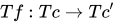
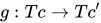
A functor is a morphism between categories. Given categories and , a functor has domain and codomain , and consists of two suitably related functions:


- The object function , which assigns to each object in , an object in .
- The arrow function (also ), which assigns to each arrow in , an arrow in , such that it satisfies and where is defined.





Examples[edit | edit source]
- The power set functor is a functor . Its object function assigns to every set , its power set and its arrow function assigns to each map , the map .
- The inclusion functor sends every object in a subcategory to itself (in ).
- The general linear group which sends a commutative ring to .
- In homotopy, path components are a functor , the fundamental group is a functor , and higher homotopy is a functor .
- In group theory, a group can be thought of as a category with one object whose arrows are the elements of . Composition of arrows is the group operation. Let denote this category. The group action functor gives for some set and the set is sent to .


















Types of functors[edit | edit source]
- A functor is an isomorphism of categories if it is a bijection on both objects and arrows.
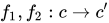
- A functor is called full if, for every pair of objects in and every arrow in , there exists an arrow in with . In other words, is surjective on arrows given objects .
- A functor is called faithful if, for every pair of objects in and every pair of parallel arrows in , the equality implies that . In other words, is injective on arrows given objects . The inclusion functor is faithful.
- A functor is called forgetful if it "forgets" some or all aspects of the structure of .
- A functor whose domain is a product category is called a bifunctor.




Types of subcategories[edit | edit source]
is a full subcategory of if and only if the inclusion functor is full. In other words, if for every pair of objects in .


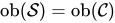
is a lluf subcategory of if and only if .