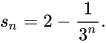
The following exercises test your understanding of infinite sequences and series. You may want to review that material before trying these problems.
Each question is followed by a "Hint" (usually a quick indication of the most efficient way to work the problem), the "Answer only" (what it sounds like), and finally a "Full solution" (showing all the steps required to get to the right answer). These should show up as "collapsed" or "hidden" sections (click on the title to display the contents), but some older web browsers might not be able to display them correctly (i.e., showing the content when it should be hidden). If this is true for your browser (or if you're looking at a printed version), you should take care not to "see too much" before you start thinking of how to work each problem.
Is the sequence monotonically increasing or decreasing?
Hint
compare adjacent terms algebraically or take a derivative
compare adjacent terms algebraically or take a derivative
Answer only
monotonically decreasing (strictly decreasing starting with the second term)
monotonically decreasing (strictly decreasing starting with the second term)
Full solution
One may either consider how compares to algebraically and try to show that one is greater than the other, or take the derivative of with respect to and check where it is positive or negative.
Algebraically, since
we see that for . That is, starting from the second term, the sequence is strictly decreasing. It is easy to check how the first two terms compare by just plugging in and :
The first two terms are equal and thereafter the terms are strictly decreasing. Therefore, the sequence is monotonically decreasing.
Using calculus,
which is negative for . The rest of the argument is the same as before.
One may either consider how compares to algebraically and try to show that one is greater than the other, or take the derivative of with respect to and check where it is positive or negative.
Algebraically, since
we see that for . That is, starting from the second term, the sequence is strictly decreasing. It is easy to check how the first two terms compare by just plugging in and :
The first two terms are equal and thereafter the terms are strictly decreasing. Therefore, the sequence is monotonically decreasing.
Using calculus,
which is negative for . The rest of the argument is the same as before.
Is the sequence bounded from below, from above, both, or neither?
Hint
consider what kind of values are taken on by the numerator and denominator, and use the previous answer
consider what kind of values are taken on by the numerator and denominator, and use the previous answer
Answer only
bounded from below and from above (both)
bounded from below and from above (both)
Full solution
The sequence is bounded from below because the terms are clearly positive (greater than 0) for all values of . Also, since the sequence is decreasing (see the previous problem), the maximum value of the sequence must be the value of the first term. So the sequence is bounded from above (by the value 1/2), as well.
The sequence is bounded from below because the terms are clearly positive (greater than 0) for all values of . Also, since the sequence is decreasing (see the previous problem), the maximum value of the sequence must be the value of the first term. So the sequence is bounded from above (by the value 1/2), as well.
Does the sequence converge or diverge?
Hint
use the previous two answers to make a conclusion, or take a limit
use the previous two answers to make a conclusion, or take a limit
Answer only
converges
converges
Full solution
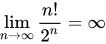
By the previous two answers, the sequence is bounded from below and monotonically decreasing, thus by a theorem it must converge.
To show this directly, consider the limit
The two limits are equal by L'Hôpital's Rule, since the numerator and denominator of the expression in the first limit both grow to infinity.
Since the limit exists, it is the number to which the sequence converges.
By the previous two answers, the sequence is bounded from below and monotonically decreasing, thus by a theorem it must converge.
To show this directly, consider the limit
The two limits are equal by L'Hôpital's Rule, since the numerator and denominator of the expression in the first limit both grow to infinity.
Since the limit exists, it is the number to which the sequence converges.
Determine whether each of the following series converges or diverges. (Note: Each "Hint" gives the convergence/divergence test required to draw a conclusion.)
Hint
p-series
p-series
Answer only
converges
converges
Full solution
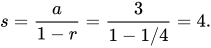
This is a p-series with . Since , the series converges.
This is a p-series with . Since , the series converges.
Hint
geometric series
geometric series
Answer only
converges
converges
Full solution
This is a geometric series with common ratio , and so converges since .
This is a geometric series with common ratio , and so converges since .
Hint
limit comparison test
limit comparison test
Answer only
diverges
diverges
Full solution
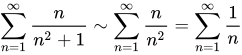
This series can be compared to a p-series:
The symbol means the two series are "asymptotically equivalent"—that is, they either both converge or both diverge because their terms behave so similarly when summed as n gets very large. This can be shown by the limit comparison test:
Since the limit is positive and finite, the two series either both converge or both diverge. The simpler series diverges because it is a p-series with (harmonic series), and so the original series diverges by the limit comparison test.
This series can be compared to a p-series:
The symbol means the two series are "asymptotically equivalent"—that is, they either both converge or both diverge because their terms behave so similarly when summed as n gets very large. This can be shown by the limit comparison test:
Since the limit is positive and finite, the two series either both converge or both diverge. The simpler series diverges because it is a p-series with (harmonic series), and so the original series diverges by the limit comparison test.
Hint
direct comparison test
direct comparison test
Answer only
diverges
diverges
Full solution
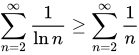
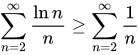
This series can be compared to a smaller p-series:
The p-series diverges since (harmonic series), so the larger series diverges by the appropriate direct comparison test.
This series can be compared to a smaller p-series:
The p-series diverges since (harmonic series), so the larger series diverges by the appropriate direct comparison test.
Hint
divergence test
divergence test
Answer only
diverges
diverges
Full solution
The terms of this series do not have a limit of zero. Note that when ,
To see why the inequality holds, consider that when none of the fractions in the square brackets above are actually there; when only 2/2 (which is the same as ) is in the brackets; when only 3/2 (equal to ) and 2/2 (equal to ) are there; when , only 4/2, 3/2, and 2/2 are there; and so forth. Clearly none of these fractions are less than 1 and they never will be, no matter what is used.
The fact that
then implies that
Therefore the series diverges by the divergence test.
The terms of this series do not have a limit of zero. Note that when ,
To see why the inequality holds, consider that when none of the fractions in the square brackets above are actually there; when only 2/2 (which is the same as ) is in the brackets; when only 3/2 (equal to ) and 2/2 (equal to ) are there; when , only 4/2, 3/2, and 2/2 are there; and so forth. Clearly none of these fractions are less than 1 and they never will be, no matter what is used.
The fact that
then implies that
Therefore the series diverges by the divergence test.
Hint
alternating series test
alternating series test
Answer only
converges
converges
Full solution
This is an alternating series:
Since the sequence
decreases to 0, the series converges by the alternating series test.
This is an alternating series:
Since the sequence
decreases to 0, the series converges by the alternating series test.
Hint
alternating series test
alternating series test
Answer only
converges
converges
Full solution
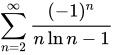
Since the terms alternate, consider the sequence
This sequence is clearly decreasing (since both n and are increasing — one may also show that the derivative of the expression is negative for ) and has limit zero (the denominator goes to infinity), so the series converges by the alternating series test.
Since the terms alternate, consider the sequence
This sequence is clearly decreasing (since both n and are increasing — one may also show that the derivative of the expression is negative for ) and has limit zero (the denominator goes to infinity), so the series converges by the alternating series test.
Determine whether each of the following series converges conditionally, converges absolutely, or diverges. (Note: Each "Hint" gives the test or tests that most easily lead to the final conclusion.)
Hint
alternating series test and either direct comparison test or integral test
alternating series test and either direct comparison test or integral test
Answer only
converges conditionally
converges conditionally
Full solution
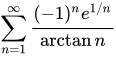
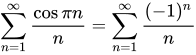
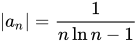
This series alternates, so consider the sequence
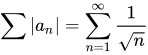
Since this sequence is clearly decreasing to zero, the original series is convergent by the alternating series test. Now, consider the series formed by taking the absolute value of the terms of the original series:
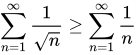
This new series can be compared to a p-series:
Since the smaller series diverges, the larger one diverges. But this means the original (alternating) series was not absolutely convergent. (This last fact can also be shown using an integral test.) Therefore, the original series is only conditionally convergent.
This series alternates, so consider the sequence
Since this sequence is clearly decreasing to zero, the original series is convergent by the alternating series test. Now, consider the series formed by taking the absolute value of the terms of the original series:
This new series can be compared to a p-series:
Since the smaller series diverges, the larger one diverges. But this means the original (alternating) series was not absolutely convergent. (This last fact can also be shown using an integral test.) Therefore, the original series is only conditionally convergent.
Hint
alternating series test and either integral test or direct comparison test
alternating series test and either integral test or direct comparison test
Answer only
converges conditionally
converges conditionally
Full solution
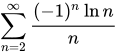
This series alternates, so consider the sequence
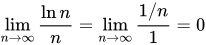
This sequence has a limit of zero by, for example, L'Hospital's Rule.
That the sequence is decreasing can be verified by, for example, showing that as a continuous function of x, its derivative is negative.
This means that the terms definitely decrease starting with the second term (). Thus, the series starting at is convergent by the alternating series test; clearly, then, the series starting at also converges (since the two series only differ by one term).
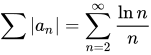
Now, consider the series formed by taking the absolute value of the terms of the original series:
This new series of positive terms only can be compared to a p-series:
Since the smaller series diverges, the larger one diverges.
Alternatively, the integral test can be used to test the convergence of the series of positive terms, since is clearly a continuous, positive function on and, as we have just verified, is also decreasing:
by the substitution ; and this last expression becomes
Since the improper integral diverges, the series of positive terms diverges.
Either way you test it, the series with all positive terms diverges, and this means the original (alternating) series was not absolutely convergent. Thus, the original series is only conditionally convergent.
This series alternates, so consider the sequence
This sequence has a limit of zero by, for example, L'Hospital's Rule.
That the sequence is decreasing can be verified by, for example, showing that as a continuous function of x, its derivative is negative.
This means that the terms definitely decrease starting with the second term (). Thus, the series starting at is convergent by the alternating series test; clearly, then, the series starting at also converges (since the two series only differ by one term).
Now, consider the series formed by taking the absolute value of the terms of the original series:
This new series of positive terms only can be compared to a p-series:
Since the smaller series diverges, the larger one diverges.
Alternatively, the integral test can be used to test the convergence of the series of positive terms, since is clearly a continuous, positive function on and, as we have just verified, is also decreasing:
by the substitution ; and this last expression becomes
Since the improper integral diverges, the series of positive terms diverges.
Either way you test it, the series with all positive terms diverges, and this means the original (alternating) series was not absolutely convergent. Thus, the original series is only conditionally convergent.
Hint
divergence test
divergence test
Answer only
diverges
diverges
Full solution
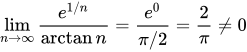
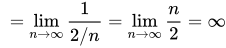
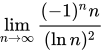
This series is alternating, but note that by L'Hospital's Rule
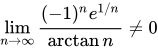
Which implies that
does not exist, and hence by the divergence test, the series diverges.
This series is alternating, but note that by L'Hospital's Rule
Which implies that
does not exist, and hence by the divergence test, the series diverges.
Hint
limit comparison test with geometric series
limit comparison test with geometric series
Answer only
converges absolutely
converges absolutely
Full solution
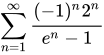
While this alternating series can be shown to converge by the alternating series test, it can also be shown that the absolute value of the terms form a convergent series, and this is sufficient to conclude absolute convergence of the original series. Thus we will skip the former test and show only the latter.
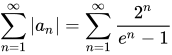
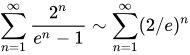
This series of positive terms is asymptotically geometric with :
The equivalence of these series is shown by using a limit comparison test:
Since the limit is positive and finite, and since the simpler series converges because it geometric with (the absolute value of which is less than 1), then the series of positive terms converges by the limit comparison test. Thus the original alternating series is absolutely convergent.
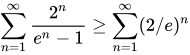
Note, by the way, that a direct comparison test in this case is more difficult (although still possible to do), since
and we need the inequality to go the other way to get a conclusion, since the geometric series converges.
This can be fixed by choosing the new series more carefully:
Comparing the original series to the new (convergent geometric) series gives the desired result.
While this alternating series can be shown to converge by the alternating series test, it can also be shown that the absolute value of the terms form a convergent series, and this is sufficient to conclude absolute convergence of the original series. Thus we will skip the former test and show only the latter.
This series of positive terms is asymptotically geometric with :
The equivalence of these series is shown by using a limit comparison test:
Since the limit is positive and finite, and since the simpler series converges because it geometric with (the absolute value of which is less than 1), then the series of positive terms converges by the limit comparison test. Thus the original alternating series is absolutely convergent.
Note, by the way, that a direct comparison test in this case is more difficult (although still possible to do), since
and we need the inequality to go the other way to get a conclusion, since the geometric series converges.
This can be fixed by choosing the new series more carefully:
Comparing the original series to the new (convergent geometric) series gives the desired result.
Hint
divergence test
divergence test
Answer only
diverges
diverges
Full solution
Since this is an alternating series, we can try the alternating series test. Consider the absolute value of the terms:
Because
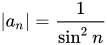
does not exist (since it continually oscillates within the interval as n gets larger)
doesn't exist either. Thus the alternating series test fails (it is inconclusive).
However, in such a situation we can use the divergence test instead. Since
also does not exist (and thus the terms of the series do not converge to 0), the original series diverges by the divergence test.
Since this is an alternating series, we can try the alternating series test. Consider the absolute value of the terms:
Because
does not exist (since it continually oscillates within the interval as n gets larger)
doesn't exist either. Thus the alternating series test fails (it is inconclusive).
However, in such a situation we can use the divergence test instead. Since
also does not exist (and thus the terms of the series do not converge to 0), the original series diverges by the divergence test.
Hint
ratio test
ratio test
Answer only
converges absolutely
converges absolutely
Full solution
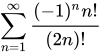
Because of the factorials in this series, we try the ratio test:
Since the limit is less than 1, the series converges absolutely by the ratio test.
Because of the factorials in this series, we try the ratio test:
Since the limit is less than 1, the series converges absolutely by the ratio test.
Hint
divergence test
divergence test
Answer only
diverges
diverges
Full solution
Although this is an alternating series, neither the numerator nor the denominator have infinite limits, so it is likely that a divergence test will work.
Note that
Thus
In fact, the latter limit does not exist. So, by the divergence test, the series diverges.
Although this is an alternating series, neither the numerator nor the denominator have infinite limits, so it is likely that a divergence test will work.
Note that
Thus
In fact, the latter limit does not exist. So, by the divergence test, the series diverges.
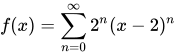
Find the Taylor series for the following functions centered at the given values.
Hint
don't try to use the summation formula—the Taylor series has a finite number of terms
don't try to use the summation formula—the Taylor series has a finite number of terms
Answer only
Full solution
This is a polynomial, so the Taylor series expansion terminates. Repeatedly differentiating and plugging in 1, we get:
All higher derivatives are also zero, so the Taylor expansion of the function:
becomes simply:
Note that the answer is not simplified any further (e.g., multiplying everything out and combining like terms), because the resulting representation would no longer appear to be centered at 1.
This is a polynomial, so the Taylor series expansion terminates. Repeatedly differentiating and plugging in 1, we get:
All higher derivatives are also zero, so the Taylor expansion of the function:
becomes simply:
Note that the answer is not simplified any further (e.g., multiplying everything out and combining like terms), because the resulting representation would no longer appear to be centered at 1.
Hint
avoid using the quotient rule
avoid using the quotient rule
Answer only
Full solution
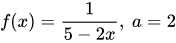
This rational function can be written in a form that is easier to repeatedly differentiate:
The answer is better written in summation form because the Taylor expansion does not terminate. It is convenient to keep the numbers resulting from the power rule separate from the numbers resulting from the chain rule, so we can see the pattern:
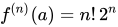
The pattern in the derivative values is:
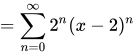
So the Taylor series is:
This rational function can be written in a form that is easier to repeatedly differentiate:
The answer is better written in summation form because the Taylor expansion does not terminate. It is convenient to keep the numbers resulting from the power rule separate from the numbers resulting from the chain rule, so we can see the pattern:
The pattern in the derivative values is:
So the Taylor series is:
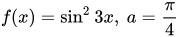
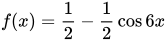
Hint
rewrite so the trigonometric function is not squared
rewrite so the trigonometric function is not squared
This is quite an awkward formula for the nth derivative. Don't worry at this point about the expression (−1)(n+1)/2 in the middle case; we're going to use a simpler version in the final series. Do, however, note the following:
The n = 0 case [i.e., f(a)] doesn't match the rest of the pattern.
When n is positive and even, the value is 0, so the "even-derivative" terms don't contribute anything to the series.
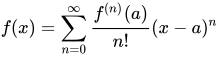
This means we can rewrite Taylor's formula
as
where
Note that the expression 2n + 1 is always odd and starts with the value 3 when n is 1. Thus n = 1 corresponds to the third derivative, n = 2 the fifth derivative, and so on. It should be clear that (−1)n+1 gives the correct signs for these derivative values.
Therefore the Taylor series is:
While this could be simplified a bit more by splitting 62n+1 into 62n · 6 and pulling the second 6 out in front of the sum (resulting in a 3 there), this is typically not done to preserve the pattern of having 2n + 1 everywhere.
This is quite an awkward formula for the nth derivative. Don't worry at this point about the expression (−1)(n+1)/2 in the middle case; we're going to use a simpler version in the final series. Do, however, note the following:
The n = 0 case [i.e., f(a)] doesn't match the rest of the pattern.
When n is positive and even, the value is 0, so the "even-derivative" terms don't contribute anything to the series.
This means we can rewrite Taylor's formula
as
where
Note that the expression 2n + 1 is always odd and starts with the value 3 when n is 1. Thus n = 1 corresponds to the third derivative, n = 2 the fifth derivative, and so on. It should be clear that (−1)n+1 gives the correct signs for these derivative values.
Therefore the Taylor series is:
While this could be simplified a bit more by splitting 62n+1 into 62n · 6 and pulling the second 6 out in front of the sum (resulting in a 3 there), this is typically not done to preserve the pattern of having 2n + 1 everywhere.


































![{\displaystyle {\frac {n!}{2^{n}}}={\frac {n}{2}}\cdot \left[{\frac {n-1}{2}}\cdot {\frac {n-2}{2}}\dots {\frac {2}{2}}\right]\cdot {\frac {1}{2}}\geq {\frac {n}{2}}\cdot (1)\cdot {\frac {1}{2}}={\frac {n}{4}}}](https://wikimedia.org/api/rest_v1/media/math/render/svg/2b14582a12a1150030403086cbb355ad045eb551)

![{\displaystyle [n-1]/2}](https://wikimedia.org/api/rest_v1/media/math/render/svg/8ada0034ac2b427d19c8c6e30567fe2f78d38ec5)

![{\displaystyle [n-2]/2}](https://wikimedia.org/api/rest_v1/media/math/render/svg/19ebab2bdd6dd2b1a72c2d37c4d9b22f88600b68)
















![{\displaystyle \lim _{n\to \infty }\left[{\frac {2^{n}}{e^{n}-1}}\div (2/e)^{n}\right]=\lim _{n\to \infty }\left({\frac {2^{n}}{2^{n}}}\cdot {\frac {e^{n}}{e^{n}-1}}\right)=\lim _{n\to \infty }{\frac {1}{1-1/e^{n}}}=1}](https://wikimedia.org/api/rest_v1/media/math/render/svg/8c2c3123c5f4e40571b4d428452b3e965c2f0f49)



![{\displaystyle [0,1]}](https://wikimedia.org/api/rest_v1/media/math/render/svg/738f7d23bb2d9642bab520020873cccbef49768d)


![{\displaystyle \lim _{n\to \infty }\left|{\frac {(-1)^{n+1}(n+1)!}{[2(n+1)]!}}\div {\frac {(-1)^{n}n!}{(2n)!}}\right|=\lim _{n\to \infty }{\frac {(n+1)!}{n!}}\cdot {\frac {(2n)!}{(2n+2)!}}=\lim _{n\to \infty }{\frac {(n+1)}{(2n+2)(2n+1)}}=\lim _{n\to \infty }{\frac {1}{2(2n+1)}}=0}](https://wikimedia.org/api/rest_v1/media/math/render/svg/bcc1c8414f6007d4097158555bdde87b5e54b210)