One useful application of derivatives is as an aid in the calculation of related rates. What is a related rate? In each case in the following examples the related rate we are calculating is a derivative with respect to some value. We compute this derivative from a rate at which some other known quantity is changing. Given the rate at which something is changing, we are asked to find the rate at which a value related to the rate we are given is changing.
These general steps should be taken in order to complete a related rates problem.
Write out any relevant formulas and information about the problem.
The problem should have a variable you "control" (i.e. have knowledge of the value and rate of) and a variable that you want to find the related rate.
Usually, related rates problem ask for a rate in respect to time. Do not panic if your equations do not appear to have any relationship to time! This will be handled later.
Combine the formulas together so that the variable you want to find the related rate of is on one side of the equation and everything else is on the other side.
Differentiate the formula with respect to time. Any other variable not a simple constant (such as ) should be differentiated as well. Be wary! Chain Rule usually should be used.
The other variables that you have differentiated should have been given in the question or should be calculated separately. Nevertheless, plug-in known information and simplify.
The value you get here is your answer.
The steps to solve a related rates problem is strikingly similar to an optimization problem, except that the main variable to find is not assigned to be 0 (it is supposed to be found) and that the extra variables in the optimization problem algorithm are actual variables in this case and are treated as variables instead of constants when differentiating.
Newton's dot notation is used to show the derivative of a variable with respect to time. That is, if is a quantity that depends on time, then , where represents the time. This notation is a useful abbreviation in situations where time derivatives are often used, as is the case with related rates.
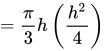
A cone with a circular base is being filled with water. Find a formula which will find the rate with which water is pumped—if the rate that water was being filled and the measurements of the cone were known.
Write out any relevant formulas or pieces of information.
Take the derivative of the equation above with respect to time. Remember to use the Chain Rule and the Product Rule.
Answer:
Example 2
A spherical hot air balloon is being filled with air. The volume is changing at a rate of 2 cubic feet per minute.
How is the radius changing with respect to time when the radius is equal to 2 feet?
Write out any relevant formulas and pieces of information.
Take the derivative of both sides of the volume equation with respect to time.
Solve for .
Plug-in known information.
Answer: ft/min.
Example 3
An airplane is attempting to drop a box onto a house. The house is 300 feet away in horizontal distance and 400 feet in vertical distance. The rate of change of the horizontal distance with respect to time is the same as the rate of change of the vertical distance with respect to time. How is the distance between the box and the house changing with respect to time at the moment? The rate of change in the horizontal direction with respect to time is -50 feet per second.
Note: Because the vertical distance is downward in nature, the rate of change of y is negative. Similarly, the horizontal distance is decreasing, therefore it is negative (it is getting closer and closer).
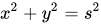
The easiest way to describe the horizontal and vertical relationships of the plane's motion is the Pythagorean Theorem.
Write out any relevant formulas and pieces of information.
(where s is the distance between the plane and the house)
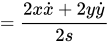
Take the derivative of both sides of the distance formula with respect to time.
Solve for .
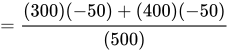
Plug-in known information
ft/s
Answer: ft/sec.
Example 4
Sand falls onto a cone shaped pile at a rate of 10 cubic feet per minute. The radius of the pile's base is always 1/2 of its altitude. When the pile is 5 ft deep, how fast is the altitude of the pile increasing?
Write down any relevant formulas and information.
Substitute into the volume equation.
Take the derivative of the volume equation with respect to time.
Solve for .
Plug-in known information and simplify.
ft/min
Answer: ft/min.
Example 5:
A 10 ft long ladder is leaning against a vertical wall. The foot of the ladder is being pulled away from the wall at a constant rate of 2 ft/sec. When the ladder is exactly 8 ft from the wall, how fast is the top of the ladder sliding down the wall?
Write out any relevant formulas and information.
Use the Pythagorean Theorem to describe the motion of the ladder.
(where l is the length of the ladder)
Take the derivative of the equation with respect to time.
1. A spherical balloon is inflated at a rate of . Assuming the rate of inflation remains constant, how fast is the radius of the balloon increasing at the instant the radius is ?
2. Water is pumped from a cone shaped reservoir (the vertex is pointed down) in diameter and deep at a constant rate of . How fast is the water level falling when the depth of the water is ?
3. A boat is pulled into a dock via a rope with one end attached to the bow of a boat and the other wound around a winch that is in diameter. If the winch turns at a constant rate of , how fast is the boat moving toward the dock?
4. At time a pump begins filling a cylindrical reservoir with radius 1 meter at a rate of cubic meters per second. At what time is the liquid height increasing at 0.001 meters per second?