Suppose that we are given a function  that is continuous on an interval
 ![{\displaystyle [a,b]}](https://wikimedia.org/api/rest_v1/media/math/render/svg/9c4b788fc5c637e26ee98b45f89a5c08c85f7935) and we want to calculate the length of the curve drawn out by the graph of
and we want to calculate the length of the curve drawn out by the graph of  from
from  to
to  . If the graph were a straight line this would be easy — the formula for the length of the line is given by Pythagoras' theorem. And if the graph were a piecewise linear function we can calculate the length by adding up the length of each piece.
The problem is that most graphs are not linear. Nevertheless we can estimate the length of the curve by approximating it with straight lines. Suppose the curve  is given by the formula
  for
for  . We divide the interval into
  subintervals with equal width
  and endpoints
  . Now let
  so
so  is the point on the curve above
  . The length of the straight line between
  and
and  is
is

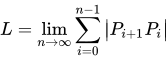
So an estimate of the length of the curve is the sum

As we divide the interval into more pieces this gives a better estimate for the length of . In fact we make that a definition.
Suppose that  is continuous on . Then the length of the curve given by between
  and
and  is given by
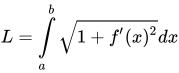
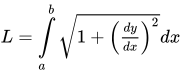
And in Leibniz notation
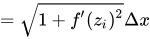
Proof: Consider  . By the Mean Value Theorem there is a point
  in
in  such that

So

|

|
|
|

|
|
|

|
|
|
|
Putting this into the definition of the length of gives
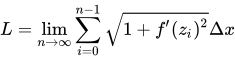
Now this is the definition of the integral of the function 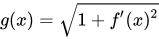 between and (notice that
  is continuous because we are assuming that is continuous). Hence
as claimed.
Example: Length of the curve  from  to  |
1. Find the length of the curve

from
to
.
:
: 2. Find the length of the curve
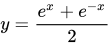
from
to
.
:
: Solutions
Arclength of a parametric curve[edit | edit source]
For a parametric curve, that is, a curve defined by  and
and  , the formula is slightly different:
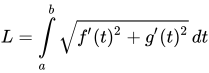
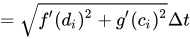
Proof: The proof is analogous to the previous one:
Consider  and
and  .
.
By the Mean Value Theorem there are points  and
and  in
in  such that

and

So
|
|
|
|
|

|
|
|

|
|
|
|
Putting this into the definition of the length of the curve gives
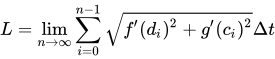
This is equivalent to:
3. Find the circumference of the circle given by the parametric equations

,

, with

running from

to

.
:
: 4. Find the length of one arch of the
cycloid given by the parametric equations

,

, with
running from
to
.
:
: Solutions