The purpose of this section is for readers to review important algebraic concepts. It is necessary to understand algebra in order to do calculus. If you are confident of your ability, you may skim through this section.
The following laws are true for all  in
in  whether these are numbers, variables, functions, or more complex expressions involving numbers, variable and/or functions.
- Commutative Law:
 .
.
- Associative Law:
 .
.
- Additive Identity:
 .
.
- Additive Inverse:
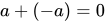 .
.
- Definition:
 .
.
- Commutative law:
 .
.
- Associative law:
 .
.
- Multiplicative identity:
 .
.
- Multiplicative inverse:
 , whenever
- Distributive law:
 .
.
- Definition:
 , where r is the remainder of a when divided by b, and n is an integer.
- Definition:
 , whenever
  .
.
Let's look at an example to see how these rules are used in practice.
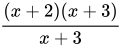
|
![{\displaystyle =\left[(x+2)\times (x+3)\right]\times \left({\frac {1}{x+3}}\right)}](https://wikimedia.org/api/rest_v1/media/math/render/svg/00f792cbaa95e7173b24f987832a7ca3cb5134c4) (from the definition of division) (from the definition of division)
|
|
|
![{\displaystyle =(x+2)\times \left[(x+3)\times \left({\frac {1}{x+3}}\right)\right]}](https://wikimedia.org/api/rest_v1/media/math/render/svg/63e733583a409e72d3e6cf410f4aeaa579491bfb) (from the associative law of multiplication) (from the associative law of multiplication)
|
|
|
 (from multiplicative inverse) (from multiplicative inverse)
|
|
|
 (from multiplicative identity) (from multiplicative identity)
|
Of course, the above is much longer than simply cancelling  out in both the numerator and denominator. However, it is important to know what the rules are so as to know when you are allowed to cancel. Occasionally people do the following, for instance, which is incorrect:
 .
.
The correct simplification is
 ,
,
where the number  cancels out in both the numerator and the denominator.
There are a few different ways that one can express with symbols a specific interval (all the numbers between two numbers). One way is with inequalities. If we wanted to denote the set of all numbers between, say, 2 and 4, we could write "all  satisfying
  ". This excludes the endpoints 2 and 4 because we use
  instead of
  . If we wanted to include the endpoints, we would write "all satisfying
  ."
."
Another way to write these intervals would be with interval notation. If we wished to convey "all satisfying " we would write  . This does not include the endpoints 2 and 4. If we wanted to include the endpoints we would write
 ![{\displaystyle [2,4]}](https://wikimedia.org/api/rest_v1/media/math/render/svg/e34ad1554b1763ca516be3e0343c4e5b7503a6a0) . If we wanted to include 2 and not 4 we would write
. If we wanted to include 2 and not 4 we would write  ; if we wanted to exclude 2 and include 4, we would write
 ![{\displaystyle (2,4]}](https://wikimedia.org/api/rest_v1/media/math/render/svg/95f52b9b2ea041f44cbbb81e8bd575b236cfaace) .
.
Thus, we have the following table:
| Endpoint conditions
|
Inequality notation
|
Interval notation
|
| Including both 2 and 4
|
all satisfying
|
|
| Not including 2 nor 4
|
all satisfying
|
|
| Including 2 not 4
|
all satisfying 
|
|
| Including 4 not 2
|
all satisfying 
|
|
In general, we have the following table, where  .
.
| Meaning
|
Interval Notation
|
Set Notation
|
All values greater than or equal to  and less than or equal to and less than or equal to 
|
![{\displaystyle [a,b]}](https://wikimedia.org/api/rest_v1/media/math/render/svg/9c4b788fc5c637e26ee98b45f89a5c08c85f7935)
|

|
| All values greater than and less than
|

|

|
| All values greater than or equal to and less than
|

|

|
| All values greater than and less than or equal to
|
![{\displaystyle (a,b]}](https://wikimedia.org/api/rest_v1/media/math/render/svg/6a6969e731af335df071e247ee7fb331cd1a57ae)
|

|
| All values greater than or equal to
|

|

|
| All values greater than
|

|

|
| All values less than or equal to
|
![{\displaystyle (-\infty ,a]}](https://wikimedia.org/api/rest_v1/media/math/render/svg/aeced831f088e701d1985fb783959d2309e0d32a)
|

|
| All values less than
|

|

|
| All values
|

|

|
Note that  and
and  must always have an exclusive parenthesis rather than an inclusive bracket. This is because is not a number, and therefore cannot be in our set. is really just a symbol that makes things easier to write, like the intervals above.
The interval is called an open interval, and the interval is called a closed interval.
Intervals are sets and we can use set notation to show relations between values and intervals. If we want to say that a certain value is contained in an interval, we can use the symbol  to denote this. For example,
 ![{\displaystyle 2\in [1,3]}](https://wikimedia.org/api/rest_v1/media/math/render/svg/0a3329d10ef6c978f0960fb9198ed04f74121e52) . Likewise, the symbol
. Likewise, the symbol  denotes that a certain element is not in an interval. For example
  .
.
There are a few rules and properties involving exponents and radicals. As a definition we have that if  is a positive integer then
  denotes factors of . That is,

If then we say that  .
.
If is a negative integer then we say that  .
.
If we have an exponent that is a fraction then we say that ![{\displaystyle a^{\frac {m}{n}}={\sqrt[{n}]{a^{m}}}=({\sqrt[{n}]{a}})^{m}}](https://wikimedia.org/api/rest_v1/media/math/render/svg/c27335eba4c1d0546f4d3617c1700aef479f082f) . In the expression
. In the expression ![{\displaystyle {\sqrt[{n}]{a}}}](https://wikimedia.org/api/rest_v1/media/math/render/svg/d7873203eb76042fcd24056c553de8c86054a2df) , is called the index of the radical, the symbol
, is called the index of the radical, the symbol  is called the radical sign, and is called the radicand.
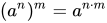
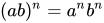
In addition to the previous definitions, the following rules apply:
| Rule
|
Example
|

|

|
|

|
|
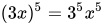
|
We will use the following conventions for simplifying expressions involving radicals:
- Given the expression
 , write this as
 ![{\displaystyle {\sqrt[{c}]{a^{b}}}}](https://wikimedia.org/api/rest_v1/media/math/render/svg/d5895c24b750d771f4ef3e0316fc03b4154c2e0f)
- No fractions under the radical sign
- No radicals in the denominator
- The radicand has no exponentiated factors with exponent greater than or equal to the index of the radical
Example: Simplify the expression 
Using convention 1, we rewrite the given expression as
(1)
![{\displaystyle \left({\frac {1}{8}}\right)^{\frac {1}{2}}={\sqrt[{2}]{\left({\frac {1}{8}}\right)^{1}}}={\sqrt {\frac {1}{8}}}}](https://wikimedia.org/api/rest_v1/media/math/render/svg/94f5c23d51b8e943f8013a14e79bffef64aeed94)
The expression now violates convention 2. To get rid of the fraction in the radical, apply the rule
 and simplify the result: and simplify the result:
(2)
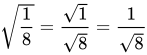
The resulting expression violates convention 3. To get rid of the radical in the denominator, multiply by  : :
(3)
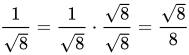
Notice that  . Since the index of the radical is 2, our expression violates convention 4. We can reduce the exponent of the expression under the radical as follows: . Since the index of the radical is 2, our expression violates convention 4. We can reduce the exponent of the expression under the radical as follows:
(4)

|
Consider the equation
(5)

is called the base and is called the exponent. Suppose we would like to solve for . We would like to apply an operation to both sides of the equation that will get rid of the base on the right-hand side of the equation. The operation we want is called the logarithm, or log for short, and it is defined as follows:
Definition: (Formal definition of a logarithm)
 exactly if and
  ,
,  , and
, and  .
.
Logarithms are taken with respect to some base. What the equation is saying is that, when is the exponent of , the result will be  .
.
Example: Calculate  |
When the base is not specified,  is taken to mean the base 10 logarithm. Later on in our study of calculus we will commonly work with logarithms with base
  . In fact, the base
  logarithm comes up so often that it has its own name and symbol. It is called the natural logarithm, and its symbol is
  . In computer science the base 2 logarithm often comes up.
Logarithms have the property that  . To see why this is true, suppose that:
 and
and 
These assumptions imply that
 and
and 
Then by the properties of exponents

According to the definition of the logarithm

Similarly, the property that  also hold true using the same method.
Historically, the development of logarithms was motivated by the usefulness of this fact for simplifying hand calculations by replacing tedious multiplication by table look-ups and addition.
Another useful property of logarithms is that  . To see why, consider the expression
  . Let us assume that

By the definition of the logarithm

Now raise each side of the equation to the power  and simplify to get

Now if you take the base log of both sides, you get

Solving for shows that
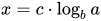
Similarly, the expression ![{\displaystyle \log _{b}{\sqrt[{c}]{a}}={\frac {\log _{b}a}{c}}}](https://wikimedia.org/api/rest_v1/media/math/render/svg/7b28fcef6627c1565bccd78fc044f97573b7940d) holds true using the same methods.
holds true using the same methods.
Most scientific calculators have the and functions built in, which do not include logarithms with other bases. Consider how one might compute  , where and are given known numbers, when we can only compute logarithms in some base
  . First, let us assume that

Then the definition of logarithm implies that

If we take the base log of each side, we get

Solving for , we find that

For example, if we only use base 10 to calculate  , we get
  .
.
A table is provided below for a summary of logarithmic identities.
|
|
Formula
|
Example
|
| Product
|

|

|
| Quotient
|
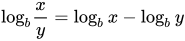
|

|
| Power
|

|

|
| Root
|
|

|
| Change of base
|
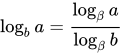
|

|
Given the expression  , one may ask "what are the values of that make this expression 0?" If we factor we obtain

.
If  , then one of the factors on the right becomes zero. Therefore, the whole must be zero. So, by factoring we have discovered the values of that render the expression zero. These values are termed "roots." In general, given a quadratic polynomial
 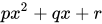 that factors as

then we have that  and
and  are roots of the original polynomial.
A special case to be on the look out for is the difference of two squares,  . In this case, we are always able to factor as

For example, consider  . On initial inspection we would see that both
  and
and  are squares of
  and
and  , respectively. Applying the previous rule we have

There is a way of simplifying the process of factoring using the AC method. Suppose that a quadratic polynomial has a formula of

If there are numbers and that satisfy both

and

Then, the result of factoring will be

The quadratic formula
Given any quadratic equation  , all solutions of the equation are given by the quadratic formula:
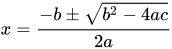
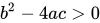
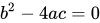
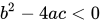
Note that the value of  will affect the number of real solutions of the equation.
| If
|
Then
|
|
There are two real solutions to the equation
|
|
There is only one real solution to the equation
|
|
There are no real solutions to the equation
|
Example: Find all the roots of 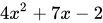
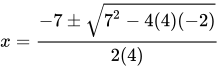
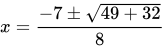
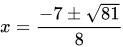
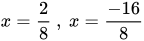
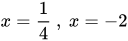
Finding the roots is equivalent to solving the equation  . Applying the quadratic formula with . Applying the quadratic formula with  , we have: , we have:

|
The quadratic formula can also help with factoring, as the next example demonstrates.
Example: Factor the polynomial |
Vieta's formulae relate the coefficients of a polynomial to sums and products of its roots. It is very convenient because under certain circumstances when the sums and products of the quadratic's roots are provided, one does not require to solve the whole quadratic polynomial.
Consider the two polynomials

and

When we take the quotient of the two we obtain

The ratio of two polynomials is called a rational expression. Many times we would like to simplify such a beast. For example, say we are given  . We may simplify this in the following way:

This is nice because we have obtained something we understand quite well,  , from something we didn't.
Here are some formulas that can be quite useful for solving polynomial problems:




Suppose we would like to divide one polynomial by another. The procedure is similar to long division of numbers and is illustrated in the following example:
Divide 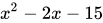 (the dividend or numerator) by (the divisor or denominator)
Similar to long division of numbers, we set up our problem as follows:
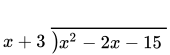
First we have to answer the question, how many times does go into  ? To find out, divide the leading term of the dividend by leading term of the divisor. So it goes in times. We record this above the leading term of the dividend: ? To find out, divide the leading term of the dividend by leading term of the divisor. So it goes in times. We record this above the leading term of the dividend:

, and we multiply by and write this below the dividend as follows:

Now we perform the subtraction, bringing down any terms in the dividend that aren't matched in our subtrahend:
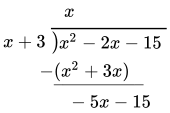
Now we repeat, treating the bottom line as our new dividend:
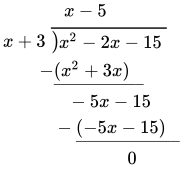
In this case we have no remainder.
|
We can use polynomial long division to factor a polynomial if we know one of the factors in advance. For example, suppose we have a polynomial  and we know that
  is a root of
  . If we perform polynomial long division using P(x) as the dividend and
  as the divisor, we will obtain a polynomial
  such that
  , where the degree of
  is one less than the degree of .
Use ^ to write exponents:
Similar to the way one can convert an improper fraction into an integer plus a proper fraction, one can convert a rational function whose numerator  has degree and whose denominator
  has degree
  with
with  into a polynomial plus a rational function whose numerator has degree
  and denominator has degree
  with
with  .
.
Suppose that divided by has quotient and remainder  . That is

Dividing both sides by gives
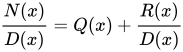
will have degree less than .
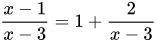
Write  as a polynomial plus a rational function with numerator having degree less than the denominator.
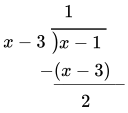
so
|














