Beginning Mathematics/Set Theory
In this section we shall go over some basic set theory.
Sets[edit | edit source]
A set is a well defined collection of things; which things can be objects, numbers, symbols and so on. If we can determine whether the given thing belongs to the collection or not,then that collection is said to be well defined. Those things that make up a set are its members, and are also called elements of that set. Elements of sets may be objects, letters, items, or even other sets. Sets can be finite(those containing a definite number of elements), or infinite(those containing an endless list of members).
Sets are denoted by capital letters of the English alphabet such as A,W,D,C,V,X,Z... . The elements of the set are indicated between the flower braces (also known as curl brackets),usually with members separated by commas. Ex: A={2,4,6,8,10}. Since all the elements are listed, it is called List form. This is also called Roster form.
Often, sets will have a pattern of elements or the elements will be similar in some fashion. At times, when it is clear what the pattern is, the set will end with "..." indicating the elements continue in that fashion. Ex:X={1,3,5,7,9,11,...}. Other times the set may be described in words or mathematical notation. Mathematical notation is read as in the following example: for the set X X={1,3,5,7,9,11,...}. This is shown as X={x/x is an odd number}
we read this as X is a set of all x's such that x is an odd number.  In general, this is read as " X is the set of x such that x has a property".
Here the / stands for "such that" often a colon (:) will be used instead.
To denote an element is in a set we write: this reads "x is an element of the set A" or "x is in A".

Special Sets[edit | edit source]
Some sets are used frequently in mathematics so they are given by special notation.





Examples[edit | edit source]





Basic operations[edit | edit source]
Union[edit | edit source]
The union of two sets is denoted by . The union of two sets is best described as "everything in both the sets once".

Formally:

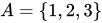
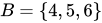
For example:

Intersection[edit | edit source]
The intersection of two sets is denoted by . The intersection of two sets is best described as "only what is in both of the sets".

Formally:

For example:


