


Algebra/Standard Form and Solving Slope
Standard Form
[edit | edit source]Standard form is another way to write slope-intercept form (as opposed to y=mx+b). It is written as Ax+By=C where A, B, C are all integers. You can also change slope-intercept form to standard form like this: Y=-3/2x+3. Next, you isolate the y-intercept(in this case it is 3) like this: Add 3/2x to each side of the equation to get this: 3/2x+y=3. You can not have a fraction in standard form so you solve this. 2(3/2x+y)=3(2). To get: 3x+2y= 6. Now you have a standard form equation! However, there are some rules for standard form. A, B, C are integers (positive or negative whole numbers) No fractions nor decimals in standard form. "Ax" term is positive. If these are not followed, it is not standard form. i.e. -1/3x+1/4y=4 is NOT standard form
Solving Slope
[edit | edit source]Solving Standard Form
[edit | edit source]Slope intercept equations (y=mx+b) are the easiest to graph. So if you encounter an equation in standard form that you are required to graph, you must convert it to slope intercept form. To do this you must take the equation and solve for Y.
Example:



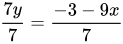
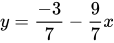
That is technically slope intercept form, but if you want to make it true (y=mx+b) simply follow the rule of negatives (a - b = a + -b):
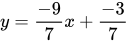
Solving an equation in slope-intercept form- how?
If you come upon an equation in slope-intercept form and require it to be in standard form, simply solve for m (c).
Example:



Standard form cannot have fractions. If they are in a fraction, you must multiply each side to get rid of it.
Example:
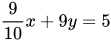
![{\displaystyle 10[{\frac {9}{10}}x+9y]=10[5]}](https://wikimedia.org/api/rest_v1/media/math/render/svg/03abcea85411df32d7c5f740bbf5bda8cc3c737f)
