Adventist Youth Honors Answer Book/Arts and Crafts/Whistles
| Whistles | ||
|---|---|---|
| Arts and Crafts North American Division See also Whistles - Advanced |
Skill Level 1 | 
|
| Year of Introduction: 2007 | ||
|
The Whistles Honor is a component of the Artisan Master Award . |
1. Relate briefly the history of whistle making and tell why whistles were invented.[edit | edit source]
The whistle has its roots dating back to ancient China, where night watchmen would blow into the tops of acorns to alert the towns to invading Mongolians. In ancient Egypt two blades of the papyrus plant along the Nile river were held together in between the palms. By blowing into the palms the papyrus leaves would make a loud vibrant sound.
Police whistles[edit | edit source]

In England since the Metropolitan Police Services inception in 1829, officers have been issued with the "Metropolitan" whistle. Prior to this, police used hand rattles, with whistles only being used as musical instruments or toys. Both rattles and whistles were used to call for back-up in areas where neighbourhood beats overlapped, and following their success in London, the whistle was adopted by most counties in England.
Police whistles fell into disuse in many countries in 1969, when early hand-held radios were brought into service. With the rise of the motor car, the whistle was no longer usefully audible in urban areas. The whistle is still used by some police forces today, and engraved ceremonial versions are sometimes presented to police officers upon occasions such as their retirement.
Industrial whistles[edit | edit source]
Industrial whistles are used for signalling and timekeeping both on railroad and ships, and in factories. Most of these whistles were steam powered and not standardized. Individual locomotives could be identified by their whistles. At noontime in industrial areas up into the 1950s whistles of every pitch could be heard, as each factory had a boiler and a whistle, if not full steam power.
Safety[edit | edit source]
Whistles are often used as warning devices or as safety devices serving to attract attention to the user. Some cyclists use a whistle as a substitute for a bell or horn. It should be noted, however, that many jurisdictions require that the warning device be permanently attached to the bicycle.
Rescue or survival whistles are often packed in survival kits and attached to personal flotation devices to allow a victim to signal for help. The whistle is audible at much greater distances than the human voice, and is less likely to cause exhaustion if used repeatedly. Survival whistles differ from pea whistles in that they are usually flat, so that water cannot collect inside if the user is immersed, for example after falling overboard from a boat.
Whistles can also produce sounds at pitches inaudible to the human ear such as dog whistles which can be heard by dogs at a range beyond that of human sensory perception, or at least conscious perception.
Boats[edit | edit source]
Ship's whistles must be very loud for safety on the seas. Modern ship's whistles can be electrically or steam driven. The RMS Queen Mary was originally equipped with three electric Tyfon whistles in 1932. They could be heard at least ten miles away and were tuned to 55 Hz, a low bass A note that was chosen for maximum passenger comfort despite the high sound pressure level. One of the three whistles was taken back to Kockum Sonics in Malmö, Sweden, where it was refurbished for a new life of service aboard the RMS Queen Mary 2. Modern IMO regulations specify ships' whistle frequencies to be in the range 70–200 Hz for vessels that are over 200 meters in length. Traditionally, the lower the frequency, the larger the ship. The Queen Mary 2, being 345 meters long, was given the lowest possible frequency (70 Hz) for her regulation whistles which means she carries both 70 Hz modern whistles and a single vintage 55 Hz whistle.
Trains[edit | edit source]
Railroads in particular used elaborate whistle codes for communication both within the train and with other trains. These methods are maintained today with motor-powered air horns. Trucks also use air horns, especially since they often have air brakes and so there is already a source of compressed air on board.
Train whistles generally produce three or four different frequencies at the same time to produce a non-major chord that is distinct, loud, and low in pitch.
Sporting[edit | edit source]
Whistles are used by referees to officiate sporting matches. The whistle was first used to stop a sports match by William Atack in an 1884 game of rugby in New Zealand. Before that game referees used their voices to control play.
Some sports use different types of whistles, but one used around the world in many sports is the Fox 40, a pealess whistle which creates sound using air pressure only. The Fox 40 is used in basketball, hockey, ice hockey, soccer and numerous other games, as it can be heard easily over the noise of the audience.
Another whistle widely used for sports such as Touch Football, Rugby League and Rugby Union is the Thunderer 58.5 by Acme Whistles. It is a metal whistle containing a cork pea. It is used mainly because of its design that allows the user to create a deep, low-pitch shrill that can be heard from hundreds of meters away.
Music[edit | edit source]

The whistle is used by a leader in samba percussion groups help to catch the percussionist's attention. The traditional samba whistle has three tones, but as the size of the percussion section rose, pealess whistles became more popular due to their high pitch and their loud sound.
The slide Whistle (or swanee whistle) was a common instrument in some types of music and was popular as a musical effect in the early days of radio and television.
Pitch pipes are reed whistles used to help in tuning musical instruments and have been common since the 1850s.
Military[edit | edit source]
Whistles were used in various military engagements in the 20th century. They were used primarily to initiate a pre-set plan so that all parts (within earshot) would move simultaneously. For example, officers in the World War I would sometimes blow whistles to signal all troops along a broad stretch of trench to attack at the same time.
Others[edit | edit source]
Other whistles include bird calls, game calls, shepherd's whistles, Swiss warblers, Chinese pigeon whistles, Chinese and Japanese kite whistles, cuckoo clocks whistles, communication tube whistles, whistling kettles, whistling tops and various toy whistles.
Patents and inventors[edit | edit source]
In 1868 Joseph Hudson of Birmingham], England, made the first whistle ever to be used by a football referee. New Zealand referee William Atack was the world's first to use a whistle to stop a game of sport in 1884. It was used for the first time (allegedly) at a game held at Nottingham Forest, prior to this referees used handkerchiefs to attract players' attention.
By 1884, Joseph Hudson had perfected his whistles and he released the world's most successful whistle to date, the "Acme Thunderer" (the first ever pea whistle). The whistle has been used as an alarm or attention-getting instrument by all manner of industries, sports and revellers. It continues to sell in great quantities throughout the world.
2. Explain the importance of conservation in regard to whistle making.[edit | edit source]
The Pathfinder motto of "Take nothing but pictures, leave nothing but footprints", is an important consideration, but obviously you cannot make a whistle without taking some wood. Consider your location carefully for harvesting a twig or two. Try searching for willow bushes in a county road ditch where road crews will have to clear the trees for the safety of drivers and harvest a few before the crews arrive. Maybe you know someone with a hedge that needs trimming ?
Avoid harvesting twigs in any areas sensitive to loss. If your harvesting would disturb nature, look for another location.
3. What do the seasons of the year have to do with making a willow whistle?[edit | edit source]

Sap is a liquid that circulates within the sapwood of trees. Sap rises up from the roots. Sap contains water and minerals; in the spring it also contains sugars and stimulates the growth of the tree.
A willow whistle requires the maker to remove the bark from a willow twig in a tube shaped piece. The best (or only) season that this can be done is in the spring when there is more sap rising up the tree. This makes the bark more removable from the twig.
A willow whistle is made by sawing a 15-20 cm branch from a green tree. It should be about 2cm in diameter, and it should not have any knots or blemishes along its length. Cut through the bark near the end opposite the mouth piece with a pocket knife, circling the twig all the way around. Then lightly bruise the stick by tapping on it with another stick to loosen the bark. You should be able to slip the bark off after a while. If you split the bark, you will need to start over.
Put the bark back on the stick and cut a notch near the mouthpiece. Then slip the bark off again. Shave off a thin sliver from the wood between the notch and the mouth piece to form an airway. Then carve out a channel between the notch and the end of the whistle. Replace the bark again and shape the mouthpiece. It should look like the picture shown to the right. [1]
4. Name two (2) trees that make the best whistles and why. List three (3) other trees that can be used to make whistles.[edit | edit source]
Willow and Maple trees (especially striped maple, Acer pensylvanicum) are considered the best for making whistles. Willow is often more plentiful than maple, and they grow back very quickly when cut. Some prefer maple because it is straighter and has fewer knots. Maples also grow back quickly if cut from a large stump.
Other trees that can be used for whistle-making include:
- Alder, aspen, and poplar
- These species can also be used for making slip-bark whistles. As with any slip-bark whistle though, they should be made in the spring or early summer when the sap is up. After that, it's too difficult to slip the bark off the wood.
- Elderberry
- Elderberry has a pithy core that can be easily removed. In this case, the bark is not used as the outer sheath, but rather, the whole twig is. You must find another piece of wood to fit tightly into the pith and shave off the top edge of it to make the whistle.
- Sumac
- If you select a sumac tree, make sure it is not a poison sumac tree (Rhus vernix). All parts of the poison sumac contain the same resin as poison ivy and can cause a person to suffer from an itchy rash. Poison sumac has white berries. If the sumac has red berries, it is OK to use and will not cause a rash.
5. Give a brief description of the following styles of whistles[edit | edit source]
a. Tube Whistles[edit | edit source]


A tube whistle is a small, very loud whistle made of a metal tube closed at one end. These are most familiar as the whistles carried by the English Bobbies (policemen).
b. Pan Whistles[edit | edit source]

The pan whistle is an ancient musical instrument based on the principle of the closed tube, consisting usually of five or more pipes of gradually increasing length (and, at times, diameter). The pan whistle (or pan flute) has long been popular as a folk instrument, and is considered the first mouth organ, ancestor of both the pipe organ and the harmonica. The pan flute is named for its association with the rustic Greek god Pan. The pipes of the pan flute are typically made from bamboo or giant cane; other materials used include wood, plastic, and metal.
c. Flute Whistles[edit | edit source]

Flute whistles are open at both ends and usually have a series of holes along the length of the tube. The pitch of the flute whistle can be changed by closing one or more of the holes.
6. Name five (5) types of modern whistles and their uses.[edit | edit source]
- Pea Whistle
- Pea whistles are used by referees in many sports. It is a whistle with a small ball trapped inside which makes a rattling sound as the whistle resonates.
- Transverse Flutes
- Transverse flutes are a form of whistle used in modern orchestras. They are operated by blowing across a hole located on the mouthpiece.
- Tin Whistle
- This is another form of musical whistle, but unlike the transverse flute, it is end-blown and has only six holes. It is an important instrument in Irish folk songs.
- Dog Whistes
- Dog whistles are used for training dogs or for commanding them from a distance. Some of these are too high to be heard by humans, but dogs can hear them (and respond) just fine.
- Slide Whistle
- A slide whistle is a whistle whose pitch can be varied by moving a slide. These are often considered novelty items (because of their use in cartoon sound effects), but also make an appearance in serious works of music in many cultures.
7. What modern musical instrument is a sophisticated whistle?[edit | edit source]

The recorder is a woodwind musical instrument of the family known as fipple flutes or internal duct flutes — whistle-like instruments which include the tin whistle and ocarina. The recorder is end-blown and the mouth of the instrument is constricted by a wooden plug, known as a block or fipple.
The recorder was popular from medieval times but declined in the 18th century in favour of orchestral woodwind instruments, such as the flute, oboe, and clarinet. During its heyday, the recorder was traditionally associated with birds, shepherds, miraculous events, funerals, marriages and amorous scenes. Images of recorders can be found in literature and artwork associated with all these. Purcell, Bach, Telemann and Vivaldi used the recorder to suggest shepherds and birds, and the pattern continued into the 20th century.
The recorder was revived in the 20th century, partly in the pursuit of historically informed performance of early music, but also because of its suitability as a simple instrument for teaching music and its appeal to amateur players. Today, it is often thought of as a child's instrument, but there are many excellent virtuosic players who can demonstrate the instrument's full potential as a solo instrument. The sound of the recorder is remarkably clear and sweet, partly because of the lack of upper harmonics and predominance of odd harmonics in the sound.
8. How does a whistle work?[edit | edit source]
The whistle works by causing the smooth flow of air to be split by a narrow blade, sometimes called a fipple, creating a turbulent vortex which causes the air to vibrate. By attaching a resonant chamber to the basic whistle, it may be tuned to a particular note and made louder. The length of the chamber typically defines the resonance frequency.
9. What is the most common equipment used in making whistles?[edit | edit source]
In making a willow whistle, all that is needed is a sharp knife. A saw is handy too for cutting the branch from the tree, but this can be done with a knife too (just not as effectively).
Other types of whistles are made by finding hollow tubes in nature (such as bamboo joints), or by boring out a chamber with a drill.
10. Explain the importance of wood grain in whittling a whistle.[edit | edit source]
For a slip-bark whistle, straight grain is important because it is easier to remove the bark intact from a piece of wood with straight grain. Grain becomes non-straight anywhere a branch grows a sub-branch. The bark will snag on these irregularities, making it difficult, if not impossible to remove.
11. Why must the size of the holes and chamber be proportional to the amount of airflow?[edit | edit source]
A whistle makes a tone as the chamber alternately fills with air and evacuates that air. This cycle repeats several hundred times per second, and the more times per second it repeats, the higher the pitch. There are three main factors that affect how often this cycle repeats: the length of the chamber, the size of the opening(s), and the speed of sound. The speed of sound is (for all intents and purposes) fixed. If the ratio of these other two factors get too "out of whack" with one another, the flute will no longer make a tone. If the chamber is too long, the flute will never resonate. Instead, the air will simply flow through from one end to the other without setting up the fill/exhaust cycles. If the chamber is too wide, it will not be able to confine the air to make it resonate, and the flute will whisper.[2]
12. How do you tune a whistle?[edit | edit source]
A whistle is tuned by changing the volume of the resonant chamber. This is primarily done by altering the length of the chamber, but altering the diameter will also have an effect.
13. Demonstrate that you can make a two-handed whistle using your hand and a piece of grass.[edit | edit source]
-
 Hold the grass like this...
 -
 ...and blow through it


Select a long, wide blade of grass. Prepare to hold your hands together as if to pray, with the lower portion of the thumbs touching one another, palms together, and with the tips of the thumbs touching. Lay the grass blade between the lower thumbs as you press them together. The upper portion of the blade will lie parallel to the thumbs and be pinched together by the thumb tips. Before pinching the upper portion of the blade, bend the thumbs slightly. Then pinch the grass blade between the tips of the thumbs (or the index fingers), and extend the thumbs (or index finger), pulling the grass taut.
This should leave a gap between the knuckles of the thumb, with the blade of grass passing through it. Place your lips over this gap and blow sharply. This should cause the blade to vibrate and make a loud, screeching whistle.
14. Demonstrate the technique and try to accomplish a whistle using your hand(s) or fingers.[edit | edit source]
-
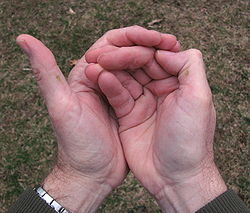 Press the tips of the fingers of the right hand together and place them in the left palm...
 -
 ...wrap the left hand around the right...
 -
 ...blow downwards through the gap between the thumbs.


Hold the fingers of the right hand together and bring the tips into a tight circle. Place them in the web between your left thumb and index finger, enclosing the left hand about the right. The two thumbs should be parallel to one another and resting on the right index finger. This should form a cavity with a small gap opening into it between the upper and lower thumb knuckles. Bend the thumbs slightly and place your lower lip just below the top joint in the thumbs. Place the upper lip on the top joint and blow downwards into the cavity. If you're doing it right, it will make a whistling noise very similar to the call of mourning dove or a bob white. Try to keep the cavity air tight except where your breath enters between the thumbs. Once you are able to do this, try raising the pinky of your left hand while whistling. The pitch should rise. Quickly raising and lowering the pinky repeatedly will cause the whistle to quaver. Try not to drive anyone crazy with your new-found skill!
15. Review and demonstrate the proper first aid and safety rules for the usage of a pocketknife.[edit | edit source]
First Aid[edit | edit source]
If you see a person who is bleeding heavily, you can do the following:
- Press hard onto the wound to stop the bleeding.
- If an arm or leg is cut, elevate the limb.
- Cover with a clean pad and apply a bandage.
- Check that the bleeding has stopped. If it has not, add another pad, and bandage, do not remove previous bandage.
- If you have bandaged a limb, check frequently that the fingers and toes remain warm. If fingers and toes are getting cold, loosen the bandage to let the blood circulate.
- For severe bleeding (5 cups of blood or more), get the person to a hospital for stitches (and possibly immunization against Tetanus) keeping the limb raised.
For more first aid information, see the First Aid honor.
Knife Safety[edit | edit source]
- Keep your blades sharp. A dull knife is difficult to push through wood, requiring additional force. When the wood finally gives, the blade keeps going.
- Always push the blade away from you, and constantly consider where the blade will go.
- Keep your fingers clear of the blade at all times.
- When splitting wood with a knife, do not hammer on the back of the blade. This weakens the attachment to the handle and deforms the blade.
- Close a pocket knife when it's not in use or when you are carrying it.
- Keep all blades away from heat. Heat will remove the temper, softening the blade. A soft blade will not hold an edge, making it nearly impossible to keep it sharp.
16. Know how to sharpen a pocketknife using a whetstone or oil sharpening stone.[edit | edit source]
A tool can be sharpened with a whetstone. Most whetstones need to be kept wet when they are in use - some are wet with water and others are wet with oil. Stones with finer grain typically use oil, but you can use water on them as well. The purpose of wetting a whetstone is to allow the steel removed from the blade to float away. The finer the stone, the finer the edge it will make on a tool, but the longer it will take to sharpen it. For this reason, a very dull tool should be sharpened first with a coarser stone, and then with a finer stone. Then it should be kept sharp. You can keep a blade sharp by respecting it - do not chop into the ground with a hatchet, and to not stick a knife blade in the ground either. Dirt is highly abrasive, and a rock will ding the edge very quickly. Close a pocket knife when you are finished using it, and do not allow the business end of a blade to touch anything other than the things you are trying to cut with it.
To sharpen a knife, hold the blade at about a 15° angle and scrape it along a whetstone as if you were trying to shave off a thin layer of the stone. Be sure to sharpen both sides.
17. Make the following whistles[edit | edit source]
a. Pan (Tubes) whistle[edit | edit source]
A pan flute covering one octave can be made from 1/2" CPVC pipe. (See the note on other types of pipe such as ABS in the section on the Flute Whistle below).
You will need to cut eight lengths of pipe as precisely as you can. Any imprecision here will translate to an out-of-tune pan whistle.
| Pan Whistle[3] | ||
|---|---|---|
| Note | Length | |
| Metric | English | |
| G4 | 211 | 8.33 |
| A5 | 187 | 7.35 |
| B5 | 167 | 6.57 |
| C5 | 156 | 6.15 |
| D5 | 138 | 5.42 |
| E5 | 122 | 4.80 |
| F5 | 116 | 4.57 |
| G5 | 106 | 4.16 |
Round the top edge of the pipes with wet sandpaper while you hold the pipe under a stream of running water. This is to keep the dust down. This is an important precaution against inhaling PVC dust which never decays and will therefore settle permanently in the lungs if inhaled. If you do decide to dry sand, you and everyone in the room should wear a dust mask.
Once you have all the pipes cut to length, glue end caps to the bottom by applying PVC cement to the pipes (not the end caps) and then inserting the pipe into the end cap. Blow over the tops of the holes to test their tune and tone.
The last step is to mount the pipes. This can be done by drilling 8 holes into a piece of solid wood and then gluing the pipes into it with epoxy. You could also bind them together with cane or with string. However you decide to bind them together, the tops should all be even.
b. Flute Whistle[edit | edit source]
A six-hole transverse flute can be made from a 3/4" (19mm) diameter length of PVC (or CPVC) pipe. PVC is used for plumbing cold water supply lines, and CPVC is used for hot water supply lines. Do not use ABS, as it is used for plumbing waste lines, and is therefore not regulated in regard to toxicity. For the same reason, you should not use plastic electrical conduit.
The pipe itself should be cut to a length of 395 mm (15 9/16 inches). Try to be as precise as possible. The next step is to measure the location of the holes to be drilled along its length as listed in the table below. Be as precise as possible both in the measuring and in the drilling. Mistakes here will make the flute be off-tune.
The "offset" column indicates the number of degrees to the left by which the hole should be offset. Most of them are in a straight line, but two of them should be rotated to the left (from the viewpoint of having the mouthpiece in your mouth). These offsets are not crucial, but they do make fingering easier.
| Flute Whistle[4] | |||||
|---|---|---|---|---|---|
| Hole | Diameter | Distance from top | Offset | ||
| Metric | English | Metric | English | ||
| Mouth | 11mm | 7/16" | 8mm | 5/16" | 0° |
| Left Index Finger | 9.5mm | 3/16" | 174mm | 6 7/8" | 0° |
| Left Middle Finger | 9.5mm | 3/16" | 203mm | 8" | 0° |
| Left Ring Finger | 9.5mm | 3/16" | 232mm | 9 1/8" | 25° |
| Right Ring Finger | 8.5mm | 11/32" | 273mm | 10 3/4" | 0° |
| Right Middle Finger | 11mm | 7/16" | 292mm | 11 1/2" | 10° |
| Right Index Finger | 8mm | 5/16" | 324mm | 12 3/4" | 0° |
Before drilling, glue an end cap on to the mouth end of the flute by applying PVC cement to the pipe (not to the cap). Once the glue has set, drill the mouth hole through the end cap. Then drill the remaining holes. Run a wooden dowel through the inside of the pipe from the uncapped end to knock off the burrs left from drilling. If desired, you can sand the outside with wet sandpaper while you hold the pipe under a stream of running water. See the note on the Pan Flute for precautions against PVC dust.
18. Learn to play a simple song on each whistle you have made.[edit | edit source]
If you are not musically inclined, an easy tune to learn is Hot Cross Buns. It consists of only three notes (C, D, and E), so the whistle does not need to span an entire octave. Indeed, any three notes that are separated by a whole step will do, so the whistle doesn't even need to be tuned to C, D, and E. It could also be F, G, A, or G, A, B, or any combination using flats or sharps as long as each note is a whole step from the previous one.
The song itself is as follows:
| E | D | C | E | D | C | |
| Hot | cross | buns, | Hot | cross | buns, |
| C | C | C | C | D | D | D | D |
| one | a | pen- | ny, | two | a | pen- | ny |
| E | D | C |
| Hot | cross | buns |
Another possibility is Mary Had a Little Lamb:
| E | D | C | D | E | E | E |
| Ma- | ry | had | a | lit- | tle | lamb |
| D | D | D | E | E | E |
| lit- | tle | lamb, | lit- | tle | lamb |
| E | D | C | D | E | E | E |
| Ma- | ry | had | a | lit- | tle | lamb |
| E | D | D | E | D | C |
| Its | fleece | was | white | as | snow |
References[edit | edit source]
- Book:Adventist Youth Honors Answer Book/Honors with an Advanced Option
- Book:Adventist Youth Honors Answer Book/Artisan Master Award
- Book:Adventist Youth Honors Answer Book/Honors
- Book:Adventist Youth Honors Answer Book
- Book:Adventist Youth Honors Answer Book/Skill Level 1
- Book:Adventist Youth Honors Answer Book/Honors Introduced in 2007
- Book:Adventist Youth Honors Answer Book/Arts and Crafts
- Book:Adventist Youth Honors Answer Book/North American Division
- Book:Adventist Youth Honors Answer Book/Overlapping requirements
- Book:Adventist Youth Honors Answer Book/Completed Honors