Abstract Algebra/Ideals
Motivation[edit | edit source]
In Rings we saw that the set of even integers was a subring of the integers.

We can also see very easily that the integers are a subring of the rational numbers under the usual operations of addition and multiplication.

The even integers, when taken as a subring of the integers have a property that the integers when taken as a subring of the rationals do not. The even integers taken as a subring of the rationals also lack this property.
The property is that the even integers, taken as a subring of the integers, absorb multiplication. Let's call the even integers for ease of notation.

Consider the following: For all , we can see by the definition of that for some .


For all see that .


In Math, regardless of which even integer is chosen, multiplying it by any integer will give us a different even integer.
Definition of an Ideal[edit | edit source]
Definition: Given a ring , a subset is said to be a left ideal of if it absorbs multiplication from the left; that is, if .



Definition: Given a ring , a subset is said to be a right ideal of if it absorbs multiplication from the right; that is, if .

Definition: We define an ideal to be something that is both a left ideal and a right ideal. We also require that is a subgroup of .


We write as shorthand for this.

To verify that a subset of a ring is an ideal, it is only necessary to check that it is closed under subtraction and that it absorbs multiplication; this is because of the subgroup criterion from Abstract Algebra/Group Theory/Subgroup.
Definition: An ideal is proper if .

Definition: An ideal is trivial if .

Lemma: An ideal is proper if and only if .

Proof: If then so .


The converse is obvious.
Theorem: In a division ring, the only proper ideal is trivial.
Proof: Suppose we have an ideal in a division with a nonzero element a. Take any element b in our division ring. Then a−1b is in the division ring as well, and aa−1b = b is in the ideal. Therefore, it is not a proper ideal.
Definition: Let S be a nonempty subset of a ring R. Then the ideal generated S is defined to be the smallest ideal in R containing S, which would be the intersection of all such ideals. We can characterize this ideal by the collection of all finite sums

And one can easily verify that this is an ideal, and that all ideals containing S must contain this ideal. If it is commutative, then one can simply characterize it as
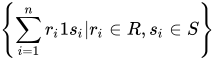
The ideal generated by a single element a is called a principal ideal. If the ring is commutative, it consists of all elements of the ring of the form ra where r is any element in the ring.
Example: Let be the ring of integers. The principal ideal is the subset of consisting of positive and negative multiples of . For example is the subset of even integers. Then one can view the factor ring simply as the set under addition and multiplication modulo .



Operations on Ideals[edit | edit source]
Given a collection of ideals we can generate other ideals. For instance it is easy to check that the intersection of any family of ideals is again an ideal. We write this simply as .

Given any set we can construct the smallest ideal of containing which we denote by . It is determined by , though often we can be more explicit than this.


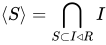
If is a collection of ideals we can determine the sum, written , as the smallest ideal containing all the ideals . One can check explicitly that its elements are finite sums of the form .


Finally if are two ideals in one can determine the ideal-theoretic product as the smallest ideal containing the set-theoretic product . Note that the ideal-theoretic product is in general strictly larger than the set-theoretic product, and that it simply consists of finite sums of the form where




Example: Let and the principal ideals in just given. Then one can check explicitly that , where r is the lcm of m and n. Moreover , and where s is the hcf of m and n. Observe that if and only if s = mn if and only if m and n are co-prime if and only if .






Homomorphisms and Ideals[edit | edit source]
Rings, like groups, have factor objects that are kernels of homomorphisms. Let be a ring homomorphism. Let us determine the structure of the kernel of f which is defined to be all elements which map to the identity.

If a and b are in the kernel of f, i.e. , and r is any element of R, then

- ,
- ,
- .



Therefore is an ideal of R.

Also note that the homomorphism will be a monomorphism i. e. it is injective or one-to-one when the kernel consists only of the identity element.
We also have the following
Theorem: If the only proper ideal of R is the trivial ideal {0}, then if f is a homomorphism from R to S, and it does not map all elements of R to the identity in S, then it is injective.
Proof: The kernel of the homomorphism must be an ideal, and since the only ideals are R and the trivial ideal, one of these two must be the kernel. However, since not all elements of R map to the identity of S, R is not the kernel, so the trivial ideal must be.
Since this condition is satisfied for all division rings, it is true for all division rings.
The construction of factor rings in the next section will prove that there exists a homomorphism with I as its kernel for any ideal I.
Factor Rings[edit | edit source]
Definition: Given a ring and an ideal , the ring of cosets of , r+I where r is within R, is written , where each coset is defined to be the set {r+i|i is an element of I}, and by Lagrange's theorem, it partitions R. This set of cosets, called the factor ring (or quotient ring) of modulo is a ring with addition defined the same way as one would define it for groups (since the ring is a group under addition), and with multiplication defined as follows:

- .

To show that this is independent of the choice of a and b (or, the operations are well-defined), suppose that a' and b' are elements of the same respective coset. Then a'=a+j and b'=b+k for some element j,k within I. Then a'b'=ab+ak+jb+jk and since ak, jb, and jk are elements of I, a'b' and ab must belong to the same coset, so ab+I=a'b'+I. Obviously the cosets form a group under addition because of what was proved earlier about factor groups, and furthermore the factor ring forms an abelian group under addition because the ring forms an abelian group under addition. Since the product rs+I is analogous to the multiplication in the ring, it obviously has all the properties of a ring. Furthermore, if the ring is commutative, then the factor ring will also be commutative.
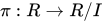
Observe that there is a canonical ring homomorphism determined by , called the projection map. We record some properties of this homomorphism in the next section of the isomorphism theorems.

Ring Isomorphism Theorems[edit | edit source]
We have already proved the isomorphism theorems for groups. Now we can use analogous arguments to prove the isomorphism theorems for rings, substitution the notion of "normal subgroups" with ideals.
Factor Theorem[edit | edit source]
Let I be an ideal of a ring R, Let be the usual homomorphism from R to R/I. Now let f be a homomorphism from R to S. Observe that if is a ring homomorphism, then the composition is a ring homomorphism such that (because ). This characterizes all such morphisms in the following sense
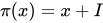
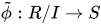



Factor Theorem: Let be a ring homomorphism such that . Then there is a unique homomorphism such that . Furthermore, is an epimorphism if and only if is an epimorphism, is a monomorphism if and only if its kernel is I.


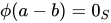
Proof We prove it the same way we did for groups. Define to be . To see that this is well-defined, let a+I=b+I, and so that a-b is an element of I, so that so that . Now is a homomorphism, implying that is also. The proofs of the additional statements can be carried over from the proofs of the additional statements of the factor theorem from groups.



First Isomorphism Theorem[edit | edit source]
Let R be a ring, and let f be a homomorphism from R to S with kernel K. Then the image of f is isomorphic to R/K.
Proof
Using the factor theorem, we can find a homomorphism from R/K to S, and since the kernel is the same as the ideal used in forming the quotient group, and since the f is an epimorphism over its image, this homomorphism is an isomorphism.
Second Isomorphism Theorem[edit | edit source]
Let R be a ring, let I be an ideal, and let S be a subring.
- S+I, the set of all s+i with s within S and i within I, is a subring of R.
- I is an ideal of S+I.
- The intersection of S and I is an ideal of S.
- (S+I)/I is isomorphic to .

Proof
- It can be verified that it contains 1, and is closed under multiplication.
- Of course, since I is an ideal of R, then it must be an ideal under any subring.
- From a similar argument for groups, it can only contain elements of I, but restricted to S, so it must be an ideal of S.
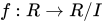
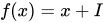
- Let be a function restricted to the domain S, and define . It is obvious that its kernel is and that its image is (S+I)/I.

Third Isomorphism Theorem[edit | edit source]
Let I be an ideal of a ring R, and let J be an ideal of the same ring R that contains I. J/I is an ideal of R/I, and R/J is isomorphic to (R/I)/(J/I).
Proof Define the function to be which is well-defined because since I is an ideal that is within J. This is also obviously a homomorphism. Its kernel is all elements that map onto J, and is thus all a+I such that a is within J, or J/I. Moreover, its image is R/J, and so we can use the first isomorphism theorem to prove the result.


Correspondence Theorem[edit | edit source]
Let I be an ideal of a ring R. Define the function to map the set of rings and ideals containing I to the set of rings and ideals of R/I, where = the set of all cosets x+I where x is an element of X. This function is one-to-one, and the image of rings or ideals containing I are rings or ideals within R/I.


Proof Define the function f from rings or ideals containing I to the rings or ideals of R/I, by f(A)=A/I. We have already proved the correspondence for addition because rings form an abelian group under addition. Thus, we need only to check for multiplication. Suppose S is a subring of R containing I. S/I is obviously closed under addition and subtraction. For multiplication, suppose that x and y are elements of S. Then (x+I)(y+I)=xy+I which is also an element of S/I, proving that it is closed under multiplication. The identity 1 is within S, and we have it that 1+I is also within S/I. Thus, S/I is a subring of R/I. Now suppose that S/I is a subring of R/I. Then it is also obvious that S is closed under addition and subtraction and multiplication, proving that S is a subring of R. Now suppose that J is an ideal of R containing I. Then by the third isomorphism theorem, J/I is an ideal of R/I. Now suppose that J/I is an ideal of R/I. Let r be any element of R, and let j be any element of J. Then since J/I is an ideal of R/I, (r+I)(j+I)=rj+I must be an element of J/I. This indicates that rj must be an element of J, proving that J is an ideal of R.
Chinese Remainder Theorem[edit | edit source]
Definitions[edit | edit source]
Definition: Two elements are said to be congruent in an ideal if and only if they belong to the same coset in R/I. This is true when a-b is within I. Write to mean that is congruent to modulo .


Lemma: Given an ideal , a subset of a ring , the congruence class modulo of an element is if and only if . To see this, simply note that means ; plugging in gives .
![{\displaystyle [r]}](https://wikimedia.org/api/rest_v1/media/math/render/svg/b2a2bcc2aac5f01558c1fdd11d9445b1a1ab2294)

![{\displaystyle [0]}](https://wikimedia.org/api/rest_v1/media/math/render/svg/ee314d016dd522b7f685325ca45f5e5003081fd0)


Definition: Two natural numbers are relatively prime when ax+by=1 for integers x and y. We do the same for rings - two ideals I and J are relatively prime when ai+bj=1 for ring elements a, b, and for an element i within I and an element j within J. In other words, two ideals are relatively prime if their sum contains the identity element i. e. if I+J is the whole ring R.
We will now prove the
Chinese Remainder Theorem[edit | edit source]
Let R be a ring, and let be n pairwise (i. e. when considering any two pairs) relatively prime ideals.

- Let a be a number from 1 to n. There exists an element r within R that is within all ideals such that , and such that
- Let be elements of R. Then there exists an element r within R such that for all i=1,2,3,...,n.
- Let I be the intersection of the ideals. Another element of R, s satisfies for all i=1,2,3,...,n if and only if .
- R/I is isomorphic to the product ring







Proof
- Since and (i>1) are relatively prime, there will exist an elements and (i>1) such that . This implies that . Now we expand this product on the left side. All terms of the product other than belong to while itself belongs the set S of all finite sums of products with . Thus, it can be written in the form b+a=1, where b is an element of , and where a is an element of S. Then and for i>1.







Prime and Maximal Ideals[edit | edit source]
There are two important classes of ideals in a ring - Prime and Maximal.
Definition: An ideal is prime if it satisfies:
for any ideals A and B such that AB is a subset of I , implies A is in I or B is in I.
Definition: An ideal is maximal if it is proper (i.e. and it satisfies:

That is, there are no proper ideals between and .
The following Lemma is important for many results, and it makes essential use of Zorn's Lemma (or equivalently the Axiom of Choice)
Lemma: Every non-invertible element of a ring is contained in some maximal ideal
Proof: Suppose is the non-invertible element. Then the first observation is that is a proper ideal, for if , then in particular so contradiction the assumption. Let be the set of proper ideals in containing ordered by inclusion. The first observation implies that is non-empty, so to apply Zorn's Lemma we need only show that every increasing set of ideals contains an upper-bound. Suppose is such an increasing set, then the least upper bound is as this is the smallest ideal containing each ideal. If one checks that the union is an ideal, then this must be . To show it's proper, we need only show for all . But this follows precisely because each is proper.


Therefore by Zorn's Lemma there is a maximal element of . It is clearly maximal for if were any ideal satisfying then would be an element of , and by maximality of we would have whence .


Properties of rings may be naturally restated in terms of the ideal structure. For instance
Proposition: A commutative ring is an Integral Domain if and only if is a prime ideal.

Proof: This follows simply because .

This explains why an Integral Domain is also referred to as a Prime Ring. Similarly, we may give a necessary and sufficient condition for a ring to be a field :
Proposition: A commutative ring is a Field if and only if is a maximal ideal (that is there are no proper ideals)
Proof: We only need to show that every element is invertible. Suppose not then by Lemma ... is contained in some (proper) maximal ideal, a contradiction.

Corollary: An ideal is maximal if and only if is a field.
Proof: By the previous Proposition we know is a field if and only if its only proper ideal is . By the correspondence theorem (...) this happens if and only if there are no proper ideals containing .
Corollary: The kernel of a homomorphism f from R to S is a maximal ideal when S is a field. The proof of this follows from the first isomorphism theorem because S is isomorphic to R/ker f.
It's also clear that
Lemma: An ideal is prime if and only if is an integral domain.
Proof: Write for the element of corresponding to the equivalence class . Clearly every element of can be written in this form.

![{\displaystyle [x]}](https://wikimedia.org/api/rest_v1/media/math/render/svg/07548563c21e128890501e14eb7c80ee2d6fda4d)
where the second equivalence follows directly because is prime.


This follows in exactly the same way.

Corollary: The kernel of a homomorphism f from R to S is a prime ideal when S is an integral domain. The proof of this follows from the first isomorphism theorem because S is isomorphic to R/ker f.
Lemma: A maximal ideal is also prime.
Proof:
Suppose is a maximal ideal, and . Suppose further that . Then the ideal is an ideal containing and , so is strictly larger than . By maximality . So .
Alternatively, we can use the above two results, and the fact that all fields are integral domains to prove this.




Glossary[edit | edit source]
Please see the extensive Wikipedia:Glossary of ring theory.