Abstract Algebra/Rings
This section builds upon and expands the theory covered in the previous chapter on groups. The reader is strongly advised to master the material presented in the sections up to and including Products and Free Groups before continuing.
Motivation[edit | edit source]
The standard motivation for the study of rings is as a generalization of the set of integers with addition and multiplication, in order to study integer-like structures in a more general and less restrictive setting. However, we will also present the following motivation for the study of rings, based on the theory of Abelian groups.

Let and be Abelian groups. Then the set (Please don't pay much attention to the subscript for now.) of group homomorphisms naturally forms an abelian group in the following way. If , define for all . It should be obvious where each addition is taking place. In particular, we can consider the set of endomorphisms of . That is, the set of homomorphisms from to itself. This set is obviously a group from the above discussion, but it is also closed under composition. By endowing the set with the operations of addition, , and composition, , we note that it has the following properties:


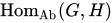







- i) It is an Abelian group under addition.
- ii) It is a monoid under multiplication.
- iii) Addition distributes over composition.
Indeed, for the third property, note that if and , then and . The following material is a generalization of this situation.



Introduction to Rings[edit | edit source]
Definition 1: A ring is a set with two binary operations and that satisfies the following properties:


For all

- i) is an abelian group.

- ii) is a monoid.

The definition of ring homomorphism does not include the existence of 1.
- iii) is distributive over :
- 1)
- 2)


We will denote the additive identity in a ring by or if the ring is understood. Similarily, we denote the multiplicative identity by or when the ring is understood. We'll often use juxtaposition in place of , i.e., for .


Remark 2: Some authors do not require their rings to have a multiplicative identity element. We will call a ring without an idenitity a rng. Pseudo-rings is another term used for rings without unity. Authors who do not require a multiplicative identity usually call a ring a ring with unity. Unless otherwise stated, we will assume that in our rings. A major part of noncommutaive ring theory was developed without assuming every ring has an identity element.

Example 3: The reader is already familiar with several examples of rings. For instance and with the usual addition and multiplication operations. We have a familiy of finite rings given by the sets for integer with addition and multiplication defined modulo . Finally we have an example of a rng given by the sets for integer with the usual addition and multiplication. The reader is invited to confirm the ring axioms for these examples.


Let us now prove some very basic properties about rings. This is analogous to what we did for groups when we first introduced them.
Theorem 4: Let be a ring, and let . Then the following are true:

- If , then .
- The equation has a unique solution.





Proof: (1), (2), and (3) all strictly concern addition, and are all previous results from being a group. The other three parts all concern both addition and multiplication (since 0 and - are additive concepts), so as a proof strategy we expect to use the distributive law in some way to link the two operations. For (4), observe that . But then by (1), 0a=0. For (5), Note that . For (6) note that . ∎



Remark 5: Take another look at the examples in Example 3. Notice that for all those rings, multiplication is a commutative opration. However, the axioms say nothing about this. Thus we should expect to find counter-examples to this.
Definition 6: A ring is called commutative if multiplication is commutative.
Example 7: An example of a non-commutative ring is the set of square matrices with real coefficients under standard addition and multiplication of matrices, where is an integer. The reader can easily check this for and conclude that it holds for all other (why?).


Theorem 8: A ring has a unique multiplicative identity.
Proof: During our brief discussion of monoids earlier, we showed that in any monoid the identity is unique. Since a ring sans addition is a monoid, this applies here. ∎
Example 9: The singleton set with addition and multiplication defined by and is a ring, called the trivial ring or the zero ring. Note that in the trivial ring, . The reader is invited to show that in a ring if and only if it is the trivial ring.


If the reader has tried to construct some of the rings , he/she may have realised that certain non-zero elements have product zero. We formalize this concept as follows.

Definition 10: Let be a ring and . is called a left(resp.right)-zero-divisor if there exists a such that .


Lemma 11: Let be a ring with . Define the function given by for all . Then is injective if and only if is not a left-zero-divisor.


Proof: Assume is not a left-zero-divisor, and assume we have for some . This implies , giving since is not a left-zero-divisor, so is injective. Conversely, assume is a left-zero-divisor. Then there exists a such that and , so is not injective. ∎





Remark 12: Thus, multiplication by is left-cancellative if and only if is not a zero-divisor. The reader is invited to state and prove the equivalent lemma for right-zero-divisors.
Example 13: are all examples of commutative rings without zero divisors. These rings motivate the next definition.

Definition 14: Let be a commutative ring without zero divisors. Then is called an integral domain.
Just like Definition 14, the majority of special types of rings will be motivated by properties of .
Example 15:
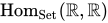
- The set of functions on with pointwise addition and multiplication is a ring.
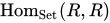
- More generally, if is a ring, the set of functions from to itself is also a ring.
- The set with function composition for multiplication is not a ring since the statement is not true in general.
- The set of integrable functions on the real numbers, , is a rng under pointwise addition and multiplication given by convolution: . This rng is important to the study of linear systems and differential equations. If the reader has enough calculus under his/her belt, he/she reader is invited to show that it does not have an identity, and that it is commutative.
- The set of Gaussian integers with standard addition and multiplication is a ring.




![{\displaystyle \mathbb {Z} \left[i\right]=\left\{a+bi|a,b\in \mathbb {Z} \right\}}](https://wikimedia.org/api/rest_v1/media/math/render/svg/67e648a9b89883f48df600946c761d1fba95731f)
Definition 16: Let be a ring. An element is a unit and is invertible if there is an element such that . The set of all units is denoted by .


Exercise 17: Prove that is a group under multiplication.
Exercise 18:: Show that a zero-divisor is not a unit.
Theorem 19: (Cancellation Law for Integral Domains): Let be an integral domain, and let be nonzero. Then if and only if .

Proof: Evidently if . To see the other direction, we rearrange the equality as . But then . Since is nonzero, and contains no zero divisors, it must be the case that , which is to say that .


Definition 20: A ring is a division ring or skew field if all non-zero elements are units, i.e. if it forms a group under multiplication with its nonzero elements.
Definition 21: A field is a commutative division ring. Alternatively, a field is a ring where is an abelian group under multiplication. As another alternative, a field is an integral domain where all non-zero elements are invertible.


As stated before, integral domains are easy to work with because they are so close to being fields. In fact, the next theorem shows just how close the two are:
Theorem 22: Let be a finite integral domain. Then is a field.
Proof: Let be nonzero and let . Clearly is a subset of . From the cancellation law, we can see that (since if two elements and are equal, then ). But then . So then there must be some such that . So is a unit.



Of course proving that a set with two operations satisfy all of the ring axioms can be tedious. So, just as we did for groups, we note that if we're considering a subset of something that's already a ring, then our job is easier.
Definition 23: A subring of a ring is a subset of that is also a ring (under the same two operations as for ) and . We denote " is a subring of " by . Note many mathematicians do not require rings or subrings to have an identity.


Theorem 24: Let be a subset of a ring . Then if and only if for all ,


- ,
- ,
- .


Example 25:
- .
- The trivial ring is a subring of every ring.
- The set of Gaussian integers is a subring of the complex numbers .


![{\displaystyle \mathbb {Z} \left[i\right]}](https://wikimedia.org/api/rest_v1/media/math/render/svg/981a623e851bb20e1d751d4fec022f6d8f009443)