A-level Physics (Advancing Physics)/Kinematics
Kinematics is the study of how objects move. One needs to understand a situation in which an object changes speed, accelerating or decelerating, and travelling a certain distance. There are four equations you need to be able to use which relate these quantities.
Variables[edit | edit source]
Before we can understand the kinematic equations, we need to understand the variables involved. They are as follows:
- t is the length of the interval of time being considered, in seconds.
- v is the speed of the object at the end of the time interval, in ms−1.
- u is the speed of the object at the beginning of the time interval, in ms−1.
- a is the acceleration of the object during the time interval, in ms−2. Has to be a constant.
- s is the displacement (distance traveled) of the object during the time interval, in meters.
Equations[edit | edit source]
The four equations are as follows:
1.

2.

3.
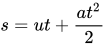
4.
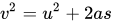
Derivations[edit | edit source]
It is also useful to know where the above equations come from. We know that acceleration is equal to change in speed per. unit time, so:
(*)


(1)
We also know that the average speed over the time interval is equal to displacement per. unit time, so:

(2)
If we substitute the value of v from equation 1 into equation 2, we get:
(3)

If we take the equation for acceleration (*), we can rearrange it to get:

If we substitute this equation for t into equation 2, we obtain:

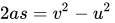
(4)
Questions[edit | edit source]
1. A person accelerates from a speed of 1 ms−1 to 1.7 ms−1 in 25 seconds. How far has he travelled in this time?
2. A car accelerates at a rate of 18 kmh−2 to a speed of 60 kmh−1, travelling 1 km in the process. How fast was the car travelling before it travelled this distance?
3. A goose in flight is travelling at 4 ms−1. It accelerates at a rate of 1.5 ms−2 for 7 seconds. What is its new speed?
4. How far does an aeroplane travel if it accelerates from 400 kmh−1 at a rate of 40 kmh−2 for 1 hour?