A-level Physics (Advancing Physics)/Gravitational Fields
The gravitational field, or gravitational field strength is the force exerted by gravity on an object per. unit mass of the object:

As gravitational field strength is a measure of the force exerted on each unit of mass, its unit is Nkg−1. If we consider a planet, Body A, the gravitational field strength experienced by another object, Body B, is given by:
Dimensions :-
![{\displaystyle [g]=[G]{\frac {[M]}{{[r]}^{2}}}=[G]ML^{-2}=LT^{-2}}](https://wikimedia.org/api/rest_v1/media/math/render/svg/2537c4a7e7a7372fc14751284c994c30d966850b)
This is the total force exerted on Body B divided by the mass of Body B. Inside the planet, force is proportional to the distance from the centre, so the field is also proportional to distance.
Acceleration[edit | edit source]
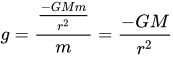
Force is given by:

This means that:

This shows that the gravitational field strength is also the acceleration due to gravity on any object. This acceleration is the same for any object, regardless of mass. When considering small heights above the Earth's surface, such as those in our day-to-day experiences, g remains roughly constant.
Field Lines[edit | edit source]

The gravitational field can be represented using field lines. These run in the direction that a mass would be accelerated in initially. The object will not necessarily fall along the field lines, but the acceleration will always be in the direction of the field lines. The closer the field lines are together, the denser the gravitational field.
Questions[edit | edit source]
G = 6.67 x 10⁻¹¹ m3kg−1s−2
1. A 15 kg object has a weight of 8000N. What is the gravitational field strength at this point?
2. Draw a graph of gravitational field strength against distance.
3. What is the gravitational field strength of the Sun (mass 2 x 1030kg) on the Earth (mass 6 x 1024kg, mean orbital radius 15 x 1010m)?
4. What is the difference in the acceleration due to gravity over a vertical distance d?
5. How far would one have to travel upwards from the Earth's surface to notice a 1Nkg−1 difference in gravitational field? (The Earth has a radius of 6400 km.)