OCR A-Level Physics/The SI System of Units
SI units are used throughout science in many countries of the world. It was adopted in 1960 as the preferred variant of the metric system. The metric system itself dates back to the 1790.
Base units[edit | edit source]
There are seven base units, from which all other units are derived. Every other unit is either a combination of two or more base units, or a reciprocal of a base unit. Since 2019 all of the base units are defined with reference to measurable natural phenomena. Also, notice that the kilogram is the only base unit with a prefix. This is because the gram is too small for most practical applications.
| Quantity | Name | Symbol |
|---|---|---|
| Length | metre | m |
| Mass | kilogram | kg |
| Time | second | s |
| Electric Current | ampere | A |
| Thermodynamic Temperature | kelvin | K |
| Amount of Substance | mole | mol |
| Luminous Intensity | candela | cd |
Derived units[edit | edit source]
Most of the derived units are the base units divided or multiplied together. Some of them have special names. You can see how each unit relates to any other unit, and knowing the base units for a particular derived unit is useful when checking if your working is correct.
Note that "m/s", "m s-1", "m·s-1" and are all equivalent. The negative exponent form is generally preferred, for example "kg·m-1·s-2" is unambiguous. In contrast "kg/m/s2" is ambiguous -

is it or is it ?


| Quantity | Name | Symbol | In terms of other derived units | In terms of base units |
|---|---|---|---|---|
| plane angle | radian | rad | m m-1 = 1 | |
| solid angle | steradian | sr | m2 m-2 = 1 | |
| Area | square metre | m2 | m2 | |
| Volume | cubic metre | m3 | m3 | |
| Speed/Velocity | metre per second | m s-1 | m s-1 | |
| Acceleration | metre per second squared | m s-2 | m s-2 | |
| Density | kilogram per cubic metre | kg m-3 | m-3 kg | |
| Specific Volume | cubic metre per kilogram | m3 kg-1 | m3 kg-1 | |
| Current Density | ampere per square metre | A m-2 | m-2 A | |
| Magnetic Field Strength | ampere per metre | m-1 A | m-1 A | |
| Concentration | mole per cubic metre | m-3 mol | m-3 mol | |
| Frequency | hertz | Hz | s-1 | s-1 |
| Force | newton | N | kg m s-2 | m kg s-2 |
| Pressure Stress |
pascal | Pa | N m-2 | m-1 kg s-2 |
| Energy Work/ Quantity of Heat |
joule | J | N m | m2 kg s-2 |
| Power Radiant Flux |
watt | W | J s-1 | m2 kg s-3 |
| Electric Charge Quantity of Electricity |
coulomb | C | A s | s A |
| Electric Potential Potential Difference Electromotive Force |
volt | V | W A-1 | m2 kg s-3 A-1 |
| Capacitance | Farad | F | C V-1 | m-2 kg-1 s4 A2 |
| Electric Resistance | Ohm | Ω | V A-1 | m2 kg s-3 A-2 |
| Electric Conductance | siemens | S | A V-1 Ω-1 |
m-2 kg-1 s3 A2 |
| Magnetic Flux | weber | Wb | V s | m2 kg s-2 A-1 |
| Magnetic Flux Density | Tesla | T | Wb m-2 | kg s-2 A-1 |
| Inductance | henry | H | Wb A-1 | m2 kg s-2 A-2 |
| Celsius Temperature | degree Celsius | °C | K - 273.15 | |
| Luminous Flux | lumen | lm | sr cd | |
| Illuminance | lux | lx | lm m-2 | sr m-2 cd |
| Activity of a Radionuclide | bequerel | Bq | s-1 | s-1 |
| Absorbed dose | gray | Gy | J kg-1 | m2 s-2 |
| Dose equivalent | sievert | Sv | J kg-1 | m2 s-2 |
Symbols usually start with a lower case letter unless the unit was named after somebody - for example "newtons" (note lower case letter when writing in English about the units) were named after Sir Isaac Newton, "watts" after James Watt, "farads" after Michael Faraday and so on.
Prefixes[edit | edit source]
The SI units can have prefixes to make larger or smaller numbers more manageable. For example, visible light has a wavelength of roughly 0.0000005 m, but it is more commonly written as 500 nm. If you must specify a quantity like this in metres, you should write it in standard form. As given by the table below, 1 nm = 1×10⁻⁹ m. In standard form, the first number must be between 1 and 10. So to put 500 nm in standard form, you would divide the 500 by 100 to get 5, then multiply the factor by 100 (so that it's still the same number), getting 5×10⁻⁷ m. The power of 10 in this answer, i.e.,. -7, is called the exponent, or the order of magnitude of the quantity.
| Prefix | Symbol | Factor | Common Term |
|---|---|---|---|
| peta | P | quadrillions | |
| tera | T | trillions | |
| giga | G | billions | |
| mega | M | millions | |
| kilo | k | thousands | |
| hecto | h | hundreds | |
| deca | da | tens | |
| deci | d | tenths | |
| centi | c | hundredths | |
| milli | m | thousandths | |
| micro | µ | millionths | |
| nano | n | billionths | |
| pico | p | trillionths | |
| femto | f | quadrillionths |


Homogenous equations[edit | edit source]
Equations must always have the same units on both sides, and if they don't, you have probably made a mistake. Once you have your answer, you can check that the units are correct by doing the equation again with only the units.
Example 1[edit | edit source]
For example, to find the velocity of a cyclist who moved 100 metres in 20 seconds, you have to use the formula
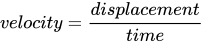
so your answer would be 100÷20 = 5 m·s-1.
This question has the units m ÷ s and should give an answer in m·s-1. Here, the equation was correct, and makes sense. In this case a middle-dot (·) has been inserted between the "m" and the "s" to show that this is metres per second, not milliseconds.
Often, however, it isn't that simple. If a car of mass 500 kg had an acceleration of 0.2 m·s-2, you could use Newton's second law

to show that the force provided by the engines is 100 N. At first glance it would seem the equation is not homogeneous, since the equation uses the units (kg) × (m·s-2), which should give an answer in kg·m·s-2. If you look at the derived units table above, you can see that a newton is in fact equal to kg·m·s-2, and therefore the equation is correct.
Example 2[edit | edit source]
Using the same example as above, imagine that we are only given the mass of the car and the force exerted by the engine, and have been asked to find the acceleration of the car. Using
again, we need to rearrange it for a. We do this incorrectly by setting
- .

By inserting the numbers, we get the answer a = 5 m·s-2. We already know that this is wrong from the example above, but by looking at the units, we can see why this is the case
- .
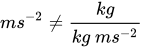
The units are m-1·s2, when we were looking for m·s-2. The problem is the fact that "F=ma" was rearranged incorrectly. The correct formula was
- ,

and using it will give the correct answer of 0.2 m·s-2. The units for the correct formula are
- .

