We think of a function as an operation that takes one number and transforms it into another number. A mapping is a more general type of function. It is simply a way to relate a number in one set, to a number in another set.
Let us look at three different types of mappings:
- one-to-one - this mapping gives one unique output for each input.
- many-to-one - this type of mapping will produce the same output for more than one value of
 .
.
- one-to-many - this mapping produces more than one output for each input.
Only the first two of these mappings are functions. An example of a mapping which is not a function is 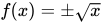
Domain and range of a function[edit | edit source]
In general:
 is called the image of .
- The set of permitted values is called the domain of the function
- The set of all images is called the range of the function
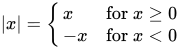
The modulus of , written  , is defined as
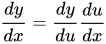
The chain rule states that:
If  is a function of
  , and is a function of ,
As you can see from above, the first step is to notice that we have a function that we can break down into two, each of which we know how to differentiate. Also, the function is of the form  .
The process is then to assign a variable to the inner function, usually , and use the rule above;
.
The process is then to assign a variable to the inner function, usually , and use the rule above;
Differentiate 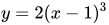
We can see that this is of the correct form, and we know how to differentiate each bit.
Let 
Now we can rewrite the original function, 
We can now differentiate each part;
 and
and

Now applying the rule above;

The product rule states that:
If  , where and
  are both functions of , then
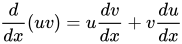
An alternative way of writing the product rule is:

Or in Lagrange notation:
If  ,
,
then 
The quotient rule states that:
If  , where and are functions of , then
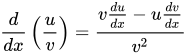
An alternative way of writing the quotient rule is:
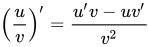
In general,

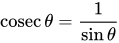
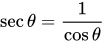
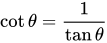
The functions cosec θ, sec θ and cot θ[edit | edit source]
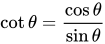
Standard trigonometric identities[edit | edit source]


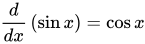
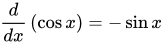
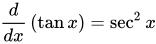
Differentiation of sin x, cos x and tan x[edit | edit source]
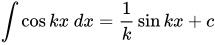
Integration of sin(kx) and cos(kx)[edit | edit source]
In general,

Exponentials and logarithms[edit | edit source]
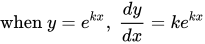
Differentiating exponentials and logarithms[edit | edit source]
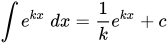
In general,
If  , then

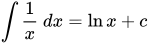
It follows from this result that


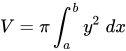
The volume of the solid formed when the area under the curve  , between
  and
and  , is rotated through 360° about the -axis is given by:
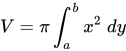
The volume of the solid formed when the area under the curve , between  and
and  , is rotated through 360° about the -axis is given by:
An iterative method is a process that is repeated to produce a sequence of approximations to the required solution.
Mid ordinate rule

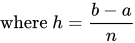
Simpson's rule

