A-level Chemistry/OCR (Salters)/Born-Haber cycles
Jump to navigation
Jump to search

Atomisation[edit | edit source]
Atomisation is the process of converting an element in its standard state to a monatomic gas.
The amount of energy required to achieve atomisation is termed the enthalpy change of atomisation, ΔHat, measured in kJ mol−1.
The quantity you find in most data tables is the standard enthalpy change of atomisation, which is the amount of energy required to convert one mole of an element in its standard state to a monatomic gas, under standard conditions.
The equation for atomisation is:
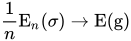
- where σ represents the standard state of the element, so
- if E is a solid is its standard state, σ = s
- if E is a liquid is its standard state, σ = l
- if E is a gas is its standard state, σ = g.
For example, the symbol represents the standard enthalpy change of atomisation of sodium,



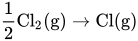
The case of chlorine is slightly more complicated: represents the standard enthalpy change of atomisation of chlorine,


Ionisation[edit | edit source]

Electron affinity[edit | edit source]

Lattice enthalpy[edit | edit source]
