There is a rendering bug lurking here, so if you see angry red text, go into the Wiki's Preferences / Appearances / Math and set it to MathJax.
1. Find parametric equations describing the line segment from P(0,0) to Q(7,17).
x=7t and y=17t, where 0 ≤ t ≤ 1
x=7t and y=17t, where 0 ≤ t ≤ 1
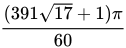
2. Find parametric equations describing the line segment from

to

.

3. Find parametric equations describing the ellipse centered at the origin with major axis of length 6 along the x-axis and the minor axis of length 3 along the y-axis, generated clockwise.

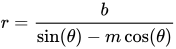
21. Find an equation of the line y=mx+b in polar coordinates.
Sketch the following polar curves without using a computer.
22.

23.

24.

Sketch the following sets of points.
25.

26.

Find points where the following curves have vertical or horizontal tangents.
40.

Horizontal tangents at (2,2) and (2,-2); vertical tangents at (0,0) and (4,0)
Horizontal tangents at (2,2) and (2,-2); vertical tangents at (0,0) and (4,0)
41.

Horizontal tangents at (r,θ) = (4,π/2), (1,7π/6) and (1,-π/6); vertical tangents at (r,θ) = (3,π/6), (3,5π/6), and (0,3π/4)
Horizontal tangents at (r,θ) = (4,π/2), (1,7π/6) and (1,-π/6); vertical tangents at (r,θ) = (3,π/6), (3,5π/6), and (0,3π/4)
Sketch the region and find its area.
60. Find an equation of the sphere with center (1,2,0) passing through the point (3,4,5)

61. Sketch the plane passing through the points (2,0,0), (0,3,0), and (0,0,4)
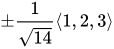
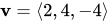
63. Find all unit vectors parallel to

64. Prove one of the distributive properties for vectors in

:

Failed to parse (SVG (MathML can be enabled via browser plugin): Invalid response ("Math extension cannot connect to Restbase.") from server "http://localhost:6011/en.wikibooks.org/v1/":): {\displaystyle \begin{eqnarray} c(\mathbf u + \mathbf v) &=& c(\langle u_1, u_2, u_3\rangle + \langle v_1, v_2, v_3\rangle)\\ &=& c\langle u_1+v_1, u_2+v_2, u_3+v_3\rangle\\ &=& \langle c(u_1+v_1), c(u_2+v_2), c(u_3+v_3)\rangle\\ &=& \langle cu_1+cv_1, cu_2+cv_2, cu_3+cv_3\rangle\\ &=& \langle cu_1, cu_2, cu_3\rangle + \langle cv_1, cv_2, cv_3\rangle\\ &=& c\mathbf u + c\mathbf v. \end{eqnarray}}
Failed to parse (SVG (MathML can be enabled via browser plugin): Invalid response ("Math extension cannot connect to Restbase.") from server "http://localhost:6011/en.wikibooks.org/v1/":): {\displaystyle \begin{eqnarray} c(\mathbf u + \mathbf v) &=& c(\langle u_1, u_2, u_3\rangle + \langle v_1, v_2, v_3\rangle)\\ &=& c\langle u_1+v_1, u_2+v_2, u_3+v_3\rangle\\ &=& \langle c(u_1+v_1), c(u_2+v_2), c(u_3+v_3)\rangle\\ &=& \langle cu_1+cv_1, cu_2+cv_2, cu_3+cv_3\rangle\\ &=& \langle cu_1, cu_2, cu_3\rangle + \langle cv_1, cv_2, cv_3\rangle\\ &=& c\mathbf u + c\mathbf v. \end{eqnarray}}
66. Find all unit vectors orthogonal to

in
![{\displaystyle \left\langle {\frac {4}{5}}c,-{\frac {3}{5}}c,{\sqrt {1-c^{2}}}\right\rangle ,\ c\in [-1,1]}](https://wikimedia.org/api/rest_v1/media/math/render/svg/ec58739fb84b755913f1b1240cecc19cacfcaa51)
Find  and
and 
80.
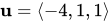
and


81.
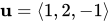
and
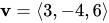

Find the area of the parallelogram with sides  and
and  .
.
84. Find all vectors that satisfy the equation

85. Find the volume of the parallelepiped with edges given by position vectors

,

, and


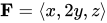
86. A wrench has a pivot at the origin and extends along the
x-axis. Find the magnitude and the direction of the torque at the pivot when the force

is applied to the wrench
n units away from the origin.
 , so the torque is directed along
, so the torque is directed along Prove the following identities or show them false by giving a counterexample.
89.

Failed to parse (unknown function "\begin{eqnarray}"): {\displaystyle \begin{eqnarray}(\mathbf u-\mathbf v)\times(\mathbf u+\mathbf v)&=&(\mathbf u-\mathbf v)\times\mathbf u + (\mathbf u-\mathbf v)\times\mathbf v\\&=&\mathbf u\times\mathbf u - \mathbf v\times\mathbf u + \mathbf u\times\mathbf v - \mathbf v\times\mathbf v\\&=&\mathbf u\times\mathbf v-\mathbf v\times\mathbf u\\&=&\mathbf u\times\mathbf v + \mathbf u \times \mathbf v\\&=&2(\mathbf u\times\mathbf v)\end{eqnarray}}
Failed to parse (unknown function "\begin{eqnarray}"): {\displaystyle \begin{eqnarray}(\mathbf u-\mathbf v)\times(\mathbf u+\mathbf v)&=&(\mathbf u-\mathbf v)\times\mathbf u + (\mathbf u-\mathbf v)\times\mathbf v\\&=&\mathbf u\times\mathbf u - \mathbf v\times\mathbf u + \mathbf u\times\mathbf v - \mathbf v\times\mathbf v\\&=&\mathbf u\times\mathbf v-\mathbf v\times\mathbf u\\&=&\mathbf u\times\mathbf v + \mathbf u \times \mathbf v\\&=&2(\mathbf u\times\mathbf v)\end{eqnarray}}
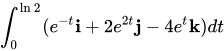
100. Differentiate

.

101. Find a tangent vector for the curve

at the point

.

102. Find the unit tangent vector for the curve

.

103. Find the unit tangent vector for the curve
![{\displaystyle \mathbf {r} (t)=\langle \sin(t),\cos(t),e^{-t}\rangle ,\ t\in [0,\pi ]}](https://wikimedia.org/api/rest_v1/media/math/render/svg/a2f30552af99a8f55083220a2960a8a6697bad79)
at the point

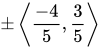
.

104. Find

if

and

.

120. Find velocity, speed, and acceleration of an object if the position is given by

.
 ,
,  ,
, 
, , 121. Find the velocity and the position vectors for

if the acceleration is given by

.
 ,
, 
, Find the length of the following curves.
142. Find a description of the curve that uses arc length as a parameter:
![{\displaystyle \mathbf {r} (t)=\langle t^{2},2t^{2},4t^{2}\rangle \ t\in [1,4].}](https://wikimedia.org/api/rest_v1/media/math/render/svg/9715ec537d31fdc34e2ac352df9235bfa517bc28)
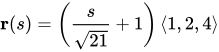
143. Find the unit tangent vector
T and the principal unit normal vector
N for the curve
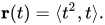
Check that
T⋅
N=0.

160. Find an equation of a plane passing through points


161. Find an equation of a plane parallel to the plane 2x−y+z=1 passing through the point (0,2,-2)

162. Find an equation of the line perpendicular to the plane x+y+2z=4 passing through the point (5,5,5).

163. Find an equation of the line where planes x+2y−z=1 and x+y+z=1 intersect.

164. Find the angle between the planes x+2y−z=1 and x+y+z=1.

165. Find the distance from the point (3,4,5) to the plane x+y+z=1.

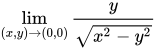
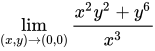
Evaluate the following limits.
180.
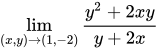
181.
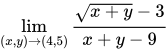
At what points is the function f continuous?
183.
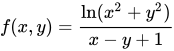
All points (x,y) except for (0,0) and the line y=x+1
All points (x,y) except for (0,0) and the line y=x+1
Use the two-path test to show that the following limits do not exist. (A path does not have to be a straight line.)
184.
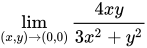
The limit is 1 along the line y=x, and −1 along the line y=−x
The limit is 1 along the line y=x, and −1 along the line y=−x
186.
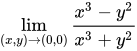
The limit is 1 along the line y=0, and −1 along the line x=0
The limit is 1 along the line y=0, and −1 along the line x=0
201. Find all three partial derivatives of the function


Find the four second partial derivatives of the following functions.
202.


203.
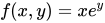

Find 
221.

222.

Find 
223.

Failed to parse (SVG (MathML can be enabled via browser plugin): Invalid response ("Math extension cannot connect to Restbase.") from server "http://localhost:6011/en.wikibooks.org/v1/":): {\displaystyle f_s = \cos(s+t)\cos(2s-2t) - 2\sin(s+t)\sin(2s-2t)\\ f_t = \cos(s+t)\cos(2s-2t) + 2\sin(s+t)\sin(2s-2t)}
Failed to parse (SVG (MathML can be enabled via browser plugin): Invalid response ("Math extension cannot connect to Restbase.") from server "http://localhost:6011/en.wikibooks.org/v1/":): {\displaystyle f_s = \cos(s+t)\cos(2s-2t) - 2\sin(s+t)\sin(2s-2t)\\ f_t = \cos(s+t)\cos(2s-2t) + 2\sin(s+t)\sin(2s-2t)}
224.

Failed to parse (syntax error): {\displaystyle \displaystyle f_s = \frac{-2t(t+1)}{(st+s-t)^2}\\ \displaystyle f_t = \frac{2s}{(st+s-t)^2}}
Failed to parse (syntax error): {\displaystyle \displaystyle f_s = \frac{-2t(t+1)}{(st+s-t)^2}\\ \displaystyle f_t = \frac{2s}{(st+s-t)^2}}
225. The volume of a pyramid with a square base is

, where
x is the side of the square base and
h is the height of the pyramid. Suppose that
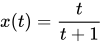
and
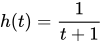
for

Find


Find an equation of a plane tangent to the given surface at the given point(s).
240.


241.


Find critical points of the function f. When possible, determine whether each critical point corresponds to a local maximum, a local minimum, or a saddle point.
260.

Local minima at (1,1) and (−1,−1), saddle at (0,0)
Local minima at (1,1) and (−1,−1), saddle at (0,0)
261.

262.

Saddle at (0,0), local maxima at  local minima at
Saddle at (0,0), local maxima at local minima at Find absolute maximum and minimum values of the function f on the set R.
263.

Maximum of 9 at (0,−2) and minimum of 0 at (0,1)
Maximum of 9 at (0,−2) and minimum of 0 at (0,1)
264.
 R
R is a closed triangle with vertices (0,0), (2,0), and (0,2).
Maximum of 0 at (2,0), (0,2), and (0,0); minimum of −2 at (1,1)
Maximum of 0 at (2,0), (0,2), and (0,0); minimum of −2 at (1,1)
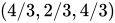
265. Find the point on the plane x−y+z=2 closest to the point (1,1,1).
Evaluate the given integral over the region R.
280.
![{\displaystyle \displaystyle \iint _{R}(x^{2}+xy)dA,\ R=\{(x,y)\mid x\in [1,2],\ y\in [-1,1]\}}](https://wikimedia.org/api/rest_v1/media/math/render/svg/ed365e6e7ddc55551e813614af01d9c10cdc9af6)

281.
![{\displaystyle \displaystyle \iint _{R}(xy\sin(x^{2}))dA,\ R=\{(x,y)\mid x\in [0,{\sqrt {\pi /2}}],\ y\in [0,1]\}}](https://wikimedia.org/api/rest_v1/media/math/render/svg/348d8c966096be3b39bffd752544bc134cb87182)

282.
![{\displaystyle \displaystyle \iint _{R}{\frac {x}{(1+xy)^{2}}}dA,\ R=\{(x,y)\mid x\in [0,4],\ y\in [1,2]\}}](https://wikimedia.org/api/rest_v1/media/math/render/svg/e1d6288e4ccdb0134f6d2546fdd60591316f57ca)

Evaluate the given iterated integrals.
Evaluate the following integrals.
300.
 R
R is bounded by
x=0,
y=2
x+1, and
y=5−2
x.

301.
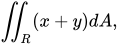 R
R is in the first quadrant and bounded by
x=0,

and


Use double integrals to compute the volume of the given region.
323. Evaluate
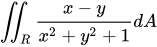
if
R is the unit disk centered at the origin.

In the following exercises, sketching the region of integration may be helpful.
341. Find the volume of the solid in the first octant bounded by the plane 2x+3y+6z=12 and the coordinate planes.

342. Find the volume of the solid in the first octant bounded by the cylinder

for
![{\displaystyle y\in [0,\pi ]}](https://wikimedia.org/api/rest_v1/media/math/render/svg/0281fdf747a9247ed8a56221ddd07b34c2a50097)
, and the planes
y=
x and
x=0.

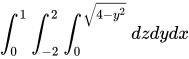
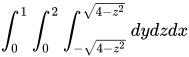
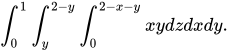
344. Rewrite the integral
in the order
dydzdx.
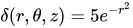
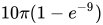
361. Find the mass of the solid cylinder
![{\displaystyle D=\{(r,\theta ,z)\mid r\in [0,3],\ z\in [0,2]\}}](https://wikimedia.org/api/rest_v1/media/math/render/svg/b3d5655e4f2397642509c6640400d7087e95cf35)
given the density function
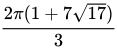
362. Use a triple integral to find the volume of the region bounded by the plane
z=0 and the hyperboloid

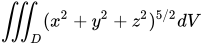
363. If
D is a unit ball, use a triple integral in spherical coordinates to evaluate

364. Find the mass of a solid cone
![{\displaystyle \{(\rho ,\phi ,\theta )\mid \phi \leq \pi /3,\ z\in [0,4]\}}](https://wikimedia.org/api/rest_v1/media/math/render/svg/f200079667c56d8b47444f8062308745eb385015)
if the density function is


380. Find the center of mass for three particles located in space at (1,2,3), (0,0,1), and (1,1,0), with masses 2, 1, and 1 respectively.

384. Find the centroid of the region in the first quadrant bounded by

,

, and

.

385. Find the center of mass for the region
![{\displaystyle \{(x,y)\mid x\in [0,4],y\in [0,2]\}}](https://wikimedia.org/api/rest_v1/media/math/render/svg/9e476dabc9b7a7dfe36cd98372488912496465f7)
, with the density


386. Find the center of mass for the triangular plate with vertices (0,0), (0,4), and (4,0), with density


One can sketch two-dimensional vector fields by plotting vector values, flow curves, and/or equipotential curves.
402. Find and sketch the gradient field

for the potential function

for

and

.

403. Find the gradient field
for the potential function


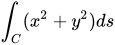
420. Evaluate
if
C is the line segment from (0,0) to (5,5)

421. Evaluate
if
C is the circle of radius 4 centered at the origin
422. Evaluate

if
C is the helix
![{\displaystyle \mathbf {r} (t)=\langle 3\cos(t),3\sin(t),t\rangle ,\ t\in [0,2\pi ]}](https://wikimedia.org/api/rest_v1/media/math/render/svg/0c08e2103ca08229383eb122b8d4d0b8dba3eac9)

423. Evaluate

if

and
C is the arc of the parabola
![{\displaystyle \mathbf {r} (t)=\langle 4t,t^{2}\rangle ,\ t\in [0,1]}](https://wikimedia.org/api/rest_v1/media/math/render/svg/642cd051fef71427b9ff15e0885d8b70e1d1f344)

Determine if the following vector fields are conservative on 
440.

441.

Determine if the following vector fields are conservative on their respective domains in  When possible, find the potential function.
442.


443.
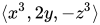

460. Evaluate the circulation of the field

over the boundary of the region above
y=0 and below
y=
x(2-
x) in two different ways, and compare the answers.
461. Evaluate the circulation of the field

over the unit circle centered at the origin in two different ways, and compare the answers.
462. Evaluate the flux of the field

over the square with vertices (0,0), (1,0), (1,1), and (0,1) in two different ways, and compare the answers.
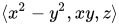
482. Find the curl of

484. Prove that the general rotation field

, where

is a non-zero constant vector and

, has zero divergence, and the curl of

is

.
If  , then
 , and then


If , then
, and then
500. Give a parametric description of the plane


501. Give a parametric description of the hyperboloid

![{\displaystyle \langle {\sqrt {v^{2}-1}}\cos(u),{\sqrt {v^{2}-1}}\sin(u),v\rangle ,\ u\in [0,2\pi ],\ |v|\geq 1}](https://wikimedia.org/api/rest_v1/media/math/render/svg/6e30ae2582ed79c8841a5ec44ce9a38adb627be5)
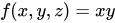
502. Integrate
over the portion of the plane
z=2−
x−
y in the first octant.

504. Find the flux of the field

across the surface of the cone
![{\displaystyle z^{2}=x^{2}+y^{2},\ z\in [0,1],}](https://wikimedia.org/api/rest_v1/media/math/render/svg/bdef9c8592f3f4001cfc49e3df0f914ece0b10df)
with normal vectors pointing in the positive
z direction.
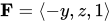
505. Find the flux of the field
across the surface
![{\displaystyle y=x^{2},\ z\in [0,4],\ x\in [0,1],}](https://wikimedia.org/api/rest_v1/media/math/render/svg/75190cd1fce58f3ae022e60f9e482de598e957cd)
with normal vectors pointing in the positive
y direction.

520. Use a surface integral to evaluate the circulation of the field

on the boundary of the plane

in the first octant.

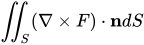
522. Use a line integral to find
where
,

is the upper half of the ellipsoid
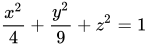
, and

points in the direction of the
z-axis.
523. Use a line integral to find
where

,
is the part of the sphere

for

, and
points in the direction of the
z-axis.

Compute the net outward flux of the given field across the given surface.
540.

,
is a sphere of radius

centered at the origin.

542.

,
is the boundary of the cube

543.
,
is the surface of the region bounded by the paraboloid

and the
xy-plane.

544.

,
is the boundary of the region between the concentric spheres of radii 2 and 4, centered at the origin.

545.

,
is the boundary of the region between the cylinders

and

and cut off by planes

and

















![{\displaystyle \mathbf {r} (t)=\langle 4\cos(3t),4\sin(3t)\rangle ,\ t\in [0,2\pi /3].}](https://wikimedia.org/api/rest_v1/media/math/render/svg/f3681f0d46ab5bdb85098ee74c0058797105aace)

![{\displaystyle \mathbf {r} (t)=\langle 2+3t,1-4t,3t-4\rangle ,\ t\in [1,6].}](https://wikimedia.org/api/rest_v1/media/math/render/svg/1513778e4cae9f336be929232f7054e2840ec58f)






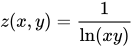









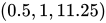
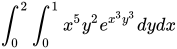

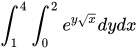




![{\displaystyle R=\{(x,y)\mid y\in [0,1],\ x\in [y,1]\}.}](https://wikimedia.org/api/rest_v1/media/math/render/svg/856d2cf8e1925376bee04c19cab0d5776798d7e3)





![{\displaystyle R=\{(r,\theta )\mid r\in [1,3],\ \theta \in [0,\pi /2]\}}](https://wikimedia.org/api/rest_v1/media/math/render/svg/bd2b79af3799bfeb6786939cced1210962a85ae2)

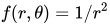
![{\displaystyle \{(r,\theta )\mid r\in [2,4]\}.}](https://wikimedia.org/api/rest_v1/media/math/render/svg/0f34d27bc87605d3269e518c127c478a3854701e)

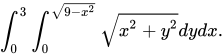


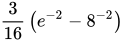

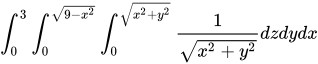




![{\displaystyle x\in [0,\pi ].}](https://wikimedia.org/api/rest_v1/media/math/render/svg/6060e8cfe67c32952064ce30d10d000735967451)

![{\displaystyle x\in [0,4].}](https://wikimedia.org/api/rest_v1/media/math/render/svg/246b2cdb5a7eb4ef2a89385af8652d13e75c1afb)

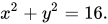

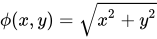
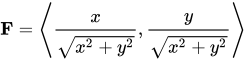

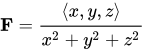

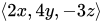


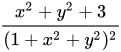



![{\displaystyle z=x^{2}+y^{2},\ z\in [0,4].}](https://wikimedia.org/api/rest_v1/media/math/render/svg/41908c387a7d4b76f5e34372862a7379b14c0707)