Waves are disturbances travelling in a medium . Fr example, Concentric circular water wave, Sin wave , Square wave ...
Characteristics of Sinusoidal wave
Wave shape
Wave equation
f
″
(
t
)
=
−
β
f
(
t
)
{\displaystyle f^{''}(t)=-\beta f(t)}
Wave function
f
(
t
)
=
A
s
i
n
ω
t
{\displaystyle f(t)=Asin\omega t}
Characteristics of Sinusoidal wave
Wave shape
Wave function
f
(
t
,
θ
)
=
A
s
i
n
(
ω
t
+
θ
)
−
A
s
i
n
(
ω
t
−
θ
)
{\displaystyle f(t,\theta )=Asin(\omega t+\theta )-Asin(\omega t-\theta )}
Characteristics of standing sinusoidal wave
Wave shape
Wave equation
a
f
″
(
t
)
+
b
f
′
(
t
)
+
c
f
(
t
)
=
0
{\displaystyle af^{''}(t)+bf^{'}(t)+cf(t)=0}
Wave function
f
(
t
)
=
A
(
α
)
s
i
n
ω
t
{\displaystyle f(t)=A(\alpha )sin\omega t}
ω
=
β
−
α
{\displaystyle \omega ={\sqrt {\beta -\alpha }}}
β
=
c
a
{\displaystyle \beta ={\frac {c}{a}}}
α
=
b
2
a
{\displaystyle \alpha ={\frac {b}{2a}}}
Characteristics of Sinusoidal wave
Wave shape
Wave equation
∇
2
E
=
−
β
E
{\displaystyle \nabla ^{2}E=-\beta E}
∇
2
B
=
−
β
B
{\displaystyle \nabla ^{2}B=-\beta B}
Wave function
E
=
A
s
i
n
ω
t
{\displaystyle E=Asin\omega t}
B
=
A
s
i
n
ω
t
{\displaystyle B=Asin\omega t}
Oscillation refers to any Periodic Motion moving at a distance about the equilibrium position and repeat itself over and over for a period of time . Example The Oscillation up and down of a Spring , The Oscillation side by side of a Spring. The Oscillation swinging side by side of a pendulum
When apply a force on an object of mass attach to a spring . The spring will move a distance y above and below the equilibrium point and this movement keeps on repeating itself for a period of time . The movement up and down of spring for a period of time is called Oscillation
Equilibrium is reached when
−
F
g
=
F
y
{\displaystyle -F_{g}=F_{y}}
m
g
=
−
k
y
{\displaystyle mg=-ky}
g
=
d
2
d
t
2
y
=
−
k
m
y
{\displaystyle g={\frac {d^{2}}{dt^{2}}}y=-{\frac {k}{m}}y}
y
=
A
e
±
j
ω
t
=
A
s
i
n
ω
t
{\displaystyle y=Ae^{\pm j\omega t}=Asin\omega t}
ω
=
k
m
=
β
{\displaystyle \omega ={\sqrt {\frac {k}{m}}}=\beta }
β
=
k
m
{\displaystyle \beta ={\frac {k}{m}}}
Equilibrium is reached when
F
a
=
−
F
x
{\displaystyle F_{a}=-F_{x}}
m
a
=
−
k
x
{\displaystyle ma=-kx}
a
=
d
2
d
t
2
x
=
−
k
m
x
{\displaystyle a={\frac {d^{2}}{dt^{2}}}x=-{\frac {k}{m}}x}
y
=
A
e
±
j
ω
t
=
A
s
i
n
ω
t
{\displaystyle y=Ae^{\pm j\omega t}=Asin\omega t}
ω
=
k
m
=
β
{\displaystyle \omega ={\sqrt {\frac {k}{m}}}=\beta }
β
=
k
m
{\displaystyle \beta ={\frac {k}{m}}}
When there is a force acting on a pendulum. The pendulum will swing from side to side for a certain period of time. This type of movement is called oscillation
Equilibrium is reached when
−
F
g
=
F
y
{\displaystyle -F_{g}=F_{y}}
−
m
g
=
l
θ
{\displaystyle -mg=l\theta }
g
=
d
2
d
t
2
θ
=
−
l
m
θ
{\displaystyle g={\frac {d^{2}}{dt^{2}}}\theta =-{\frac {l}{m}}\theta }
θ
=
A
e
±
j
ω
t
=
A
s
i
n
ω
t
{\displaystyle \theta =Ae^{\pm j\omega t}=Asin\omega t}
ω
=
l
m
{\displaystyle \omega ={\sqrt {\frac {l}{m}}}}
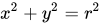
Concentric circles travels in a direction when there is a cobble drops on the water surface
x
2
+
y
2
=
r
2
{\displaystyle x^{2}+y^{2}=r^{2}}
T
a
n
θ
=
y
x
{\displaystyle Tan\theta ={\frac {y}{x}}}
Which can be expressed as
y
(
θ
)
=
r
S
i
n
θ
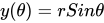
{\displaystyle y(\theta )=rSin\theta }
x
(
θ
)
=
r
C
o
s
θ
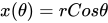
{\displaystyle x(\theta )=rCos\theta }
Water wave moves in a direction that changes its amplitude sinusoidally
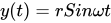
y
(
t
)
=
r
S
i
n
ω
t
{\displaystyle y(t)=rSin\omega t}
ω
=
λ
t
=
λ
f
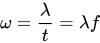
{\displaystyle \omega ={\frac {\lambda }{t}}=\lambda f}
With
λ
{\displaystyle \lambda }
: Wavelength . The distance between 2 crests (highest point)
f
{\displaystyle f}
: Frequency . frequency of time to complete a cycle
v
L
+
v
C
=
0
{\displaystyle v_{L}+v_{C}=0}
L
d
I
d
t
+
1
C
∫
I
d
t
=
0
{\displaystyle L{\frac {dI}{dt}}+{\frac {1}{C}}\int Idt=0}
d
I
d
t
+
1
L
C
∫
I
d
t
=
0
{\displaystyle {\frac {dI}{dt}}+{\frac {1}{LC}}\int Idt=0}
d
2
I
d
t
2
+
1
L
C
I
=
0
{\displaystyle {\frac {d^{2}I}{dt^{2}}}+{\frac {1}{LC}}I=0}
s
2
I
+
1
T
I
=
0
{\displaystyle s^{2}I+{\frac {1}{T}}I=0}
s
2
=
−
1
T
{\displaystyle s^{2}=-{\frac {1}{T}}}
s
=
−
1
T
=
±
j
1
T
=
±
j
ω
{\displaystyle s={\sqrt {-{\frac {1}{T}}}}=\pm j{\sqrt {\frac {1}{T}}}=\pm j\omega }
I
==
A
e
s
t
=
A
e
±
j
ω
t
=
A
S
i
n
ω
t
{\displaystyle I==Ae^{st}=Ae^{\pm j\omega t}=ASin\omega t}
The natural response of the LC series is a Sinusoidal Wave . Therefore, LC series can be used as a Sin Wave Oscillator
Resonance occurs in the circuit when
Z
L
−
Z
C
=
0
{\displaystyle Z_{L}-Z_{C}=0}
Z
L
=
−
Z
C
{\displaystyle Z_{L}=-Z_{C}}
ω
o
L
=
−
1
ω
o
C
{\displaystyle \omega _{o}L=-{\frac {1}{\omega _{o}C}}}
ω
o
==
−
1
L
C
=
−
1
T
o
=
±
j
1
T
o
{\displaystyle \omega _{o}=={\sqrt {-{\frac {1}{LC}}}}={\sqrt {-{\frac {1}{T_{o}}}}}=\pm j{\sqrt {\frac {1}{T_{o}}}}}
T
o
=
L
C
{\displaystyle T_{o}=LC}
V
L
+
V
C
=
0
{\displaystyle V_{L}+V_{C}=0}
V
L
=
−
V
C
{\displaystyle V_{L}=-V_{C}}
V
(
t
,
θ
)
=
−
A
s
i
n
(
ω
o
t
+
θ
)
−
A
s
i
n
(
ω
o
t
−
θ
)
{\displaystyle V(t,\theta )=-Asin(\omega _{o}t+\theta )-Asin(\omega _{o}t-\theta )}
At Resonance, the LC series has the capability to generate Standing Wave Oscillation
Wave shape
Wave equation
∇
2
E
=
−
β
E
{\displaystyle \nabla ^{2}E=-\beta E}
∇
2
B
=
−
β
B
{\displaystyle \nabla ^{2}B=-\beta B}
Wave function
E
=
A
s
i
n
ω
t
{\displaystyle E=Asin\omega t}
B
=
A
s
i
n
ω
t
{\displaystyle B=Asin\omega t}
Sinusoidal wave function
f
(
t
)
=
A
s
i
n
ω
t
{\displaystyle f(t)=Asin\omega t}
ω
=
β
{\displaystyle \omega ={\sqrt {\beta }}}
Sinusoidal wave equation
f
″
(
t
)
=
−
β
f
(
t
)
t
{\displaystyle f^{''}(t)=-\beta f(t)t}
β
=
k
m
{\displaystyle \beta ={\frac {k}{m}}}
. Spring oscillation
β
=
l
m
{\displaystyle \beta ={\frac {l}{m}}}
. Sting oscillation
β
=
1
L
C
{\displaystyle \beta ={\frac {1}{LC}}}
. LC series circuit oscillation