|
Let  be continuous on be continuous on ![{\displaystyle [0,1]\!\,}](https://wikimedia.org/api/rest_v1/media/math/render/svg/b26fc5fee30dada6f15cc080115cae582606d7f3) . A polynomial . A polynomial  of degree not greater than of degree not greater than  is said to be a best (or Chebyshev) approximation to if minimizes the expression is said to be a best (or Chebyshev) approximation to if minimizes the expression
![{\displaystyle E(p)=\max _{x\in [0,1]}|f(x)-p(x)|\!\,}](https://wikimedia.org/api/rest_v1/media/math/render/svg/15b8ffd5183ad8a4f4f698751b796f0dbcc5a82f)
|
|
Show that a sufficient condition for to be a best approximation is that there exists points ![{\displaystyle x_{0}<x_{1}<\cdots <x_{n+1}\;{\mbox{in}}\;[0,1]\!\,}](https://wikimedia.org/api/rest_v1/media/math/render/svg/858aac44a3962f2a3c122752fae733a83030bb7a) such that such that
![{\displaystyle f(x_{i})-p(x_{i})=-[f(x_{i+1})-p(x_{i+1})]=\pm E(p),\qquad i=0,1,2,\dots ,n\!\,}](https://wikimedia.org/api/rest_v1/media/math/render/svg/dd9d2bc5fe1f5ccfedbdc9eaa1432f65f0afba49) . .
|
Assume there exists  such that
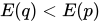
Then for 

Let  and
and  .
.
Then  takes on the sign of
  since
since

Since changes signs  times (by hypothesis),
  has zeros.
However  and thus can only have at most zeros. Therefore
  and
and 
|
Compute the best linear approximation to ![{\displaystyle x^{2}\;{\mbox{in}}\;[0,1]\!\,}](https://wikimedia.org/api/rest_v1/media/math/render/svg/15637ae5c6b9644f9c10e0a307fdb6fd3198f65c) . [Hint: Drawing a line through the parabola will allow you to conjecture where two points of oscillation must lie. Use conditions from (a) to determine the third point and coefficients of .] . [Hint: Drawing a line through the parabola will allow you to conjecture where two points of oscillation must lie. Use conditions from (a) to determine the third point and coefficients of .]
|
First we need to find the roots of  in [0,1], which are given by
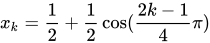
So our points at which to interpolate are
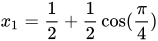

Our linear interpolant passes through the points  and
and  , which using point-slope form gives the equation
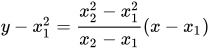
or

|
We will be concerned with the least squares problem of minimizing
 . .
Here  is an is an  matrix of rank (which implies matrix of rank (which implies  ) and ) and  is the Euclidean vector norm. Let is the Euclidean vector norm. Let
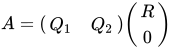
be the QR decomposition of . Here  are respectively are respectively  . .
|
|
Show that the solution of the least squares problem satisfies the QR equation  and that the solution is unique. Further show that and that the solution is unique. Further show that 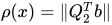 . .
|
First notice
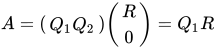
Then we can write
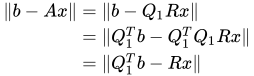
Note that multiplying by orthogonal matrices does not affect the norm.
Then solving 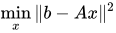 is equivalent to solving
  , which is equivalent to solving . Note that a solution exists and is unique since
  is n-by-n and non-singular.
Show that 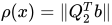
[edit | edit source]Similarly
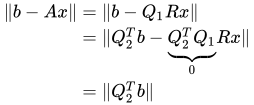
Then
 , or simply , as desired.
|
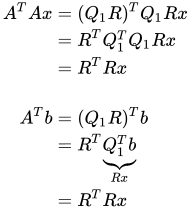
Use the QR equation to show that the least squares solution satisfies the normal equations 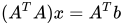 . .
|
|
 Let
Let  be real symmetric and let be real symmetric and let  be given. For be given. For  , define , define  as the linear combination of the vectors as the linear combination of the vectors  with the coefficient of with the coefficient of  equal to one and orthogonal to the vectors equal to one and orthogonal to the vectors  ; i.e. ; i.e.

|
|
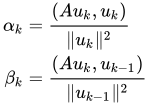
Find formulas for  and and 
|
Using Gram Schmidit, we have
|
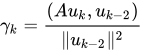
Show that  Where do you use the symmetry of ? Where do you use the symmetry of ?
|
Since
, if  , then

Since is symmetric,

From hypothesis,
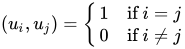
Also from hypothesis,

Using the above results we have,

|
For which non-zero vectors  does does  hold? hold?
|
For  ,
,

If , then

Since  is a scalar, is an eigenvector of .