|
Let  be an arbitrary fixed partition of the interval be an arbitrary fixed partition of the interval ![{\displaystyle [a,b]\!\,}](https://wikimedia.org/api/rest_v1/media/math/render/svg/1ef1354dbfeea71ab05cf297ffc40786b7813474) . A function . A function  is a quadratic spline function if is a quadratic spline function if
(i) ![{\displaystyle q\in C^{1}[a,b]\!\,}](https://wikimedia.org/api/rest_v1/media/math/render/svg/1eb6e01010a11d964a63b3bf79d620077625bb83)
(ii) On each subinterval ![{\displaystyle [x_{i},x_{i+1}]\!\,}](https://wikimedia.org/api/rest_v1/media/math/render/svg/022b4375c1548cc0bbbf2b262948b49d8956f798) , ,  is a quadratic polynomial is a quadratic polynomial
The problem is to construct a quadratic spline interpolating data points  . The construction is similar to the construction of the cubic spline but much easier. . The construction is similar to the construction of the cubic spline but much easier.
|
|
Show that if we know  , we can construct . , we can construct .
|
Consider interval . Since  is linear on this interval, using the point slope form we have

Integrating, we have

or, in a more convenient form,

Since is continuous on ,

i.e.

Simplifying and rearranging terms yields the reoccurrence formula





Suppose 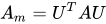 for some unitary
  . Since
 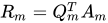 we have

which is as desired as  is unitary.
For the shifted case, the same argument holds using the fact that  .
.
|
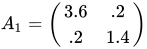
Let
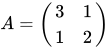
Use plane rotations (Givens rotations) to carry out one step of the  algorithm on
  , first without shifting and then using the shift , first without shifting and then using the shift  . Which seems to do better? The eigenvalues of are . Which seems to do better? The eigenvalues of are  . (Recall that a plane rotation is a matrix of the form . (Recall that a plane rotation is a matrix of the form

with 
|
The shifted iteration appears to work better because its diagonal entries are closer to the actual eigenvalues than the diagonal entries of the unshifted iteration.

|
Let be an  symmetric, positive definite matrix. Then we know that solving symmetric, positive definite matrix. Then we know that solving  is equivalent to minimizing the functional is equivalent to minimizing the functional 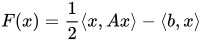 where where  denotes the standard inner product in denotes the standard inner product in  . To solve the problem by minimization of . To solve the problem by minimization of  we consider the general iterative method we consider the general iterative method 
|
|
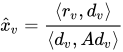
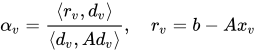
When  and and  are given, show that the value of are given, show that the value of  which minimizes which minimizes 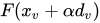 as a function of as a function of  is given in terms of the residual is given in terms of the residual 
|
Since is symmetric

This relationship will used throughout the solutions.



which implies
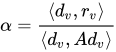
|
Let  be an -orthogonal basis of , be an -orthogonal basis of ,  . Consider the expansion of the solution . Consider the expansion of the solution  in this basis: in this basis:

Use that  orthogonality of the orthogonality of the  to compute the to compute the  in terms of the solution and the 's in terms of the solution and the 's
|
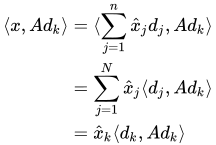
which implies
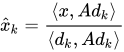
|
Let denote the partial sum
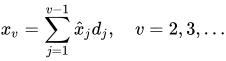
so that  where the where the  's are the coefficients found in (b). Use the fact that 's are the coefficients found in (b). Use the fact that  and the -orthogonality of the 's to conclude that the coefficient is given by the optimal i.e. and the -orthogonality of the 's to conclude that the coefficient is given by the optimal i.e.
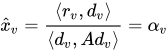
|

which implies