In the propositional case we defined the resolution inference rule by
"cutting away" a pair of complementary literals in two clauses which
are resolved upon. In the first order case however this is not always
sufficient:
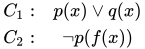
In these two clauses there are no complementary literals, however,
after substituting the term  for the variable
  in
in  and
and
 for in
  we arrive at:
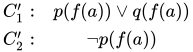
Now we can apply the inference rule from propositional logic and
arrive at the resolvent  .
.
Another possibility is to substitute  for in to get

and then we can have the resolvent  from
from  and , which is in a certain sense more general then the resolvent derived
previously.
and , which is in a certain sense more general then the resolvent derived
previously.
A substitution  is a function, which maps variables
to terms and which is the identical mapping almost everywhere. Hence
it can be represented as
is a function, which maps variables
to terms and which is the identical mapping almost everywhere. Hence
it can be represented as

If  are groundterms, we call a
ground substitution. The empty substitution is
notated by
are groundterms, we call a
ground substitution. The empty substitution is
notated by  .
.
Let  be a substitution and
  an
expression (i.e. a literal or a term), then
an
expression (i.e. a literal or a term), then  is the expression,
obtained from by replacing simultaneously each occurrence of
is the expression,
obtained from by replacing simultaneously each occurrence of
 in by the term
  .
.
Example:
With  and
and 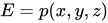 , we get
Let and  be substitutions. Then the composition of substitutions, denoted by
  ,
is the substitution, which is obtained from
,
is the substitution, which is obtained from  by deleting any element
 for which
  and any element
 such that
  .
.
Example:
Let 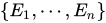 be a set of expressions and
  a
substitution, is unifier for
iff
a
substitution, is unifier for
iff

.
A unifier is called most general unifier iff for every
unifier there is a substitution  such that
  .
.
In the following we discuss an algorithm for computing most general
unifiers. For this we assume a set of terms  to be unified. First we transform this into a set of equations
by introducing a new variable not yet occurring in this set, say
to be unified. First we transform this into a set of equations
by introducing a new variable not yet occurring in this set, say  and by defining the set of equations

We will now transform this set such that its unifiers stay invariant,
where a is a unifier of a set of  if
if  holds.
Unification
Given a set of expression. Transform it into a set of equations  as defined above. Apply the following transformation rules as long as
possible:
as defined above. Apply the following transformation rules as long as
possible:
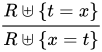 Orient
where is a variable and  a non-variable term
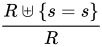 Delete
 Decompose (Termreduction)
![{\displaystyle {\frac {R\uplus \{x=t\}}{R[x/t]\uplus \{x=t\}}}}](https://wikimedia.org/api/rest_v1/media/math/render/svg/b00afc306f39edb6d78dd4dd9cf1882d8d2aed33) Eliminate (Elimination of variable I)
Eliminate (Elimination of variable I)
if not in , but in 
![{\displaystyle {\frac {R\uplus \{x=y\}}{R[x/y]\uplus \{x=y\}}}}](https://wikimedia.org/api/rest_v1/media/math/render/svg/3375d2f6a69e886d488026b47fd1c7a5ecf41413) Coalesce (Elimination of variable II)
Coalesce (Elimination of variable II)
if  in
in
 Conflict
if  or
or 
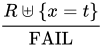 Occur Check
if in
Let be a set of expressions. The above unification algorithm
terminates. If it returns  , there is no unifier for , otherwise
is transformed into a set of equation
, there is no unifier for , otherwise
is transformed into a set of equation  , which represents the most general unifier for .
Let two or more literals of a clause  have a unifier , then
 is called a factor of .
Example:
With  and
and 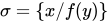 we
get the factor
we
get the factor 
Let and be two clauses with no variables in common, such
that  and
and  and
and  and
and  have a most
general unifier . A binary resolvent of and
is
have a most
general unifier . A binary resolvent of and
is

Example:
Given  and
and  . After
renaming into
. After
renaming into  we get the resolvent
 by using the most general unifier
  .
.
We often depict resolvent graphically, e.g.

A resolvent of two clauses and is one of the
following binary resolvents:
- a binary resolvent of and
- a binary resolvent of and a factor of
- a binary resolvent of a factor of and
- a binary resolvent of a factor of and a factor of
Example:
Given  and
and  .
.
A factor of is  . A binary
resolvent of
. A binary
resolvent of  and and hence also of and
is
and and hence also of and
is  .
.
The following lemma is used in the completeness proof of resolution.
If  and
and  are instances of and ,
respectively, and
are instances of and ,
respectively, and  is a resolvent of and ,
then there is a resolvent of and such that
is an instance of .
is a resolvent of and ,
then there is a resolvent of and such that
is an instance of .
 Figure 1
A set  of clauses is unsatisfiable iff the empty clause can be
derived from by resolution.
of clauses is unsatisfiable iff the empty clause can be
derived from by resolution.
Proof:
Assume that is unsatisfiable. Let  be
the ground atom set of , hence the Herbrand basis. Let
be
the ground atom set of , hence the Herbrand basis. Let  be a
complete binary tree, as given in Figure 2. According to Herbrand's theorem
(version1) there exists a closed finite semantic tree
be a
complete binary tree, as given in Figure 2. According to Herbrand's theorem
(version1) there exists a closed finite semantic tree
 . There are two cases:
- If consists only of one node (hence the root), The interpretation to be collected from the empty branch in this tree falsifies only the empty clause. Hence the empty clause must be in .
- Assume consists of more than one node. Then there must be an inference node in , hence both its descendants
 and
and  are failure nodes. If such a node would not exist, every node would have at least one non-failure node, which would mean that there is at least an infinite path in , which would violate, that fact that it is a finite closed semantic tree. Let
  given as described above; and let
Now, let  and
and  be ground instances of clauses and , such that is falsified by
  and by
  , such that both are not falsified by
  .
.
Hence we have 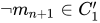 and
and  and we can construct the resolvent

must be false in , because both 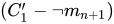 and
and 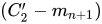 are false in . According to the Lifting Lemma 5 there exists a resolvent of and , such that is a ground instance of . Let
  be the closed semantic tree for
  , obtained from by deleting all nodes below the first node which falsifies . Note, that is unsatisfiable if and only if is unsatisfiable. Clearly, has less nodes than and we now can iterate this process until only the root of the semantic tree is remaining. This, however is only possible if the empty clause
  is derivable.
For the opposite direction, assume that is derivable by
resolution from and let
is derivable.
For the opposite direction, assume that is derivable by
resolution from and let  the resolvents
constructed during this process. Assume is satisfiable and
the resolvents
constructed during this process. Assume is satisfiable and
 to be a model for . From the correctness lemma according to
the propositional case we known, that if a model satisfies two
clauses it also satisfies its resolvent. Therefore has to satisfy
to be a model for . From the correctness lemma according to
the propositional case we known, that if a model satisfies two
clauses it also satisfies its resolvent. Therefore has to satisfy
 ; this, however, is impossible, because one of this
resolvents is .
; this, however, is impossible, because one of this
resolvents is .
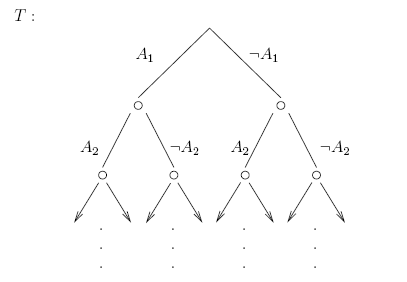
Figure 2
Indicate in each case a derivation of the empty clause with predicate-logical resolution!


(

)


Show the following Lifting lemma by means of
induction over the term- and formula construction:
Is  a predicate-logical formula, and
  a fitting interpretation for
and ![{\displaystyle F[x/t]}](https://wikimedia.org/api/rest_v1/media/math/render/svg/34f6c858d274f9d292d0d8348142a04658048d3e) . Then
. Then
![{\displaystyle {\mathcal {I}}(F[x/t])={\mathcal {I}}_{[x/{\mathcal {I}}(t)]}(F),}](https://wikimedia.org/api/rest_v1/media/math/render/svg/af8c733f03d88cddf67e35e698af3075c6d6415b)
is valid, if does not contain any variable that ![{\displaystyle [x/t]}](https://wikimedia.org/api/rest_v1/media/math/render/svg/ff5a99a8641a9e4e67622b7b0e152230a5f72ed1) is laced
is laced
by the substitution in .
Compute - if possible - the most general unifier of following sets of clauses:




Determine all direct resolvents of the following pairs of clauses:
 and
and 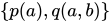
 and
and 
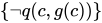 and
and 
 and
and 
Compute - if possible - the most general unifier of following sets of clauses:



Determine all direct resolvents of the following pairs of clauses:
 and
and  and
and 
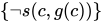 and
and 
Give for the following set of clauses (a) a linear derivation,
(b) a derivation with unit resolution, (c) a further (maximally
short) derivation of the empty clause by means of
predicate-logical resolution!

Indicate in each case a derivation of the empty clause with predicate-logical resolution!
-
(
)


