- This exercise is recommended for all readers.
- Problem 1
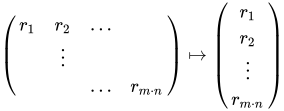
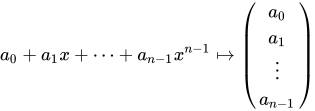
Verify, using Example 1.4 as a model, that the two correspondences given before the definition are isomorphisms.
- Example 1.1
- Example 1.2
- Answer
- Call the map
 .
.
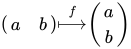
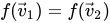
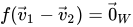
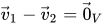
It is one-to-one because if sends two members of the domain to the same image, that is, if  , then the definition of gives that
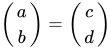
and since column vectors are equal only if they have equal components, we have that  and that
  . Thus, if maps two row vectors from the domain to the same column vector then the two row vectors are equal:
  .
To show that is onto we must show that any member of the codomain
.
To show that is onto we must show that any member of the codomain  is the image under of some row vector. That's easy;

is  .
The computation for preservation of addition is this.
.
The computation for preservation of addition is this.

The computation for preservation of scalar multiplication is similar.

- Denote the map from Example 1.2 by . To show that it is one-to-one, assume that
 . Then by the definition of the function,
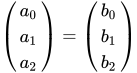
and so  and
and  and
and  . Thus
  , and consequently is one-to-one.
The function is onto because there is a polynomial sent to
, and consequently is one-to-one.
The function is onto because there is a polynomial sent to

by , namely, 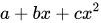 .
As for structure, this shows that preserves addition
.
As for structure, this shows that preserves addition
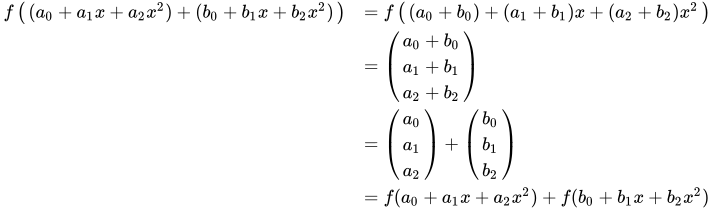
and this shows
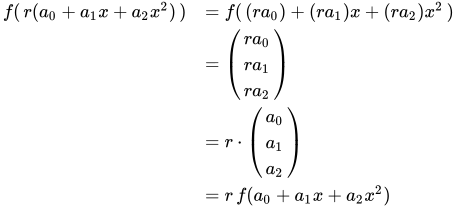
that it preserves scalar multiplication.
- This exercise is recommended for all readers.
- Problem 3
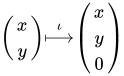
Show that the natural map  from
Example 1.5
is an isomorphism.
from
Example 1.5
is an isomorphism.
- Answer
To verify it is one-to-one, assume that  . Then
  by the definition of . Members of
  are equal only when they have the same coefficients, so this implies that
  and
and  and
and  . Therefore implies that
  , and so is one-to-one.
To verify that it is onto, consider an arbitrary member of the codomain  and observe that it is indeed the image of a member of the domain, namely, it is
  .
(For instance,
.
(For instance,  .)
.)
The computation checking that preserves addition is this.

The check that preserves scalar multiplication is this.
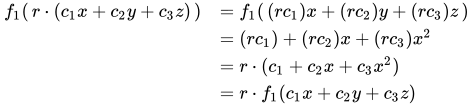
- This exercise is recommended for all readers.
- Problem 4
Decide whether each map is an isomorphism (if it is an isomorphism then prove it and if it isn't then state a condition that it fails to satisfy).
-
 given by
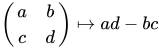
-
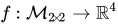 given by
-
 given by

- given by

- Answer
- No; this map is not one-to-one. In particular, the matrix of all zeroes is mapped to the same image as the matrix of all ones.
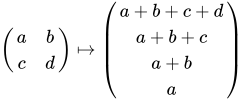
- Yes, this is an isomorphism.
It is one-to-one:

gives that  , and that
  , and that
  , and that
  .
It is onto, since this shows
.
It is onto, since this shows
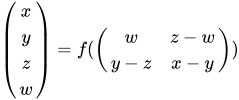
that any four-tall vector is the image of a  matrix.
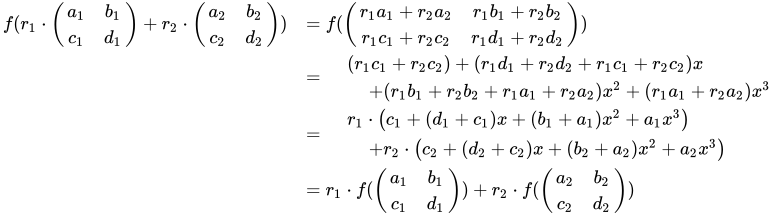
Finally, it preserves combinations
matrix.
Finally, it preserves combinations
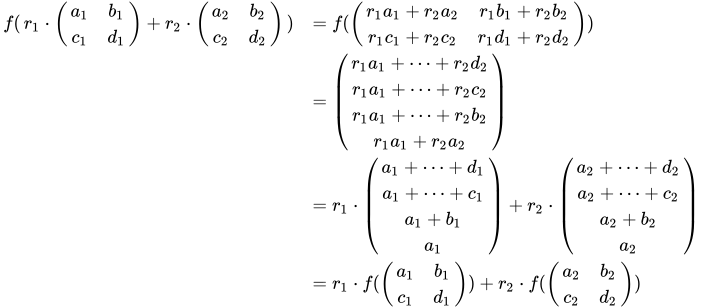
and so item 2 of Lemma 1.9 shows that it preserves structure.
- Yes, it is an isomorphism.
To show that it is one-to-one, we suppose that two members of the domain have the same image under .

This gives, by the definition of , that  and then the fact that polynomials are equal only when their coefficients are equal gives a set of linear equations
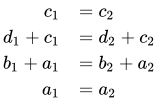
that has only the solution , , , and .
To show that is onto, we note that  is the image under of this matrix.

We can check that preserves structure by using item 2 of Lemma 1.9.
- No, this map does not preserve structure. For instance, it does not send the zero matrix to the zero polynomial.
- This exercise is recommended for all readers.
- Problem 6
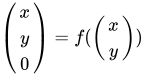
Refer to Example 1.1. Produce two more isomorphisms (of course, that they satisfy the conditions in the definition of isomorphism must be verified).
- Answer
Many maps are possible. Here are two.

The verifications are straightforward adaptations of the others above.
- Problem 7
Refer to Example 1.2. Produce two more isomorphisms (and verify that they satisfy the conditions).
- Answer
Here are two.

Verification is straightforward (for the second, to show that it is onto, note that

is the image of  ).
).
- This exercise is recommended for all readers.
- Problem 9
Find two isomorphisms between  and
and  .
.
- Answer
Here are two:

Verification that each is an isomorphism is easy.
- This exercise is recommended for all readers.
- Problem 12
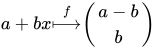
Prove that the map in Example 1.7, from  to given by
  , is a vector space isomorphism.
- Answer
This is the map, expanded.
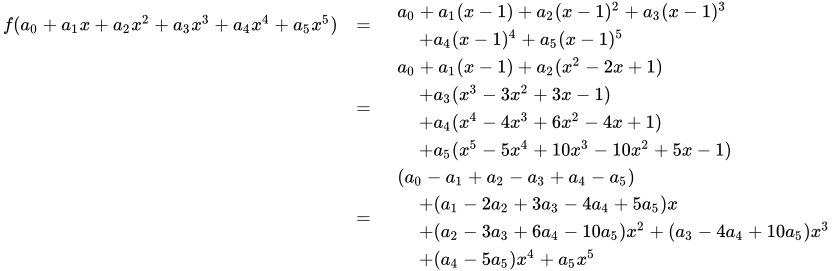
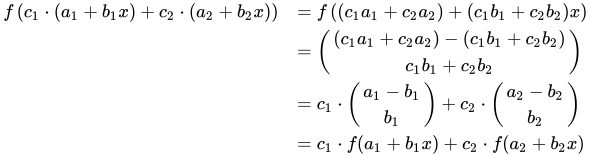
To finish checking that it is an isomorphism, we apply item 2 of Lemma 1.9 and show that it preserves linear combinations of two polynomials. Briefly, the check goes like this.



- Problem 13
Why, in Lemma 1.8, must there be a  ? That is, why must
  be nonempty?
- Answer
No vector space has the empty set underlying it. We can take  to be the zero vector.
- Problem 15
In the proof of Lemma 1.9, what about the zero-summands case (that is, if  is zero)?
- Answer
A linear combination of  vectors adds to the zero vector and so Lemma 1.8 shows that the three statements are equivalent in this case.
- This exercise is recommended for all readers.
- Problem 17
These prove that isomorphism is an equivalence relation.
- Show that the identity map
 is an isomorphism. Thus, any vector space is isomorphic to itself.
- Show that if
 is an isomorphism then so is its inverse
  . Thus, if is isomorphic to
  then also is isomorphic to .
- Show that a composition of isomorphisms is an isomorphism: if is an isomorphism and
 is an isomorphism then so also is
  . Thus, if is isomorphic to and is isomorphic to
  , then also is isomorphic to .
- Answer
In each item, following item 2 of Lemma 1.9, we show that the map preserves
structure by showing that the it preserves linear combinations of two members of the domain.
-
The identity map is clearly one-to-one and onto. For linear combinations the check is easy.

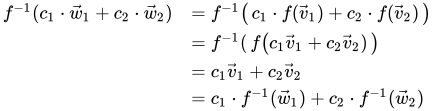
- The inverse of a correspondence is also a correspondence (as stated in the appendix), so we need only check that the inverse preserves linear combinations. Assume that
 (so
(so 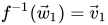 ) and assume that
  .
.
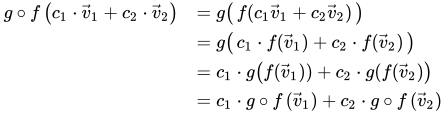
- The composition of two correspondences is a correspondence (as stated in the appendix), so we need only check that the composition map preserves linear combinations.
- Problem 19
Suppose that is an isomorphism. Prove that the set  is linearly dependent if and only if the set of images
  is linearly dependent.
- Answer
We will prove something stronger— not only is the existence of a dependence preserved by isomorphism, but each instance of a dependence is preserved, that is,


The  direction of this statement holds by item 3 of Lemma 1.9. The
  direction holds by regrouping

and applying the fact that is one-to-one, and so for the two vectors  and
and  to be mapped to the same image by , they must be equal.
- This exercise is recommended for all readers.
- Problem 20
Show that each type of map from Example 1.6 is an automorphism.
- Dilation
 by a nonzero scalar
  .
.
- Rotation
 through an angle
  .
.
- Reflection
 over a line through the origin.
Hint.
For the second and third items, polar coordinates are useful.
- Answer
-
This map is one-to-one because if
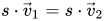
 then by definition of the map,
  and so
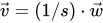
  , as is nonzero. This map is onto as any
  is the image of
  (again, note that is nonzero). (Another way to see that this map is a correspondence is to observe that it has an inverse: the inverse of is
  .)
To finish, note that this map preserves linear combinations
.)
To finish, note that this map preserves linear combinations

and therefore is an isomorphism.
- As in the prior item, we can show that the map is a correspondence by noting that it has an inverse,
 .
That the map preserves structure is geometrically easy to see. For instance, adding two vectors and then rotating them has the same effect as rotating first and then adding. For an algebraic argument, consider polar coordinates: the map sends the vector with endpoint
.
That the map preserves structure is geometrically easy to see. For instance, adding two vectors and then rotating them has the same effect as rotating first and then adding. For an algebraic argument, consider polar coordinates: the map sends the vector with endpoint  to the vector with endpoint
  . Then the familiar trigonometric formulas
  and
and  show how to express the map's action in the usual rectangular coordinate system.

Now the calculation for preservation of addition
is routine.

The calculation for preservation of scalar multiplication is similar.
-
This map is a correspondence because it has an inverse (namely, itself).
As in the last item, that the reflection map preserves structure is geometrically easy to see: adding vectors and then reflecting gives the same result as reflecting first and then adding, for instance. For an algebraic proof, suppose that the line
 has slope
  (the case of a line with undefined slope can be done as a separate, but easy, case). We can follow the hint and use polar coordinates: where the line forms an angle of
  with the
  -axis, the action of is to send the vector with endpoint
  to the one with endpoint
  .
.

To convert to rectangular coordinates, we will use some trigonometric formulas, as we did in the prior item. First observe that  and
and  can be determined from the slope of the line. This picture

gives that  and
and  . Now,
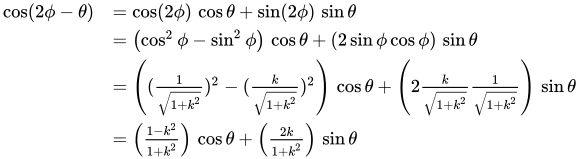
and thus the first component of the image vector is this.

A similar calculation shows that the second component of the image
vector is this.

With this algebraic description of the action of

checking that it preserves structure is routine.
- Problem 22
- Show that a function
 is an automorphism if and only if it has the form
  for some
  .
.
- Let be an automorphism of
 such that
  . Find
  .
.
- Show that a function
 is an automorphism if and only if it has the form
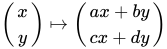
for some  with
with  . Hint. Exercises in prior subsections have shown that
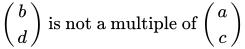
if and only if .
- Let be an automorphism of with

Find

- Answer
- For the "only if" half, let to be an isomorphism. Consider the basis
 . Designate
  by . Then for any we have that
  , and so 's action is multiplication by . To finish this half, just note that or else would not be one-to-one.
For the "if" half we only have to check that such a map is an isomorphism when . To check that it is one-to-one, assume that
, and so 's action is multiplication by . To finish this half, just note that or else would not be one-to-one.
For the "if" half we only have to check that such a map is an isomorphism when . To check that it is one-to-one, assume that 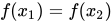 so that
  and divide by the nonzero factor to conclude that
  . To check that it is onto, note that any
  is the image of
  (again, ). Finally, to check that such a map preserves combinations of two members of the domain, we have this.

- By the prior item, 's action is
 . Thus
  .
.
- For the "only if" half, assume that is an automorphism. Consider the standard basis
 for . Let

Then the action of on any vector is determined by by its action on the two basis vectors.

To finish this half, note that if  , that is, if
  is a multiple of
  , then is not one-to-one.
For "if" we must check that the map is an isomorphism, under the condition that . The structure-preservation check is easy; we will here show that is a correspondence. For the argument that the map is one-to-one, assume this.
, then is not one-to-one.
For "if" we must check that the map is an isomorphism, under the condition that . The structure-preservation check is easy; we will here show that is a correspondence. For the argument that the map is one-to-one, assume this.

Then, because , the resulting system

has a unique solution, namely the trivial one
 and
and  (this follows from the hint).
The argument that this map is onto is closely related— this system
(this follows from the hint).
The argument that this map is onto is closely related— this system

has a solution for any and  if and only if
this set
if and only if
this set
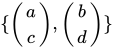
spans , i.e., if and only if this set is
a basis (because it is a two-element subset of ),
i.e., if and only if .
-

- Problem 23
Refer to Lemma 1.8 and Lemma 1.9. Find two more things preserved by isomorphism.
- Answer
There are many answers; two are linear independence and subspaces.
To show that if a set  is linearly independent then its image
  is also linearly independent, consider a linear relationship among members of the image set.

Because this map is an isomorphism, it is one-to-one. So maps only one vector from the domain to the zero vector in the range, that is,  equals the zero vector (in the domain, of course). But, if is linearly independent then all of the
  's are zero, and so is linearly independent also. (Remark. There is a small point about this argument that is worth mention. In a set, repeats collapse, that is, strictly speaking, this is a one-element set:
  , because the things listed as in it are the same thing. Observe, however, the use of the subscript in the above argument. In moving from the domain set to the image set , there is no collapsing, because the image set does not have repeats, because the isomorphism is one-to-one.)
To show that if is an isomorphism and if is a subspace of the domain then the set of image vectors  is a subspace of , we need only show that it is closed under linear combinations of two of its members (it is nonempty because it contains the image of the zero vector). We have

and  is a member of because of the closure of a subspace under combinations. Hence the combination of
  and
and  is a member of
  .
.
- Problem 24
We show that isomorphisms can be tailored to fit in that, sometimes, given vectors in the domain and in the range we can produce an isomorphism associating those vectors.
- Let
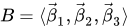 be a basis for so that any
  has a unique representation as
  , which we denote in this way.

Show that the  operation is a function from to
  (this entails showing that with every domain vector
  there is an associated image vector in , and further, that with every domain vector there is at most one associated image vector).
- Show that this function is one-to-one and onto.
- Show that it preserves structure.
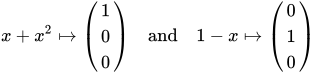
- Produce an isomorphism from to
that fits these specifications.
- Answer
- The association
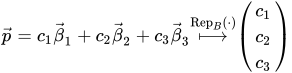
is a function if every member  of the domain is associated with at least one member of the codomain, and if every member of the domain is associated with at most one member of the codomain. The first condition holds because the basis
  spans the domain— every can be written as at least one linear combination of
  's. The second condition holds because the basis is linearly independent— every member of the domain can be written as at most one linear combination of the 's.
 - For the one-to-one argument, if
 , that is, if
  then
then
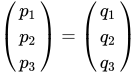
and so  and
and  and
and  , which gives the conclusion that
  . Therefore this map is one-to-one.
For onto, we can just note that
. Therefore this map is one-to-one.
For onto, we can just note that
equals  , and so any member of the codomain is the image of some member of the domain .
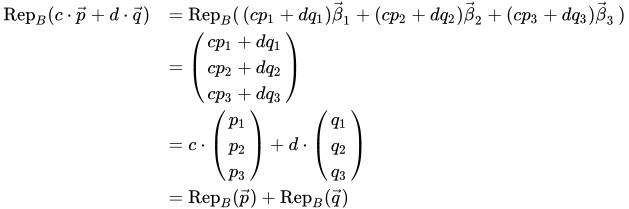
- This map respects addition and scalar multiplication because it respects combinations of two members of the domain (that is, we are using item 2 of Lemma 1.9): where
 and
and  , we have this.
- Use any basis for whose first two members are
 and
and  , say
, say  .
.
- Problem 26
(Requires the subsection on Combining Subspaces, which is optional.) Let and be vector spaces. Define a new vector space, consisting of the set  along with these operations.

This is a vector space, the external direct sum of and .
- Check that it is a vector space.
- Find a basis for, and the dimension of, the external direct sum
 .
.
- What is the relationship among
 ,
,  , and
, and 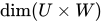 ?
?
- Suppose that and are subspaces of a vector space such that
 (in this case we say that is the internal direct sum of and ). Show that the map
  given by

is an isomorphism. Thus if the internal direct sum is defined then the internal and external direct sums are isomorphic.
- Answer
- Most of the conditions in the definition of a vector space are routine. We here sketch the verification of part 1 of that definition.
For closure of
 , note that because and are closed, we have that
  and
and  and so
  . Commutativity of addition in follows from commutativity of addition in and .

The check for associativity of addition is similar. The zero element is  and the additive inverse of
  is
is  .
The checks for the second part of the definition of a vector space are also straightforward.
.
The checks for the second part of the definition of a vector space are also straightforward.
- This is a basis

because there is one and only one way to represent any member of with respect to this set; here is an example.

The dimension of this space is five.
- We have
 as this is a basis.

- We know that if then each can be written as
 in one and only one way. This is just what we need to prove that the given function an isomorphism.
First, to show that is one-to-one we can show that if
in one and only one way. This is just what we need to prove that the given function an isomorphism.
First, to show that is one-to-one we can show that if  , that is, if
  then
then  and
and  . But the statement "each is such a sum in only one way" is exactly what is needed to make this conclusion. Similarly, the argument that is onto is completed by the statement that "each is such a sum in at least one way".
This map also preserves linear combinations
. But the statement "each is such a sum in only one way" is exactly what is needed to make this conclusion. Similarly, the argument that is onto is completed by the statement that "each is such a sum in at least one way".
This map also preserves linear combinations

and so it is an isomorphism.










![{\displaystyle f^{-1}(x)={\sqrt[{3}]{x}}}](https://wikimedia.org/api/rest_v1/media/math/render/svg/c7c3ee50a06fa60166baec42d9c2200474fbf2a1)