The following definitions are straightforward generalisations from linear algebra. We begin by repeating a definition we already saw in chapter 6.
Definition 6.1 (generators of modules):
Let  be a module over the ring
  . A generating set of is a subset
 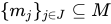 such that
 .
.
We also have:
Definition 11.1:
Let be an -module. A subset  of is called linearly independent if and only if, whenever
  , we have
 .
.
Theorem 11.3:
Let  be free modules. Then the direct sum

is free.
Proof:
Let bases  of the
  be given. We claim that

is a basis of
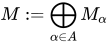 .
.
Indeed, let an arbitrary element  be given. Then by assumption, each of the
  has a decomposition
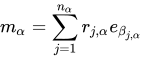
for suitable 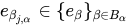 . By summing this, we get a decomposition of in the aforementioned basis. Furthermore, this decomposition must be unique, for otherwise projecting gives a new composition of one of the particular .
 The converse is not true in general!
Theorem 11.4:
Let  be free -modules, with bases
  and
and  respectively. Then

is a free module, with basis
 ,
,
where we wrote for short
![{\displaystyle e_{\alpha }\otimes f_{\beta }:=[(e_{\alpha },f_{\beta })]}](https://wikimedia.org/api/rest_v1/media/math/render/svg/2813954a588b7a76e283d3215743041935bd4fef)
(note that it is quite customary to use this notation).
Proof:
We first prove that our supposed basis forms a generating system. Clearly, by summation it suffices to show that elements of the form
 ,
, 
can be written in terms of the  . Thus, write
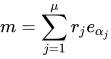 and
and 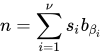 ,
,
and obtain by the rules of computing within the tensor product, that
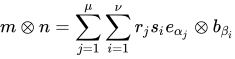 .
.
On the other hand, if
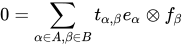
is a linear combination (i.e. all but finitely many summands are zero), then all the  must be zero. The argument is this: Fix
  and define a bilinear function
 ,
,
where  ,
,  are the coefficients of
  ,
,  in the decomposition of
  and
and  respectively. According to the universal property of the tensor product, we obtain a linear map
 with
with  ,
,
where  is the canonical projection on the quotient space. We have the equations
![{\displaystyle g(e_{\alpha '}\otimes f_{\beta '})=f(e_{\alpha '},f_{\beta '})=[\alpha =\alpha '\wedge \beta =\beta ']}](https://wikimedia.org/api/rest_v1/media/math/render/svg/70aca022a97b8e7ffd9608c343f0cf2f52345963) ,
,
and inserting the given linear combination into this map therefore yields the desired result.
The following is a generalisation of free modules:
Theorem 11.6:
Every free module is projective.
Proof:
Pick a basis of , let  be surjective and let
  be some morphism. For each
  pick
pick  with
with  . Define
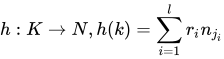 where
where 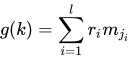 .
.
This is well-defined since the linear combination describing  is unique. Furthermore, it is linear, since we have
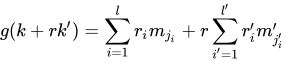 ,
,
where the right hand side is the sum of the linear combinations coinciding with and  respectively, which is why
  . By linearity of
  and definition of the
  , it has the desired property.
There are a couple equivalent definitions of projective modules.
Theorem 11.7:
A module is projective if and only if there exists a module  such that
  is free.
Proof:
 : Define the module

(this obviously is a free module) and the function
 .
.
is a surjective morphism, whence we obtain a commutative diagram
 ;
;
that is,  .
.
We claim that the map

is an isomorphism. Indeed, if 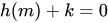 , then
  and thus also
  (injectivity) and further
  , where
  , which is why

(surjectivity).
 : Assume
  is a free module. Assume is a surjective morphism, and let be any morphism. We extend
  to
to  via
via
 .
.
This is still linear as the composition of the linear map and the linear inclusion  . Now is projective since it's free. Hence, we get a commutative diagram

where  satisfies
  . Projecting to gives the desired diagram for .
Definition 11.8:
An exact sequence of modules

is called split exact iff we can augment it by three isomorphisms such that

commutes.
Theorem 11.9:
A module is projective iff every exact sequence
is split exact.
Proof:
: The morphism  is surjective, and thus every other morphism with codomain lifts to . In particular, so does the projection
  . Thus, we obtain a commutative diagram

where we don't know yet whether  is an isomorphism, but we can use to define the function
 ,
,
which is an isomorphism due to injectivity:
Let  , that is
  . Then first

and therefore second
 .
.
And surjectivity:
Let  . Set
. Set  . Then

and hence  for a suitable
  , thus
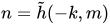 .
.
We thus obtain the commutative diagram

and have proven what we wanted.
: We prove that  is free for a suitable .
We set
 ,
, 
where is defined as in the proof of theorem 11.7 . We obtain an exact sequence

which by assumption splits as

which is why  is isomorphic to the free module
  and hence itself free.
Theorem 11.10:
Let and be projective -modules. Then  is projective.
Proof:
We choose  -modules such that and
  are free. Since the tensor product of free modules is free,
  is free. But
 ,
,
and thus occurs as the summand of a free module and is thus projective.
Theorem 11.11:
Let be -modules. Then is projective if and only if each is projective.
Proof:
Let first each of the be projective. Then each of the occurs as the direct summand of a free module, and summing all these free modules proves that is the direct summand of free modules.
On the other hand, if is the summand of a free module, then so are all the s.
The following is a generalisation of projective modules:
The morphisms in the right sequence induced by any morphism are given by the bilinear map
 .
.
Theorem 11.13:
The module  is a flat -module.
Proof: This follows from theorems 9.10 and 10.?.
Theorem 11.14:
Flatness is a local property.
Proof: Exactness is a local property. Furthermore, for any multiplicatively closed 

by theorem 9.11. Since every -module is the localisation of an -module (for instance itself as an -module via  ), the theorem follows.
Theorem 11.15:
A projective module is flat.
Proof:
We first prove that every free module is flat. This will enable us to prove that every projective module is flat.
Indeed, if is a free module and  a basis of , we have

via
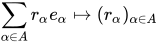 ,
,
where all but finitely many of the summands on the left are nonzero. Hence, by distributivity of direct sum over tensor product, if we are given any exact sequence
 ,
,
to show that the sequence

is exact, all we have to do is to prove that
is exact, since we may then augment the latter sequence by suitable isomorphisms
Theorem 11.16:
direct sum flat iff all summands are
Theorem 11.17:
If are flat -modules, then is as well.
Proof:
Let
be an exact sequence of modules.
The following is a generalisation of flat modules:
Lemma 11.19:
The torsion of a module is a submodule of that module.
Proof:
Let 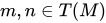 ,
,  . Obviously
  (just multiply the two annihilating elements together), and further
  if
if  (we used commutativity here).
We may now define torsion-free modules. They are exactly what you think they are.
Definition 11.20:
Let be a module. is called torsion-free if and only if
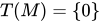 .
.
Theorem 11.21:
A flat module is torsion-free.
To get a feeling for the theory, we define  -torsion for a multiplicatively closed subset .
Definition 11.22:
Let be a multiplicatively closed subset of a ring , and let be an -module. Then the -torsion of is defined to be
 .
.
Theorem 11.23:
Let be a multiplicatively closed subset of a ring , and let be an -module. Then the -torsion of is precisely the kernel of the canonical map  .
.
 The converse is not true in general!
 .
.




