Vibrations of Structures/Introduction to vibrations
Many times, we use the terms vibration and oscillation without knowing the difference between them. The term oscillation refers strictly to the repeating motion of a point mass or that of a rigid body while the term vibration refers to the repeating motion or deformations of an elastic structure. Thus any oscillation is a term used only in cases like the motion of a pendulum or that of a ship as a rigid body moving on the wavy seas while vibration is a term used for phenomenon exhibited by structures such as rotating fans or motors etc. Vibration involves deformation by definition while an oscillating structure does not deform.
In Structural and Mechanical engineering context, oscillation and vibration are differentiated based on the "restoring force" present in the system. For both oscillation and vibration, the mass of a system at rest (static equilibrium) need to be disturbed from its rest or equilibrium position. The mass gets excited and initiate oscillation or vibration; but only with the presence of a restoring force. If the disturbance is from an unstable or neutral equilibrium, possibility of any restoring force is lacking and the mass eventually moves away and occupies a new position. In the case of (i) stable equilibrium of a mass or (ii) mass being attached to a spring (or an elastic member), a restoring force comes into being and the mass is tended back to the original equilibrium position and as a result, periodic motion starts.
In case (i), generally, component of gravity (g) operated upon the associated mass component serves as restoring force. Thus the system undergoes no "elongations or strains" than rigid body motion, as in the case of a simple pendulum. Such "no-strain" periodic motions are referred to as oscillation.
In case (ii), spring force developed on the attached spring or elastic member serves as the restoring force. Thus the attached member undergoes "periodic elongation or strain". Thus the mass as well as attached member undergoes periodic motion. Such "strained" periodic motions are referred to as vibrations.
In the expression for natural frequency,ω, 'g' is a parameter in the case of oscillations and 'k' in the case of vibrations. For the oscillation of simple pendulum, ω = sqrt(g/l), where as for the vibration of spring-mass system, ω = sqrt(k/m); with usual notations.
Dynamic Load[edit | edit source]
We have studied how we find the response of a structure to static load. When we come to study vibrations, what we have is not static load but dynamic load. The very nature of the load means that the response of the structure i.e the displacement, stress, reactions etc. also varies with time (see, also, Seismic Fitness).
What is Dynamic load ? Dynamic load is the load which varies. The variation may be with respect to time (Ex : reciprocating engine) or with respect to space (Ex : Moving vehicle on bridge). The next question arises is at what rate it should change ? For example in a Dam the water level changes throughout the year then should we consider it as a dynamic load for designing the dam? NO, because though the load is changing with respect to time its inertial effect is very less for practical consideration.
To make it more clear, a Dynamic load (externally applied) is not only a function of time, say F(t), but also one which excites the mass of the system causing inertial effect. The physicist who deals with the problem has to decide whether the force, F(t) is a dynamic one or not based on the significance of the excitation.
It is also interesting to note that a dynamic load is not essential to produce vibration or oscillation. An initial displacement or velocity will trigger free vibration in an appropriate system (Ex : a spring-mass system like shock absorber of automobile)
Forces Involved[edit | edit source]
In any vibrating system, there are a total of four types of forces that need to be taken into account. These are listed here.
- Inertial Force
- Spring Force
- Damping Force
- Total External Force
The inertial force occurs because acceleration is present. We know if a body having mass 'm' is moving with an acceleration 'a' then the force acting on it is the inertial force given by :

The Spring force arises due to the elasticity of the material. It is proportional to the displacement. But actually it may vary linearly, quadratically or other proportionality law but for simplicity in modelling we assume that this force varies linearly. This assumption holds good for most of the general cases and hence accepted. If the extension in the spring is 'x' then the spring force is given by :
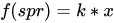
where 'k' is the proportionality constant known as stiffness of the member.
While these forces are enough to set up harmonic vibrations in a system, most systems also have intrinsic damping even if an external damper is not used. The damping force tends to oppose motion and acts against the velocity in most cases (the exception is negative damping). It generally varies with some power of the velocity though the most useful is viscous damping which varies linearly with velocity. If 'v' is the velocity then the viscous damping force is :

The total External force 'f(ext)' is the remaining force that acts on the system. It is the force that causes the excitation in the first place and may or may not be present while the system vibrates.