Trigonometry/Radians
There are in
a complete circle

Units of Measure
[edit | edit source]We have been measuring angles in degrees, with in a complete circle. However, what if we measured the circle according to how many units we went around it. Think about it this way, do you measure the runner going around the circular track according to the degrees from the centre or the meters around the circle? The obvious answer is meters around the circle. However, how do you measure this in trigonometry?
Choice of Units for Length and Weight
[edit | edit source]In measuring many quantities we have a choice of units. For example with distances we can use the metric system and measure in metres, kilometres, centimetres, millimetres. It is also possible to measure distances in miles, yards, feet and inches. With weights we can measure in kilogrammes and grammes. We can also measure in pounds and ounces.
Choice of Units for Measuring Time
[edit | edit source]In measuring time we choose to have 60 seconds in a minute and 60 minutes in an hour. We could devise a new more metric system for time and divide an hour into 100 units, each three fifths of our current minute, and then divide these shorter 'minutes' up into 100 units each of which would be about a third of a second.
Why 60? Why 360?
[edit | edit source]The choice of dividing into 60 is not entirely arbitrary. 60 can be divided evenly into 2,3,4,5 or 6 or 10 or 12 parts. 60 can't be divided evenly into 7 equal parts, each a whole number in size, but it's still pretty good. Using 360 degrees in a full circle gives us many ways to divide the circle evenly with a whole number of degrees. Nevertheless, we could divide the circle into other numbers of units.
Metric Degrees?
[edit | edit source]From the earlier talk of the metric system you might be anticipating that we are about to divide the circle up into 100 or 1000 'degrees'. There is actually a unit called the 'grade' or 'Gradian' (Grad on calculators which have it) in which angles are measured by dividing a right angle up into 100 equal parts, each of one Gradian in size. One Gradian is 0.9 of a degree - quite close to being one degree. The grade is in turn divided into 100 minutes and one minute into 100 seconds. This centesimal system (from the Latin centum, 100) was introduced as part of the metric system after the French Revolution. The Gradian unit is nothing like as widely used as either degrees or the units that interests us most on this page. The unit we introduce here is called the Radian.
Radians is the circumference measure at
the point from .

Choice of Units for Radians
[edit | edit source]Radians are quite large compared to degrees (and to Gradians). There are about 6.28 Radians to a complete circle. There are about 57.3 degrees in one Radian.
|
Exercise: Check the Statements Are the statements:
Compatible? It is not hard to check.
|


We said "there are about 6.28 Radians to a complete circle". The exact number is , making the number of radians in a complete circle the same as the length of the circumference of a unit circle.

Remember that:
The circumference of a circle is
where is the radius.


Justifying Choice of Units for Radians
[edit | edit source]At this stage in explaining trigonometry it is rather difficult to justify the use of these strange units. There aren't even an exact whole number of radians in a complete circle. In more advanced work, particularly when we use calculus they become the most natural units to use for angles with functions like and . A flavour of that, but it is only a hint as to why it is a good unit to use, is that for very small angles.


And the approximation is better the smaller the angle is. This only works if we choose Radians as our unit of measure and very small angles.
|
Worked Example: Small angles in Radians and Degrees We claim that for small angles measured in radians the angle measure and the sine of the angle are very similar.
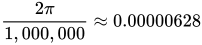
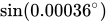
Let us take one millionth of a circle. In degrees that is 0.00036 degrees. In Radians that is Radians. The angle of course is the same. It's one millionth of a circle, however we choose to measure it. It is just as with weights where a weight is the same whether we measure it in kilogrammes or pounds. The sine of this angle, which is the same value whether we chose to measure the angle in degrees or in radians, it turns out, is about 0.00000628. If your calculator is set to use degrees then will give you this answer. |
The Radian Measure
[edit | edit source]There are
Radians
in a complete circle.
It is traditional to measure angles in degrees; there are 360 degrees in a full revolution. In mathematically more advanced work we use a different unit, the radian. This makes no fundamental difference, any more than the laws of physics change if you measure lengths in metres rather than inches. In advanced work, If no unit is given on an angle measure, the angle is assumed to be in radians.
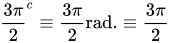
A notation used to make it really clear that an angle is being measured in radians is to write 'radians' or just 'rad' after the angle. Very very occasionally you might see a superscript c written above the angle in question.
What You need to Know
[edit | edit source]For book one of trigonometry you need to know how to convert from degrees to radians and from radians to degrees. You also need to become familiar with frequently seen angles which you know in terms of degrees, such as in terms of radians as well (it's Radians). Angles in Radians are nearly always written in terms of multiples of Pi.


You will also need to be familiar with switching your calculator between degrees and radians mode.
Everything that is said about angles in degrees, such as that the angles in a triangle add up to 180 degrees has an equivalent in Radians. The angles in a triangle add up to Radians.

Defining a radian
[edit | edit source]A single radian is defined as the angle formed in the minor sector of a circle, where the minor arc length is the same as the radius of the circle.


Measuring an angle in radians
[edit | edit source]The size of an angle, in radians, is the length of the circle arc s divided by the circle radius r.
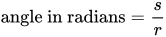

We know the circumference of a circle to be equal to , and it follows that a central angle of one full counterclockwise revolution gives an arc length (or circumference) of . Thus radians corresponds to , that is, there are radians in a circle.


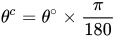
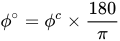
Converting between Radians and Degrees
[edit | edit source]Because there are radians in a circle:
To convert degrees to radians:
To convert radians to degrees:
Exercises
[edit | edit source]|
Conversion from degrees to radians
|


|
Conversion from radians to degrees
|


